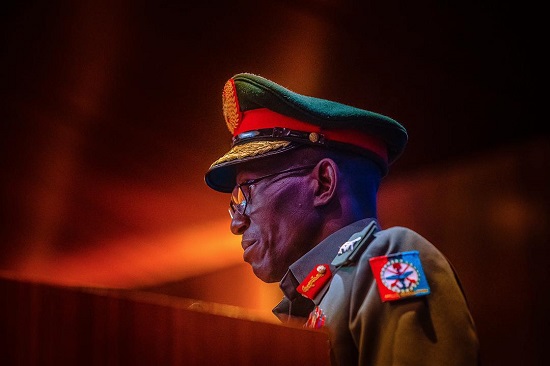
Former Chief of Defence Staff (CDS), Lucky Irabor, says some political actors are involved in financing terrorism and exploiting insecurity for political gain.
Gatekeepers News reports that Irabor made the disclosure on Monday during an interview on Channels Television’s Politics Today. His comments follow a statement by Daniel Bwala, Special Adviser to President Bola Tinubu on Policy Communication, who recently said the federal government would soon unveil the identities of those sponsoring terrorism in the country.
Bwala had hinted that the government was “making far-reaching decisions,” adding that the outcome would become evident soon. He also emphasised the need for global cooperation in tackling terrorism.
Addressing the issue on the programme, Irabor said certain politicians are complicit in sustaining instability.
When asked directly whether political actors fund terror networks, he replied: “Some politicians.”
He explained that some party chieftains deliberately feed off insecurity to paint an image of failed leadership or to gain political leverage.
“Some politicians have now taken advantage of the state of under-governance, as it were, to perhaps gain some form of leverage to give the impression that they can do better,” he said.
“Others perhaps want to give an impression they can do better, to score the point that there is poor governance… they could also instigate a certain crisis one way or the other.”
Irabor, however, said it would be wrong to assume the problem is strictly political, noting that motivations vary.
On Publishing Terror Financiers’ Names
Responding to criticisms over the federal government’s reluctance to publish names of alleged terror financiers, Irabor said security agencies have interrogated several individuals but insisted that the sensitive findings cannot be made public yet.
“I believe there are a lot of individuals who have been called to question. When I was CDS, there were some trials that were made, especially for the financiers. It’s not for public consumption,” he said.
He urged Nigerians to support institutions responsible for tackling terrorism, adding that “not everybody in government is a liar or is unserious.”
Rising Attacks, Operational Gaps
Irabor said Nigeria continues to suffer major gaps in manpower and equipment, stressing that the recent spike in attacks is not entirely new but reflects long-term patterns aggravated by the acquisition of more sophisticated weapons by criminal groups.
He warned that unless the country addresses operational deficiencies, reversing the deteriorating security situation will remain difficult.
Uptick in Attacks Across the North
Northern Nigeria has recorded a surge in kidnappings and killings in recent weeks, including high-profile attacks on schoolchildren.
In November, ISWAP ambushed a military convoy in Borno State, capturing and later killing Brigadier General M. Uba.
Zamfara, Sokoto and Yobe have also witnessed multiple abductions and killings.
More than 200 schoolchildren were kidnapped in separate incidents in Niger and Kebbi states, while 38 worshippers were abducted during a live-streamed church service in Kwara.
The Christian Association of Nigeria (CAN) later announced that 50 of the abducted students in Niger escaped, though at least 250 remain in captivity.
The 24 schoolgirls kidnapped in Kebbi were freed on November 25, just as the 38 abducted Kwara worshippers were also released.