
By Gbenga Akingbule.
As part of measures to ensure continued religious harmony, the Borno State Governor, Prof Babagana Zulum on Monday disclosed the state government under his watch will continue to rebuild Churches and Mosques distroyed by the notorious Boko Haram terrorist .
Gatekeepers News reports that the governor’s initiative seeks to prevent exploitation of the Boko Haram crisis for religious gain, stressing that the 16-year insurgency is not a religious war .
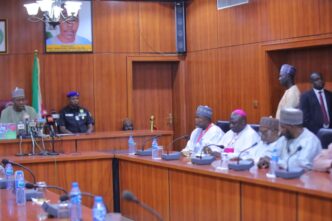
Prof Zulum disclosed this when he convened a meeting of Christian and Muslim religious leaders held at the Government House, Maiduguri, the Borno State Capital.

The meeting also seeks to continue to maintain the peaceful coexistence amongst Christians and Muslims and avoid narratives that seek to set adherents of one religion against the other
According to the governor, It is absolutely crucial that ” we collectively dispel all false narratives that seek to portray our security crisis in a religious colouration. Religious conflict is alien to us.

” The Boko Haram conflict is not a religious crisis. It is an assault on our civilisation, humanity, and all that we hold dear, irrespective of creed. The perpetrators of violence have killed, maimed, and displaced Muslims and Christians alike. They have destroyed mosques and churches with equal impunity.” He said
Among the measures being taken by Governor Zulum to address the impact of the Boko Haram insurgency is the rebuilding of churches, mosques, and other key infrastructures.

Zulum stated that lots of churches and mosques have since been rebuilt by the state government, pointing out that more would be rebuilt . He requested religious leaders to liaise with his aide in charge of reconstruction to finalize details of new rebuilding of worship centres.
” As part of our massive reconstruction programme across the affected local government areas, the Borno State Government has reconstructed 45 Christian worship centres that were destroyed during the Boko Haram insurgency. This number includes 16 from Hawul, 11 from Gwoza, 10 from Askira-Uba, and 8 from Chibok.
” We did not do all these as a favour; we did it as a duty. Just as we have rebuilt countless mosques, markets, schools, and homes, these churches stand as physical testaments to our policy of non-discrimination. They are symbols of hope and of our collective determination to rebuild not just structures but trust.
“In our reconstruction, resettlement and rehabilitation drives, the Borno State Government has been guided by one principle: justice, equity, and inclusivity. Our reconstruction policy is not based on religion and ethnicity. We rebuild based on need and on our commitment towards restoring the social fabric of every community.” Zulum said.
The governor urged Christians and Muslims to continue living in peace with each other, noting that ” Borno is not only strategically positioned geographically but also has a unique and beautiful family composition dynamics. It is common to find under one roof, brothers and sisters, uncles and aunts, who profess different faiths.
“We share meals, we celebrate festivities and milestones, we grieve losses together, as one family, bound by blood and love that transcends religious labels. This is our reality. This is our strength. We must protect this sacred bond within our homes and allow it to define our individual, as well as intra- and cross-community engagements.” Zulum said.
The religious leaders present, including Catholic Archbishop John Bakeni, Chairman of the Christian Association of Nigeria (CAN), and Sheikh Jafar Ngamdu, Chairman of Jama’atu Nasril Islam (JNI), along with their executive members, urged their followers to maintain peaceful coexistence in the state .