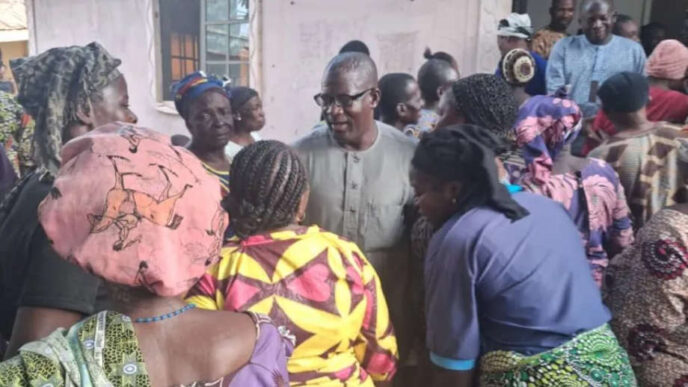


Governor Peter Mbah of Enugu State on Tuesday presented a record N1.62 trillion 2026 Appropriation Bill to the State House of Assembly, describing it as a transition from “laying foundations to scaling transformation across every sector.”
Gatekeepers News reports that the proposed budget—tagged the Budget of Renewed Momentum—represents a 66.5% increase from the revised N971 billion 2025 spending plan. It allocates N1.296 trillion (80%) to capital projects and N321.3 billion (20%) to recurrent expenditure, totalling N1.617 trillion.
Mbah said the budget would be financed through a projected N870 billion IGR, N387 billion FAAC allocation, and N329 billion in capital receipts.
A sectoral breakdown shows that the Economic Sector will receive N825.9 billion (51%), followed by the Social Sector with N644.7 billion (40.1%). The Administration, Justice, and Regional sectors are allocated N128 billion, N15.8 billion, and N2 billion, respectively.
“Allocating N825.9 billion to the Economic Sector is strategic and deliberate,” Mbah said. “When we invest in agriculture, industry, and trade, we create jobs, reduce poverty, and generate revenue that strengthens the entire economy. The performance of this sector remains central to our vision of achieving a seven-fold GDP growth in Enugu State.”
Infrastructure, Transportation, and Housing
Key projects in the Economic Sector include the construction of 1,200 urban roads, extensive rural road development, and the completion of major projects such as the 40km Owo–Ubahu–Amankanu–Neke–Ikem dual carriageway, the Abakpa Nike–Ugwogo Nike–Ekwegbe–Opi–Nsukka dualisation, and the 21.65km Enugu–Abakaliki Expressway.
On transportation, the governor announced plans to acquire 14 additional aircraft for Enugu Air, increasing its fleet to 20. Three new planes are expected before the end of 2025. The state will also build five new transport terminals in Emene, Udi, Awgu, Four-Corners (Ozalla), and Obollo-Afor.
The administration earmarked 15% of the budget for 15,000 mass housing units and continued infrastructure expansion at the New Enugu City.
In agriculture, the state will accelerate the rollout of 20-hectare Farm Estates across all 260 wards, several of which are already under development.
Education, Health, and Social Sector Priorities
Education remains the biggest beneficiary in the Social Sector with 32.27% of the total budget, consistent with allocations in 2024 and 2025.
Mbah said the state would shift from completing 260 Smart Green Schools to building Smart Secondary Schools and TVET colleges.
“There are some who might look at what we spend on education and cringe,” he said. “But what we spend currently on education is largely insignificant, weighed against the future social cost of having a disproportionate population of out-of-school children.”
The governor set aside N20 billion to clear inherited gratuity arrears, stressing: “Our workers should not wait years to receive benefits they have earned.”
The budget also provides N11 billion for the second phase of the state’s security surveillance system, while the health sector is allocated 10% of total spending.
2025 Budget Performance and Revenue Growth
Mbah disclosed that the state had already spent N806 billion in the 2025 fiscal year.
“This means that we utilised 97.5 per cent of all the money that came into the state and achieved 83 per cent of the total budget implementation,” he said.
He hailed the surge in state revenues, noting: “Our internally generated revenue is set to exceed N400 billion by the end of the year… already the highest IGR in the history of Enugu State – a 221.6% increase over 2024.”
Praise for Tinubu’s Economic Policies
The governor commended President Bola Tinubu’s fiscal reforms for boosting FAAC inflow to the state.
“Our FAAC inflow did not just meet expectations – it exceeded them by more than half. We projected about N150 billion, but we received N230 billion – over 50 per cent above projection.
“This is not accidental. It reflects the impact of President Bola Ahmed Tinubu’s bold economic reforms.”
Mbah said that measures such as fuel subsidy removal and FX unification had “strengthened key macro indicators,” adding that inflation was declining, interest rates had eased, and the naira had stabilised. He also noted that Nigeria’s foreign reserves recently reached $46 billion.