

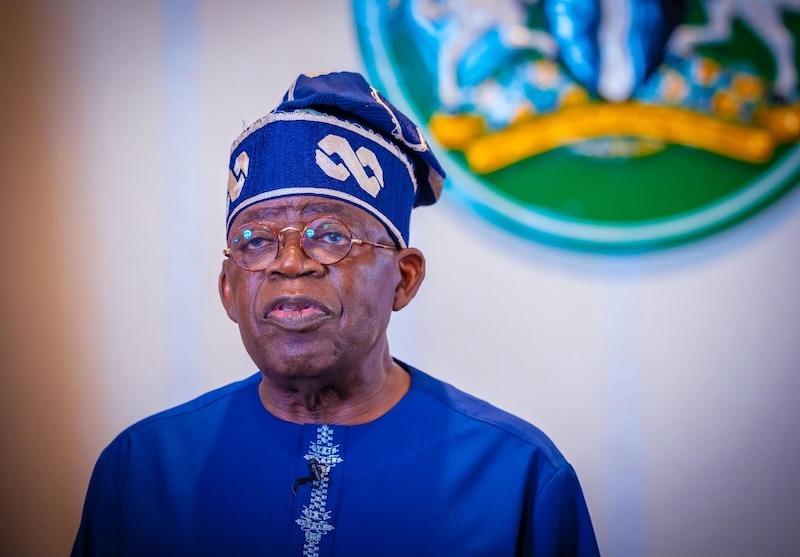
President Bola Tinubu has commended Nigeria’s private sector, investors and capital market stakeholders after the Nigerian Exchange (NGX) crossed the N100 trillion market capitalisation milestone.
Gatekeepers News reports that the NGX hit the historic mark on January 5, with market capitalisation rising to N100 trillion from N99.94 trillion recorded on January 2 — an increase of N1.87 trillion.
According to a statement issued on Thursday by Bayo Onanuga, special adviser to the president on information and strategy, Tinubu described the achievement as a major boost for the investing public operating in the money and capital markets.
The president urged Nigerians to deepen their investments in the local economy, assuring that 2026 would deliver stronger returns as the administration’s economic reforms continue to yield results.
“With the Nigerian Exchange (NGX) crossing the historic N100 trillion market capitalisation mark, the country is witnessing the birth of a new economic reality and rejuvenation,” Tinubu said.
“In 2025, while many of the world’s markets struggled with stagnation or tepid recovery, the NGX All-Share Index was on the ascent. It closed 2025 with a 51.19% return, higher than the 37.65% recorded in 2024.
“This performance ranks among the highest in the world. Year-to-date returns have significantly outpaced the S&P 500, the FTSE 100, and even many of our emerging-market peers in the BRICS+ group.
“Nigeria is no longer a frontier market to be ignored — it is now a compelling destination where value is being discovered.”
Tinubu said the strong performance of the stock market reflects Nigeria’s improving economic health and growing investor confidence, citing robust results across listed companies ranging from industrial and banking stocks to technology-driven firms.
“And we are just getting started. The pipeline for new and upcoming listings looks robust,” he said.
“More indigenous energy firms, tech unicorns, telecoms and infrastructure-heavy entities are seeking to access the public market to fund their expansion.
“As these firms are listed, they will boost market capitalisation and deepen democratic ownership of the Nigerian economy.”
The president added that the market gains are being reinforced by the microeconomic effects of the administration’s reforms.
“We are not celebrating the superlative stock market performance in isolation. We are also celebrating the microeconomic effects of our reforms,” he said.
“After the initial headwinds that followed our reforms, we are finally seeing a bend in the inflation curve.”
Microeconomic effects of reforms
Tinubu said critical monetary tightening and the removal of distortionary ways-and-means financing have helped restore stability to the naira, while increased investments in agriculture have contributed to a steady decline in inflation.
“From a 24-month high of 34.8% in December 2024, inflation decelerated to 14.45% as of November 2025, with projections indicating it will reach 12% in 2026,” the statement said.
“Indeed, inflation is likely to fall below 10 per cent before the end of this year, leading to improved living standards and accelerated GDP growth. The year 2026 promises to be an epochal year for delivering prosperity to all Nigerians.”
The president also highlighted improvements in Nigeria’s external position, noting that the country posted a current account surplus of $16 billion in 2024.
According to the Central Bank of Nigeria (CBN), Tinubu said Nigeria’s current account balance is projected to rise to $18.81 billion in 2026, from $16.94 billion in 2025.
“Under our administration, Nigeria is exporting more and importing less of what we can produce locally,” he said.
“Non-oil exports surged by 48% by the third quarter of 2025, totalling N9.2 trillion. Exports to Africa alone rose by 97% to N4.9 trillion. Manufacturing exports increased by 67% year-on-year in the second quarter of 2025, suggesting a strong close to the year.”
Tinubu added that Nigeria’s foreign reserves have exceeded $45 billion and are projected to cross $50 billion in the first quarter of 2026, giving the Central Bank greater capacity to stabilise the naira.
He also cited progress in infrastructure, healthcare, education and transport, including expanded rail networks, improved ports, major road projects and reduced medical tourism costs.
The president said the N100 trillion market capitalisation milestone underscores the strength and productivity of Nigeria’s economy.
Nation-building, he added, requires sacrifice and collective commitment, pledging to continue efforts to build an egalitarian, transparent and high-growth economy anchored on historic tax and fiscal reforms implemented from January 1.