Dangote Refinery has reached a daily production of 50 million litres of Premium Motor Spirit (PMS), also known as petrol, supported by a 24-hour loading operation that dispatches more than 1,000 trucks daily, reinforcing fuel supply stability across Nigeria.
Gatekeepers News reports that speaking on the refinery’s operations and expansion plans, the Managing Director and Chief Executive Officer, David Bird, said the scale of the round-the-clock operation ensures that rising production levels are matched by efficient nationwide distribution.
Bird disclosed that the company plans to deliver a 1.4 million-barrel-per-day expansion of the refinery within three years, adopting a replication strategy aimed at avoiding the cost overruns and delays that often affect large-scale energy projects.
According to him, the logistics framework underpinning the refinery’s operations represents a significant improvement in fuel distribution efficiency and has helped eliminate the fuel scarcity that previously plagued major Nigerian cities, particularly during festive periods.
“So, we have been easily able to achieve over 1,000 trucks of offtake. So it’s not just the production, it’s also the offtake that has achieved that 50 million litres a day,” Bird said.
“This is not just a crude single processing plant. We have built a flexible, resilient production process where we can make finished products from crude, intermediates, or blending components.”
Bird stressed that even during planned maintenance, the refinery has continued to meet domestic fuel demand, highlighting the facility’s operational flexibility.
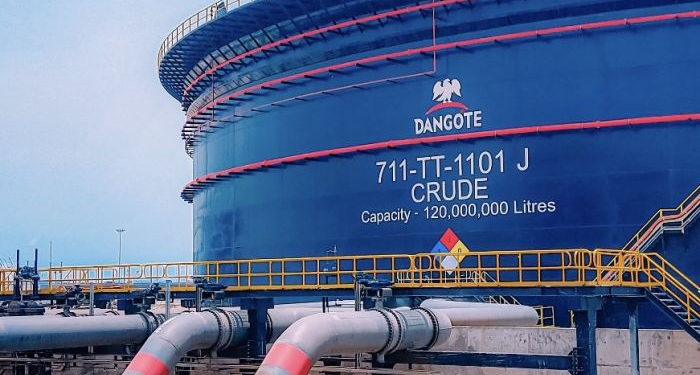
The $20 billion refinery, located in the Lekki Free Trade Zone (FTZ) near Lagos, is already the largest single-train refinery in the world, with a nameplate capacity of 650,000 barrels per day. Its ability to deliver 50 million litres daily, Bird explained, is enabled by its modern design, which he described as a “merchant refining, blending and trading platform.”
On the planned expansion targeted for 2026, Bird said the refinery would pursue what he termed a “roofless replication” of its existing configuration—essentially duplicating the current design without reopening extensive engineering work.
“Once you let engineers go back into an expansion, they often start to tinker, and that sends you back into months or years of detailed engineering,” he said.
“The idea here is replication. We will not need to reengineer, so we can get straight into ordering long-lead items and commencing construction.”
An expansion to 1.4 million barrels per day, he noted, would cement Dangote Refinery’s position as one of the world’s largest refining complexes and significantly reshape fuel flows across Africa, a region long dependent on imported refined petroleum products.
Bird, who was appointed the refinery’s first standalone CEO, said the expansion timeline is anchored on two parallel sets of activities beginning immediately to ensure timely delivery.
Addressing pricing concerns, Bird dismissed claims by some industry players that the ₦739 per litre petrol price was anti-competitive.
On capital market plans, he reaffirmed that Dangote Refinery would be listed, assuring Nigerians that increased scale, efficiency and local supply would help support long-term price stability.
Speaking separately, Head of Communications for the Dangote Group, Anthony Chiejina, noted that the ongoing crisis in Venezuela has had indirect benefits for Nigeria’s energy market.
On petrochemicals, Bird said polypropylene production remains central to the refinery’s strategy, adding that future diversification could include detergents, base oils, lubricants and Liquefied Petroleum Gas (LPG), driven by import substitution and Nigeria’s growing population.
Responding to questions on the crude-for-naira programme, Bird said 30 to 40 per cent of the refinery’s crude supply currently comes from the scheme. He added that the company would continue engaging the Nigerian National Petroleum Company Limited (NNPCL) and the Federal Government to improve crude allocations and volumes.