

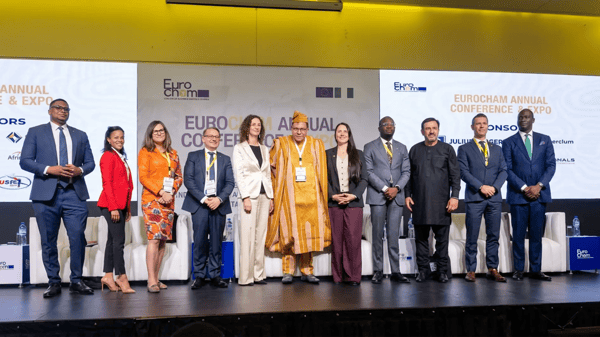
European diplomats have called for stronger coordination between governments, businesses and development finance institutions to turn existing Nigeria–EU cooperation frameworks into real, bankable projects.
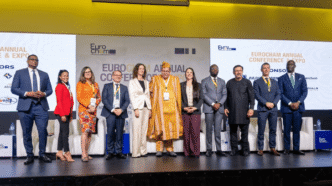
Gatekeepers News reports that they made the call at a panel session on EU–Nigeria trade relations during the European Business Chamber in Nigeria (Eurocham) Annual Conference and Expo in Lagos, themed “Europe–Nigeria Partnerships for Industrial Growth, Financial Innovation and Sustainable Development.”
Head of the Foreign Trade Office in Nigeria at the Polish Investment and Trade Agency, Justyna Sitarska, said although Nigeria and the EU are supported by several policy and investment frameworks — including Global Gateway initiatives and bilateral agreements — converting them into concrete business deals remains difficult.
She identified limited market information, regulatory and tax unpredictability, foreign exchange risks and access to finance as major obstacles.
Sitarska said well-structured trade missions help to close perception gaps, often driven by negative media narratives, while allowing European and Nigerian partners to better understand market realities.
According to her, successful projects require early collaboration among businesses, governments, investors and development finance institutions.
“Export credit agencies and development banks play a critical role in de-risking initial transactions, while sector-focused business-to-business engagements deliver better outcomes,” she said.
Commercial Counsellor at the Austrian Embassy, Barbara Lehninger, said broad policy frameworks must be matched with practical, company-level solutions.
She cited policy inconsistency as a recurring concern, referencing the introduction, suspension and reintroduction of the four per cent Free On Board (FOB) levy, which created compliance and cost uncertainties for businesses.
Consul General of Germany in Lagos, Daniel Krull, said Africa — and Nigeria in particular — should be viewed as part of the solution to global economic and geopolitical pressures.
He identified the automotive industry as a key area for deeper cooperation, noting strong demand across Nigeria and the wider African market.
Policy Adviser for Economic Affairs and Public Diplomacy at the Netherlands Consulate in Lagos, Opeyemi Oriniowo, said global efforts to diversify trade dependencies present significant opportunities for Nigeria.
However, he noted that production constraints, scaling challenges and limited access to finance continue to prevent the country from fully benefiting from existing trade agreements.
Oriniowo added that although investments are emerging in energy, waste-to-energy, manufacturing, retail and agriculture, they remain below Nigeria’s full trade potential with the EU.
On market entry challenges, Jette Bjerrum of the Royal Danish Consulate General in Lagos said Danish firms usually take a long-term approach to Nigeria, supported by development finance institutions.
She said security concerns, foreign exchange risks, procurement processes, legal frameworks and market entry barriers pose major challenges, particularly for small and medium-sized enterprises.
Consul General of France in Lagos, Laurent Favier, said French companies employ about 16,000 Nigerians and maintain a strong presence across several sectors.
While describing Nigeria as a strategic partner, he identified visa processes, infrastructure gaps and international perception as key challenges.
Favier, however, said ongoing macroeconomic and currency reforms were positive signals for long-term investors and institutions seeking deeper engagement with Nigeria.