

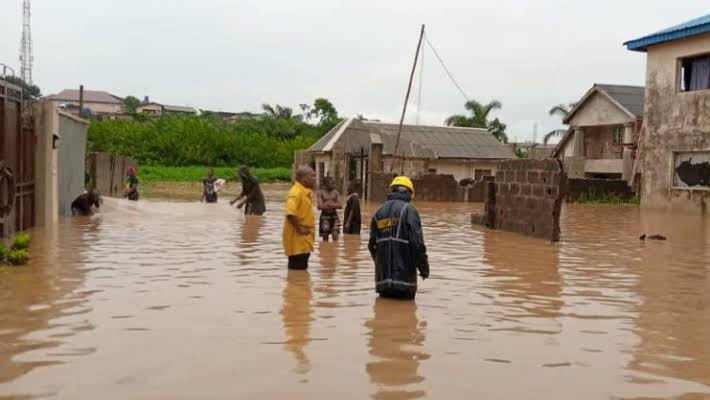
The National Emergency Management Agency (NEMA) says the number of people affected by flooding in Nigeria dropped significantly from over five million in 2024 to about 500,000 in 2025, reflecting improved disaster preparedness and response.
Gatekeepers News reports that the agency disclosed this during a high-level technical session convened to analyse the 2026 seasonal climate prediction (SCP) and strengthen early warning systems. The meeting, held in collaboration with the Emergency Coordination Forum (ECF), also featured a review of Nigeria’s response to recent climate-related disasters.
Speaking at the session, Dapo Akingboade, assistant director of planning at NEMA, said fatalities also declined from over 1,000 in 2024 to 241 in 2025, while the number of affected states dropped from 35 to 27.
Akingboade attributed the improvement to early dissemination of forecasts, increased public awareness, simulation exercises, and better inter-agency coordination.
“Early warnings issued by the Nigerian Meteorological Agency (NiMet) and the Nigeria Hydrological Services Agency (NIHSA), coupled with improved coordination at NEMA’s operations centre, helped reduce casualties and losses,” he said.
He, however, noted that challenges remain, including poor drainage maintenance, delayed evacuation from high-risk areas, and limited reach of early warning systems in rural communities.
Akingboade called for stronger state-level contingency planning, improved implementation of disaster response frameworks, and greater use of local languages and traditional institutions in awareness campaigns.
“Our progress in 2025 shows what is possible when forecasts are linked to action. We must now build on these lessons to strengthen preparedness in 2026,” he added.
In her remarks, Zubaida Umar said projections from NiMet should guide decision-making across all levels of government, stressing the need for coordinated, evidence-based responses to climate risks.
“The theme of this meeting is ‘strengthening multisectoral preparedness and early action for climate-related disasters in Nigeria’,” she said.
“Preparedness must be proactive, not reactive. The effectiveness of our collective response will depend on the actions we take following this meeting.”
Presenting the 2026 climate outlook, Abubakar Sadiq, assistant chief meteorologist at NiMet, said weather patterns this year will be influenced by a transition from a weak La Niña to neutral conditions in the Pacific.
He added that NiMet’s rainfall predictions have reached about 74 percent accuracy, with ongoing efforts to improve precision through automation.
Sadiq also linked unusual weather patterns recently observed in the Federal Capital Territory (FCT) to “extra-tropical factors” rather than normal seasonal variations.
Also speaking, John Gbadegesin, representing the NIHSA director-general, said the 2026 annual flood outlook will be released on April 15, noting that improved forecasting has helped reduce the socio-economic impact of flooding.
Timothy Yohana, disaster management coordinator of the Nigerian Red Cross Society, said the organisation is ready to deploy volunteers nationwide to support early warning efforts.