

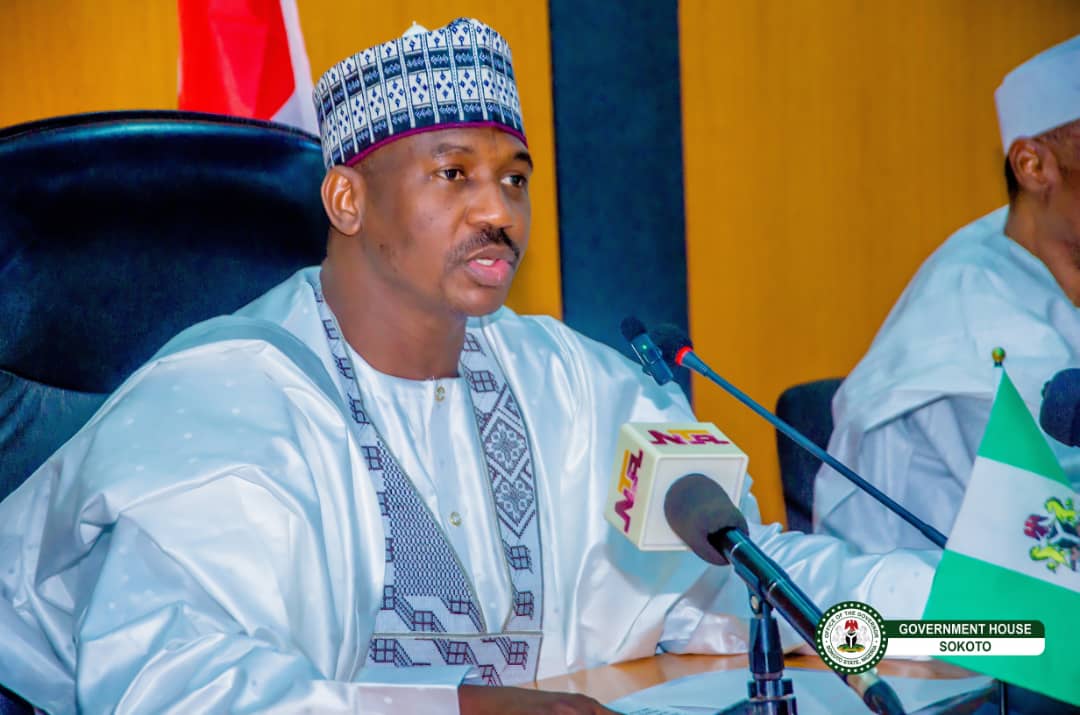
“Sustainable development is attainable when visionary leadership and committed development partners come together with a shared vision, and an unwavering commitment to improving the lives of our people.” — Governor Ahmed Aliyu
Sokoto State, the historic seat of the Sokoto Caliphate and a state long defined by its resilience in the face of harsh climatic and economic realities, stands today at a defining moment in its development journey. Under the leadership of Governor Ahmed Aliyu, the state government has embraced a governance philosophy that recognises the reality that the state government cannot single-handedly meet the myriad needs of its people, especially after the years of neglect by the previous administration. From tackling insecurity and addressing the challenge of out-of-school children to expanding access to healthcare and building climate resilience across its farming communities, the scale and complexity of Sokoto’s challenges clearly demand that it collaborates. Even with the prudent management of available resources, the state cannot, on its own, provide all that is required to address the challenges that it is clearly in a hurry to meet.
This reality is particularly evident in Sokoto State, where the administration of Governor Ahmed Aliyu has placed development partnerships at the heart of its development agenda. Since assuming office in May 2023, his administration has actively engaged several international development institutions, the European Union (EU), and countries such as Germany, opening new avenues for collaboration in critical areas including healthcare, education, nutrition, water supply, child protection, social protection, skills acquisition and institutional reforms. Rather than relating with development partners as sources of funding, Governor Aliyu’s administration sees them as strategic allies whose expertise, resources and experience can complement his government efforts and help deliver better outcomes for the people of Sokoto State.
More importantly, Governor Aliyu understands that such partnerships can only deliver lasting impact when built on trust, shared responsibility and a common vision for the future of the state.
If this collaborative momentum is sustained, Governor Ahmed Aliyu’s administration would have laid the foundation for a development model in which international partnerships complement the efforts of the state government and translate them into lasting improvements in the lives of the people—improvements that will endure well beyond the lifespan of the administration. In an increasingly interconnected world, this willingness to engage, learn and work with partners beyond the state would ultimately become one of Sokoto State’s greatest strengths: a government prepared to work with global partners in the pursuit of a better future for its people.
Recent engagements with the United Nations Children’s Fund (UNICEF) and the European Union (EU) provide a clear illustration of how this partnership-driven approach has gained momentum in Sokoto State. Among these engagements, the visit of UNICEF Executive Director, Ms. Catherine Russell, stands out. As the head of the world’s foremost child-focused organisation, her decision to visit Sokoto State is very significant, and reflects growing international interest in and recognition of the state government’s efforts to improve the lives of the children and women.
Her commendation of Governor Aliyu’s child-centred development agenda was more than diplomatic courtesy; but a commendation grounded in the progress observed across several critical sectors. Ms. Russell highlighted the fact that the UNICEF delegation had witnessed encouraging improvements in literacy programmes, vocational and life-skills training, mental health services, nutrition interventions, routine immunisation, and other initiatives aimed at improving the wellbeing of children. More significantly, is her observation that Nigeria has the potential to become a global example of how political leadership and sound public policy can translate into measurable improvements in the lives of the children. Her indication that UNICEF was prepared to document and showcase Sokoto’s achievements as a model for other states adds an important dimension to the significance of the visit—and to the growing recognition of the state’s development efforts.
These gains are increasingly evident in the numbers. State health officials report a steady rise in routine immunisation coverage across the three senatorial zones, with more children receiving life-saving vaccines against measles, polio and other preventable diseases than in the recent years. This progress has been driven by the government working with the religious and traditional leaders and other community stakeholders. Complementing these immeasurable gains are the government interventions such as expanded antenatal and postnatal care, community-based nutrition screening for malnourished children, and the distribution of insecticide-treated nets to pregnant women. Taken together, these measures point to a health system that is expanding its reach and becoming more responsive to the specific needs of women and children—precisely the kind of measurable progress that has given substance to the UNICEF’s positive assessment of Sokoto State.
The same partnership-driven approach is evident in the education sector, where the Sokoto State Government, working with UNICEF and other development partners, has established ten Integrated Qur’anic Schools across ten Local Government Areas. The initiative seeks not to remove children from the almajiri system, but to broaden their opportunities by combining Qur’anic instruction with basic literacy and numeracy—allowing them to benefit from both worlds and addressing one of the state’s longstanding development challenges. This effort is complemented by the construction and renovation of classroom blocks, the recruitment and training of additional teachers, and the provision of instructional materials to improve learning outcomes in public primary schools. Meanwhile, the establishment of Child-Friendly Centres and Care Coordination Centres has provided additional support for vulnerable and malnourished children, and created an important link between education, protection and basic welfare services.
This emphasis on human capital development extends beyond formal education to skills acquisition and economic empowerment. Under various vocational training programmes, more than 2,700 beneficiaries have graduated and received starter packs to support self-employment and economic independence, as part of the state government’s broader efforts to equip out-of-school youth with practical, income-generating skills. It must be stressed that producers of leather works are heavily patronized by the state government as gifts to visitors. Complementing these initiatives is the establishment of an ICT Centre at Sultan Muhammadu Maccido Primary School, which provides digital learning opportunities for out-of-school children and reflects the administration’s growing recognition of technology as an essential tool for expanding educational access and preparing the young people for the knowledge economy.
For Governor Ahmed Aliyu, every indigene of Sokoto State should have the opportunity to acquire the skills, that would make them productive and contribute meaningfully to the development of the society. This philosophy has also informed the administration’s broader approach to addressing the security challenges, a recognition that economic exclusion and lack of opportunity can leave young people vulnerable to be recruited by criminal gangs. By expanding access to skills that would help them with livelihoods, the government is seeking not only to improve individual lives, particularly in the eastern axis of the state, along the border with Zamfara State, which have faced persistent challenges from banditry and related insecurity.
The real test, therefore, is not simply whether Sokoto State can attract development partners, but whether it can build the institutions, systems and human capacity required to sustain the gains that these partnerships make possible. On this score, the signs are very encouraging. Governor Ahmed Aliyu’s emphasis on collaboration, institutional strengthening and community ownership provides a solid foundation for ensuring that development interventions do not remain isolated projects, but become part of a broader and sustainable development framework. By aligning the expertise and resources of development partners with the priorities of his administration, Sokoto State is steadily creating the conditions for partnerships that will translate into lasting improvements in the lives of its people.
For Sokoto State, the journey ahead inevitably requires patience, consistency and shared responsibility. Yet, with government, development partners, traditional and religious institutions, communities and citizens working together around a common vision, the state can turn its various development challenges into opportunities for lasting transformation. In this regard, the most enduring legacy of the Ahmed Aliyu administration will be the foundation it has laid for a new development trajectory—one in which Sokoto State is more closely connected to the global development community, more confident in its own capacity, and better equipped to build a more secure, healthier, better educated and economically productive future for its people.
Gatekeepers News is not liable for opinions expressed in this article; they’re strictly the writer’s.