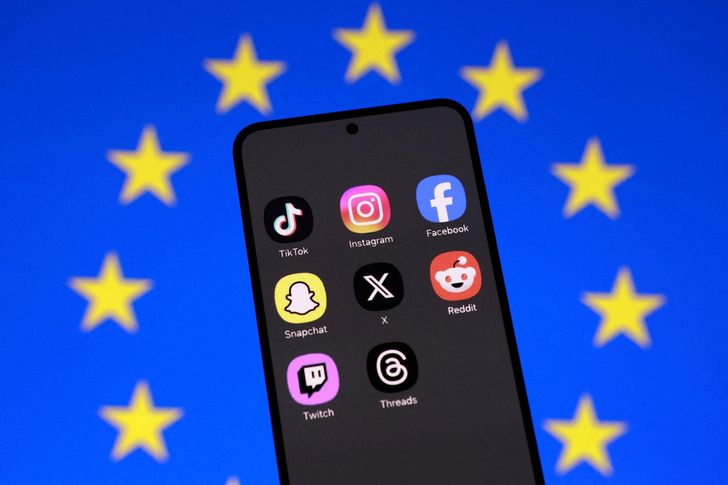
The European Union is set to propose new restrictions on children’s access to social media, video-sharing platforms, AI chatbots and online games, including a ban on minors under 15 opening independent accounts, according to a draft legal document seen by AFP.
Gatekeepers News reports that the proposed legislation, known as the “EU KIDS Act”, is expected to be formally presented on Thursday. It would introduce a tiered system allowing younger children to access some digital services only through accounts controlled or supervised by their parents.
Under the proposal, children aged 13 and 14 would require parental approval to create “introductory” accounts on social media, AI and gaming platforms. Such accounts would have limited features, strict screen-time controls and remain under parental supervision.
Children aged between three and 13 would be permitted to use fully parent-controlled accounts on designated “childfriendly” services that meet strict safety standards.
Children below the age of three would have no access to social media and other services classified as “risky” under the draft.
The proposal would also require major technology companies to make their platforms “safe by design” for children by removing features considered addictive, including infinite scrolling, artificial notifications and certain reward mechanisms.
The European Commission has faced growing pressure from member states, including France and Greece, to introduce bloc-wide measures addressing concerns about the impact of social media on children. The push gained momentum after Australia introduced restrictions preventing under-16s from accessing social media platforms.
EU Commission President Ursula von der Leyen is expected to outline elements of the proposal during her annual address to the European Parliament in Strasbourg on Wednesday.
She is scheduled to present the proposal alongside EU tech chief Henna Virkkunen on Thursday.
The European Commission declined to comment on the specific details contained in the draft document.
Gradual age limits
The draft states that the proposed law would “set an EU-wide minimum age for minors to open an autonomous account at the age of 15.”
The tiered system would give younger children different levels of access depending on their age.
The EU is also preparing an age-verification application aimed at preventing children from accessing restricted platforms.
The approach differs from Australia’s system, under which parents cannot give consent for children under 16 to access social media.
The proposed EU rules would be financed through a supervisory fee imposed on digital platforms.
The bloc already has rules aimed at protecting children online under its Digital Services Act (DSA). The Commission has previously required platforms including Facebook, Instagram and TikTok to address potentially addictive design features.
However, the draft acknowledges that “existing rules do not suffice”, arguing that there is currently no “outright ban on common problematic features.”
The new legislation would build on enforcement of the DSA, which allows for fines of up to six per cent of a company’s annual global turnover.
‘Safe design’
The draft says the EU’s approach “needs to limit the access of tech companies to our children and not the other way around.”
In addition to restrictions on addictive features, the proposal would regulate recommender systems — algorithms that personalise the content users see — to limit potentially harmful material promoted to children.
Children’s accounts would also be required to remain private, while “risky settings” would be disabled by default. Unknown users would be prevented from contacting minors.
The proposal would include “tailored commitments” covering online games and AI chatbots.
If presented as expected, the proposal would still need to go through negotiations between the European Parliament and EU member states before it could become law.