


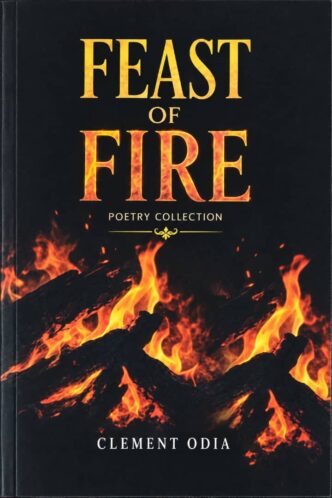
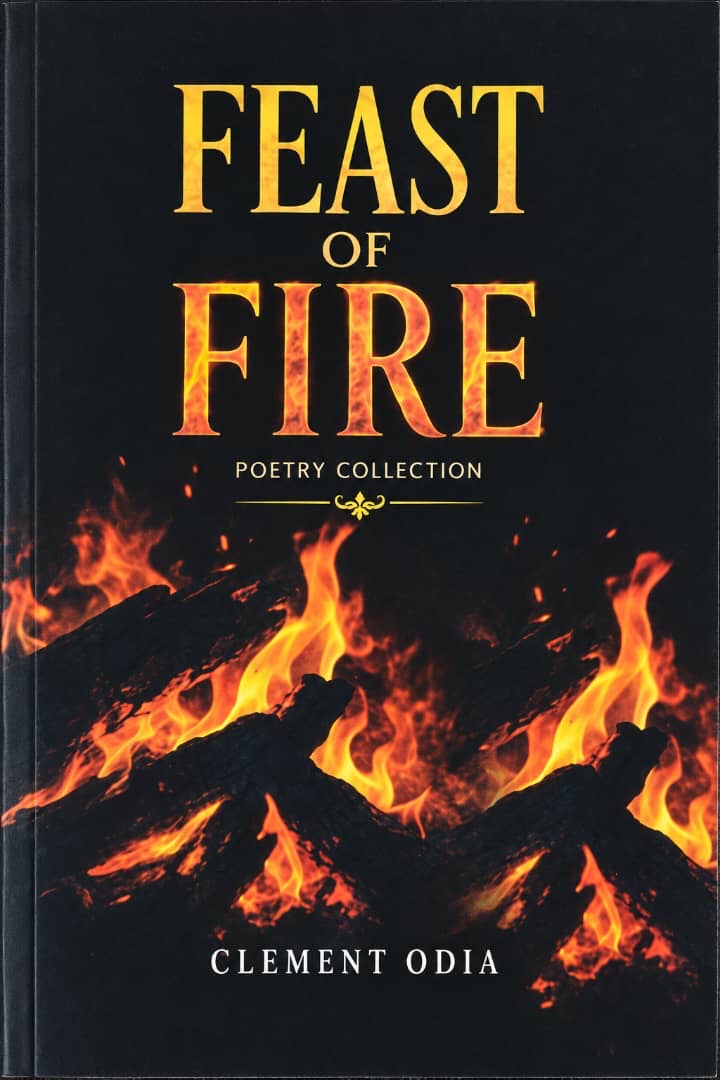
Lagos:Linearich Artrosoft, 2026, pp. 162, ISBN:9789 7868 88537 7
A Review by Ugonma Uba Kalu-Bazuaye
Clement Odia has never been a poet content to let language sit still. Across a body of work that spans poetry, drama, and short fiction — plays such as Bekekele (A Journey Beyond the Sunset), Venom of Vengeance, and Forbidden Dance and Other Plays — he has built a reputation on what might be called a logoclastic instinct: a willingness to fracture and re-forge words until they yield meanings decorous English would rather keep separate. His scholarship in African oral traditions is not background reading for this practice; it is its engine room. Odia writes as a poet who has spent as much time listening to chants, dirges, and market invocations as he has to the conventions of the printed page, and that dual citizenship — between the shrine and the study — has produced a poetic voice unusually comfortable moving between register, tongue, and register again. Feast of Fire, his latest and most searching collection, is where this instinct finds its most urgent occasion. It is a book written, by the poet’s own account, “in the heat of a country speaking in contradictions,” and it asks to be read not as a set of grievances catalogued but as a ritual convened — one in which fire is summoned, named, and finally handed to the reader to carry.
There is a moment early in Feast of Fire when Clement Odia stops describing corruption and begins to stage it — inviting the “limousine-lit” plunderers of the Nigerian commonwealth to a banquet, seating them at a table set not with cutlery but with “cut-throat memory,” and serving them, course by course, the very suffering they authored. It is a small formal decision with large consequences. Odia does not ask the reader to sympathize with outrage from a safe distance; he choreographs a ritual and hands the reader a seat at it. By the time the opening diptych closes — “they were invited— / and they came— / and they were fed / exactly what they served” — the collection has already declared its method: poetry here is not commentary on justice, it is an instrument of it.
That opening poem gives the book its title and its argument. Fire, across these fifty-two poems, refuses to settle into a single meaning. It is the arsonist’s rage of the dispossessed, yes, but it is equally the shrine-fire that purifies, the hearth-fire that remembers, and — in the collection’s most tender register — the slow-burning ember of longing and grief. Odia’s genius is structural: he does not let one register cancel the other. He lets them share a book, section by section, so that the same imagistic vocabulary that indicts a “chop-I-chop” political class in “A Feast of Fire” can, sixty pages later, warm a love poem like “Caffeine Love,” where absence “brews slowly in the chambers of my mind, / aromatic, bitter-sweet.” This is not inconsistency; it is a poet insisting that fire is too large a metaphor for outrage alone, that it also belongs to intimacy, memory, and reverence.
The book’s architecture rewards attention. Odia organizes his fifty-two poems into seven movements — Message, Reverence, Tales, Homage, Memories, Warning, Departure — and the sequence behaves less like a table of contents than like a liturgical order of service. Message opens in the mode of public indictment: “A Million Tears” catalogues the human cost of subsidy removal with the incantatory repetition of a market-square lament (“Scars upon scars, / Tears upon tears! / A million, a million!”), while poems like “One Bag of Rice” and “City Billionaires” (held back until Warning) train the same unblinking eye on the daily arithmetic of survival under misrule. Reverence pivots startlingly toward invocation — “A Chant to Ekuwemwen” and the storm-god hymn “Eziza” summon Edo cosmology directly into the register of protest, so that the poet’s fury against “those who slaughter for profit” is no longer only political but sacral, backed by ancestral authority: “Let iron remember justice. / Let fire pronounce sentence.” Tales and Homage slow the tempo into narrative and tribute — “More Flowers to Efuru” is a moving act of literary filiation, a poet thanking Flora Nwapa’s heroine for having “lured my young eyes / into the forest of books” — before Memories opens the book’s most private chamber, full of elegy and tenderness. Warning and Departure then return the reader to the public square, closing on “Burn their Sweetstem,” a poem that dares to imagine what should be built once the burning ends: systems that “heal without asking for wealth,” that “judge without selling justice.” The collection, in other words, does not simply escalate; it breathes — indictment, invocation, narrative, homage, grief, warning, and finally a hard-won vision of renewal. Few protest collections manage that respiratory range without losing their nerve.
What distinguishes Odia’s practice from the more familiar Nigerian poetry of grievance is his refusal to let English alone carry the weight of witness. He lets Pidgin erupt into the high register without apology — “Make dem chop am. / Yes— / make dem chop / wetin dem cook” sits inside the same poem as “syntax of revolt” and “the red grammar of consequence” — and the effect is not stylistic slumming but a democratization of the indictment: the language of the palace and the language of the street are made to share a plate. Elsewhere, Edo invocatory chant structures — the naming, the repeated summons, the call for ancestral witness in “Eziza” and the memorial chants of Section E — root the collection’s moral authority in oral performance traditions rather than in imported rhetorics of protest. This is poetry conceived for the ear as much as the page; its repetitions (“Sweep them away! / Sweep them away!”), its percussive onomatopoeia (“kpák! kpák! kpák!”), and its call-and-response cadences all but require a voice and an audience, a chorus of the aggrieved answering the poet-priest.
What ultimately gives Feast of Fire its staying power, though, is Odia’s command of image and symbol — a density of sensory detail rare in poetry this politically urgent, where the temptation is usually to let slogan crowd out sense. His central conceit is itself an act of synesthetic imagination: corruption rendered as cuisine, outrage as appetite, consequence as something one must taste. The oppressors are served “coal-hot commas, / full stops of flame,” and made to “drink deeply” a wine “dark, undiluted, ancestral” — grammar and gastronomy fused so that language itself becomes edible, combustible, a thing with texture and heat. The foreword’s own observation holds: the kola nut, the river, the stone, the tree recur throughout as active participants rather than decoration, and Odia extends this animist attentiveness to modern debris as well — the agbada becomes “fabric fat with padded budgets,” a wardrobe item transfigured into a ledger of theft, its folds hiding “bridges aborted mid-breath.” Even his invocatory poems are built from precise, tactile particulars: Eziza’s “shoulders carry the weight of clouds,” his “whirlwind fingers tear down / their hidden altars,” and the Harmattan’s “stern palm” erases footprints with a specificity that makes the mythic feel physically present. That same sensory precision softens beautifully in the collection’s quieter poems — Efuru arrives through “camwood fragrance,” “ochre glow,” and a marketplace of “spiced soups, / roasted dreams, / palm-oil memories rising like incense,” while in “Caffeine Love” longing is not merely described but chemically enacted, “steaming like a cup poured at dawn,” “a pulse beneath my eyelids.” Whether the register is indictment, invocation, or intimacy, Odia consistently thinks in the body — taste, scent, touch, sound — and it is this refusal to let abstraction stand in for sensation that keeps even his most declarative lines from hardening into rhetoric.
If the collection has a vulnerability, it is one shared by most poetry written in a state of moral emergency: the sustained pitch of outrage occasionally leaves little room for ambiguity, and a reader unfamiliar with the specific texture of Nigerian governance — subsidy removal, “agbada”-clad political theatre, the particular betrayals catalogued in “One Bag of Rice” — may need the book’s own author’s note to fully locate the fires it names. But this is a minor cost against what the collection achieves: a genuinely disciplined intensity, as the book’s own foreword rightly notes, that never mistakes volume for craft. Odia’s images are worked and reworked with a formalist’s patience even at their angriest — the recurring grammar of feast and fire, syntax and reckoning, gives the collection a coherent symbolic vocabulary rather than a scattershot of complaints.
Feast of Fire ultimately makes good on the ambition announced in its author’s note: to be not merely read but partaken of. It belongs to a lineage of African committed poetry that runs through Osundare’s Songs of the Season and Ojaide’s ecological laments, but its closest kinship is with the oral performance tradition itself — chant, dirge, praise-song, and curse repurposed as instruments of contemporary reckoning. Odia has written a collection that a nation in “contradictions” deserves: unsentimental about power, unashamed of tenderness, and utterly convinced that language, properly kindled, can still do the work of justice.