

The Securities and Exchange Commission (SEC) has unveiled a national savings scheme to encourage Nigerians to save and invest, as it targets growing the country’s capital market to N750 trillion by 2036.
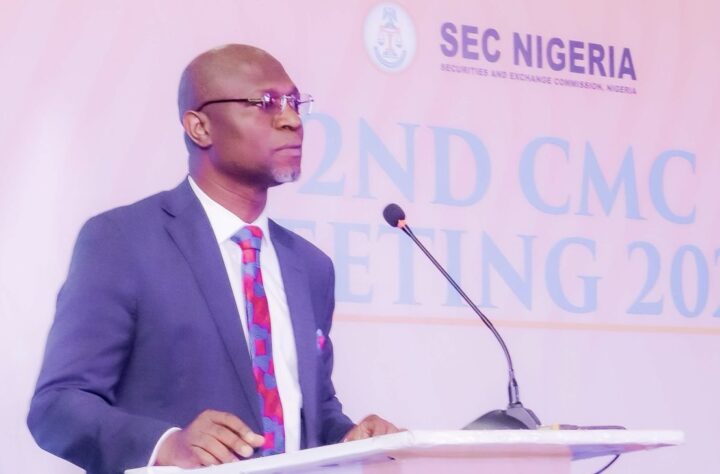
Gatekeepers News reports that Emomotimi Agama, director-general of the SEC, announced the initiative on Monday at the 2026 National Capital Market Conference in Abuja, where he presented the Nigerian Capital Market Master Plan (NCMMP) 2026–2036.
Agama said the master plan seeks to expand the market from a baseline of about N250 trillion to N750 trillion over the next decade, positioning it as a major source of financing for President Bola Tinubu’s ambition of building a $1 trillion economy.
“It rests on three convictions: that our market must be broader in participation, richer in products, and stronger in its integrity and infrastructure,” he said.
The SEC chief noted that despite the market’s growth in value, participation among Nigerians remained inadequate.
“Too few Nigerians own a share, a bond or a unit in a collective investment scheme. Too much of our savings sits idle, outside the formal system, quietly eroded by inflation,” he said.
“And too many of our enterprises, our infrastructure projects and our states still look abroad, or to the banks alone, for capital that ought to be raised from Nigerians, for Nigeria.”
National savings scheme to boost financial inclusion
Agama described the National Savings Scheme as a mechanism for expanding participation in the formal financial system by providing Nigerians with an accessible channel to save and invest.
“The National Savings Scheme is, first and foremost, an instrument of inclusion,” he said.
“It gives every Nigerian, the trader in Onitsha, the farmer in Benue, the young graduate in Yenagoa, a simple and trusted way to save, and to have those savings invested for the future.”
He said the scheme is backed by the Investments and Securities Act 2025, adding that funds would be managed by professional fund managers registered with the commission under established governance arrangements.
According to Agama, the SEC will sign a memorandum of understanding with the Nigeria Revenue Service and FSD Africa to support the initiative, including the introduction of tax incentives to encourage savings.
He added that the scheme was proposed in the original capital market master plan but is now moving into implementation.
SEC outlines implementation framework
Agama said the new master plan was developed through consultations with market operators, issuers, investors, regulators and government institutions.
He announced that Vice-President Kashim Shettima would inaugurate the project steering committee and the Capital Market Master Plan Implementation Committee (CAMMIC) at the conference.
The SEC director-general said the implementation process would be guided by clearly assigned responsibilities, timelines and performance indicators, with progress made public.
“Every commitment in NCMMP 2.0 will have an owner, a timeline and a scorecard, and we will report progress openly to this nation,” he said.
SEC highlights capital market gains
Agama said Nigeria’s capital market had recorded significant growth, with equity market capitalisation crossing N100 trillion for the first time in January and setting fresh records above N160 trillion in September.
He added that the All-Share Index rose by about 60 per cent in 2026, following a 51 per cent return in 2025.
The SEC chief also highlighted Nigeria’s reinstatement in the FTSE Russell Frontier Market Index on September 21, ending nearly three years outside the global benchmark.
“These gains did not come by chance. They are the fruit of the courageous choices of His Excellency, President Bola Ahmed Tinubu, GCFR: a unified exchange rate, the end of fuel subsidy, and the most far-reaching tax reform in our history,” Agama said.
“They are also the fruit of the Investments and Securities Act 2025, which gave this Commission modern tools to regulate a modern market.”
He reiterated that the master plan would be implemented through measurable targets, assigned responsibilities and timelines, with the SEC providing regular public updates on progress.