

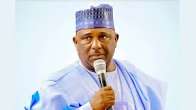
Abdul Samad Rabiu, chairman of BUA Group, says Nigeria’s foreign exchange reforms have made it easier for businesses to access dollars, reducing their reliance on direct allocations from the Central Bank of Nigeria (CBN).
Gatekeepers News reports that Rabiu spoke on Monday at the 32nd Nigerian Economic Summit, where he highlighted the impact of the reforms on businesses’ ability to plan investments and access foreign currency for importing machinery and raw materials.
He recalled that companies previously had to visit the apex bank regularly to secure foreign exchange, a process that created uncertainty and complicated long-term investment decisions.
“In the past, we had to make a pilgrimage every two weeks to the Central Bank of Nigeria here in Abuja,” he said.
According to Rabiu, the reforms have allowed businesses to source foreign exchange through the market at prevailing rates rather than depend on direct allocations from the CBN.
“Today, I hardly need to go to CBN. In fact, since Yemi Cardoso assumed office as CBN governor, I think I’ve maybe seen him three or four times because I don’t need him for foreign exchange allocation. That is the truth,” he said.
He said the previous system made it difficult for companies to commit to major industrial projects, particularly those requiring substantial foreign currency financing.
“Imagine trying to build or set up a billion-dollar industrial investment under those circumstances,” Rabiu said.
The BUA chairman said he preferred a transparent foreign exchange market that allows businesses to plan around prevailing rates to a system in which the official rate appears favourable but foreign currency is difficult to obtain.
“Certainty gives businesses the confidence to invest,” he said.
Rabiu identified foreign exchange liberalisation as one of several major reforms introduced over the past three years, alongside petrol subsidy removal and fiscal and tax changes.
However, he acknowledged that the measures had “come with real costs for households and businesses”, noting that high financing costs, infrastructure deficits and pressure on household incomes continued to weigh on economic activity.
He urged the government to focus on translating the gains from economic reforms into broader growth and improved living standards.
“We must move from reform to results, from stabilization to expansion, and from economic adjustment to shared prosperity,” he said.
Rabiu Calls for More Industrial Companies
Rabiu said Nigeria must broaden its industrial base by helping more businesses grow from small enterprises into large companies capable of investing in manufacturing, agriculture, mining and other productive sectors.
He challenged policymakers and business leaders to focus on creating more indigenous companies with the capacity to drive industrialisation and economic growth.
“The question we must ask ourselves is not simply how BUA can continue to grow. It is how Nigeria can create another 100 BUAs,” he said.
Rabiu identified access to affordable, long-term financing as one of the biggest obstacles to industrial expansion, explaining that investments in manufacturing often require between 10 and 20 years to reach their full potential.
“You cannot build a strong industrial economy primarily with expensive short-term finance,” he said.
He called on pension funds, insurance companies, banks, development finance institutions and capital markets to provide longer-term funding for productive investments.
The industrialist also stressed the importance of predictable government policies, arguing that businesses need certainty to make investments with long gestation periods.
“We cannot expect businesses to make 20-year investments if they cannot plan with confidence beyond the next few years,” he said.
BUA Chairman Proposes New Economic Accord
Rabiu cited Nigeria’s cement industry as an example of how investment in local processing can reduce import dependence, strengthen domestic production and create opportunities for economic growth.
He said Nigeria previously imported almost 80 per cent of its cement consumption but had since achieved self-sufficiency and become a net exporter.
“The limestone has always been there. What changed was our decision to invest in processing that limestone into cement right here in Nigeria,” he said.
Rabiu said BUA was applying the same approach through its cement plants in Sokoto and Edo states, as well as its integrated sugar project in Lafiagi, Kwara State.
The sugar project combines sugar-cane cultivation, refining, ethanol production and power generation, reflecting the company’s focus on integrating different stages of production locally.
He also highlighted BUA Foods and BUA Cement, both listed on the Nigerian Exchange, saying the two companies have a combined market capitalisation of more than $17 billion.
According to Rabiu, the group is expanding its flour milling, pasta, noodles, edible oils, rice milling and animal-feed operations. The projects are expected to be completed in 2027 and double production capacity.
Beyond industrial investment, Rabiu proposed a new economic accord involving the government, businesses and citizens, built around five commitments: policy stability, productive investment, human capital development, long-term capital and shared prosperity.
Under the proposed arrangement, he said, the government should create an enabling environment for investment, while businesses should expand production, create jobs and equip workers with relevant skills.
He cautioned against relying on population growth alone as a measure of economic potential.
“Population alone does not create prosperity. Productivity does,” he said.
Rabiu Urges Nigeria to Tap African Continental Market
Rabiu also called on Nigeria to take greater advantage of the African Continental Free Trade Area (AfCFTA) by positioning the continent as a major market for locally produced goods and services.
He said Nigeria needed better transport connections, more efficient ports, seamless payment systems and easier movement of businesspeople across African borders to strengthen intra-African trade.
He maintained that improving these areas would help Nigerian businesses expand beyond the domestic market, increase production and compete more effectively across the continent.