

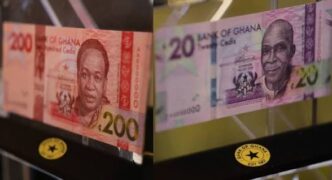
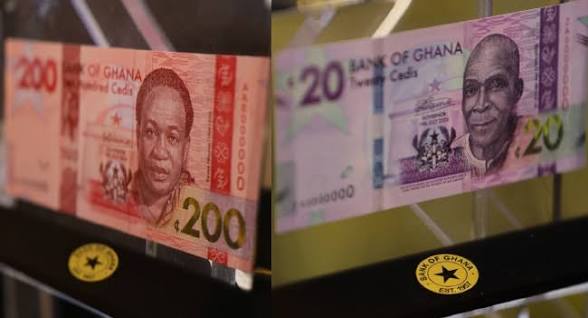
Ghana has unveiled redesigned banknotes featuring enhanced security measures, smaller sizes and more durable materials as part of efforts to combat counterfeiting and modernise its currency.
Gatekeepers News reports that the Bank of Ghana announced the new notes on Thursday, explaining that the redesign had become necessary because some of the existing banknote designs had been in circulation for more than two decades, while counterfeiting technology and international security standards had advanced.
Made from reinforced cotton paper, the redesigned notes are expected to withstand frequent handling and the country’s tropical climate, reducing wear and the cost of replacing damaged currency.
The new banknotes also feature improved tactile markings to make it easier for people with visual impairments to identify different denominations.
Speaking at the launch ceremony, President John Mahama said the smaller dimensions would make the notes more convenient for everyday transactions.
“The new notes are also smaller and easier to handle,” Mahama said.
The redesigned currency, known as the Heritage Series, will enter circulation on December 1 alongside existing banknotes, which will remain legal tender, Governor of the Bank of Ghana, Johnson Asiama, announced at the ceremony in Accra.
The new series retains eight denominations, ranging from one to 200 cedis, and reintroduces the two-cedi banknote.
However, the redesign does not represent a change in the currency’s value or a redenomination.
Beyond the enhanced security features, the new banknotes celebrate Ghana’s national heritage, with designs honouring prominent figures such as former United Nations Secretary-General Kofi Annan and the country’s first President, Kwame Nkrumah.
They also feature historic landmarks and national monuments.
Ghana introduced the cedi as its national currency in July 1965, eight years after gaining independence from Britain.
The redesign comes as the West African country continues to expand digital payment systems, although the central bank maintains that physical cash remains essential to the economy.
The redesign comes as the West African country continues to expand digital payment systems, although the central bank maintains that physical cash remains essential to the economy.
“Physical cash remains an essential pillar of our monetary resilience,” Asiama said.
He warned that cyberattacks, technical failures and natural disasters could disrupt electronic payment networks, underscoring the need to maintain reliable physical currency.
Meanwhile, the Bank of Ghana is preparing legislation to replace the 1964 Currency Act, with provisions aimed at strengthening the fight against counterfeiting and addressing the deliberate destruction and misuse of banknotes.