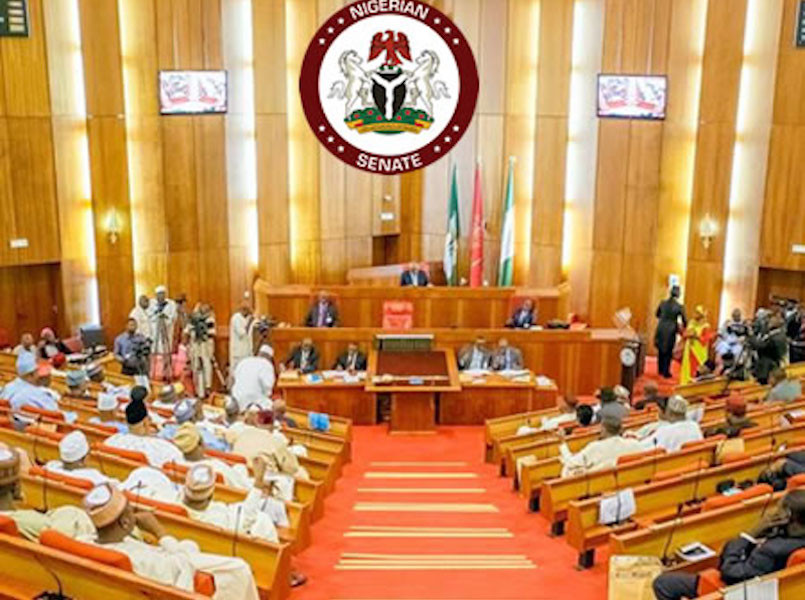
Senate has opened debate on a proposal that would give the Central Bank of Nigeria authority to classify and supervise major non-bank financial institutions.
Gatekeepers News reports that the move is aimed at bringing fast-growing fintech operators under the same top-tier rules that govern traditional banks.
The amendment to the Banks and Other Financial Institutions Act (BOFIA) 2020 targets digital lenders, mobile money operators, payment service banks, switching companies and wallet providers whose platforms now serve tens of millions of Nigerians.
Tokunbo Abiru, who chairs the Senate committee on banking and is sponsoring the bill, said the financial sector has changed so quickly that the regulatory framework has not kept pace.
He explained that these companies handle large volumes of transactions daily, store extensive financial and behavioural data, and have grown so influential that they could pose risks comparable to or even greater than established banks.
He said, “The reality today is that a non-bank institution, because of its market dominance, data concentration, customer reach, or technological capacity, may pose risks equal to or even greater than those posed by a traditional bank.”
“We are therefore confronted with a regulatory gap that leaves critical parts of the financial system operating outside the highest tier of statutory oversight; this bill seeks to correct that mischief.”
Abiru warned that without updating BOFIA, Nigeria could expose itself to data insecurity, foreign control over sensitive financial systems, and vulnerabilities that threaten national security.
He noted that many fintech companies operate through foreign-owned infrastructure or offshore servers, making it unclear who controls the data or which countries could claim jurisdiction.
He referred to the temporary onboarding freeze placed on several fintechs by the CBN in April 2024 following concerns over KYC breaches, money laundering risks, and suspicious transactions.
The amendment outlines several reforms, including a national registry for fintech companies, a framework for identifying systemically important platforms, and stricter rules to protect consumers and safeguard data sovereignty.
Abiru rejected suggestions to create a separate regulator for fintechs, arguing that oversight should remain with the CBN because fintech activities are closely tied to monetary policy, payments regulation, and systemic-risk management.
He said, “Fintech regulation is deeply intertwined with monetary policy, payments oversight, prudential supervision, and systemic-risk monitoring, functions that already reside naturally within the Central Bank. International best practice overwhelmingly favours integrating fintech oversight within existing regulators, not creating new bureaucracies.”
Lawmakers also raised concerns about the growing fragility of the digital financial space. Adams Oshiomhole said his bank accounts were hacked through a fintech platform and argued that many operators have ownership structures that are opaque.
He said, “I know the directors of our regular banks, but I can’t say the same of these fintech banks; I don’t know the directors of MoniePoint, Opay, and all others.”
The senator said clear regulation would ensure that online financial institutions act in the interest of Nigerians.
Natasha Akpoti-Uduaghan added that the debate must consider the income inequality affecting young Nigerians who earn their living from global digital platforms.
She highlighted huge discrepancies in payments to Nigerian creators, saying some receive as little as 50 cents per 1,000 views while creators in the United States earn $10 to $30 for the same reach.
She said such gaps weaken the earning potential of the country’s digital workforce and called for deeper engagement with global tech firms.
After the discussion, Deputy Senate President Barau Jibril referred the bill to the banking committee for more legislative work after it passed its second reading.