

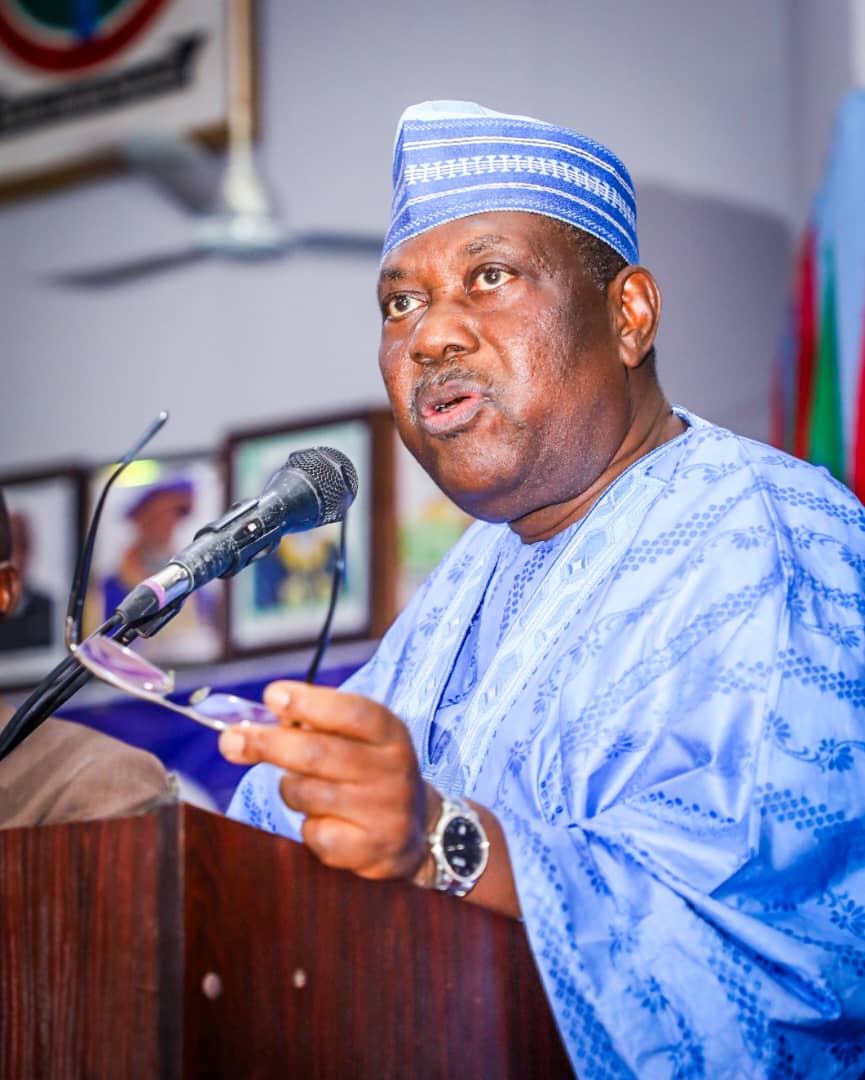
Secretary to the Government of the Federation (SGF), Senator George Akume, has expressed optimism that Nigeria will soon be delisted from the United States’ “Country of Particular Concern” (CPC) designation.
Gatekeepers News reports that speaking at the second triannual meeting of the Nigeria Inter-Religious Council (NIREC) in Abuja on Wednesday, Akume said the country is navigating one of its most delicate periods, characterised by heightened political rhetoric, security challenges and a decline in mutual trust that “was almost ebbing into religious conflict” in recent months.
Nigeria’s CPC designation by the US government, he said, has triggered a series of diplomatic engagements aimed at correcting what he described as “a wrong perception of our situation.”
Akume revealed that President Bola Tinubu has established a new US–Nigeria Joint Working Group on Security, in which NIREC leaders are expected to play significant roles as part of non-kinetic approaches to peacebuilding.
“Much success has been achieved, but much more work is needed in the short, medium and long term,” he said.
He stressed that the most pressing issue for NIREC is the erosion of trust among followers of different faiths, reflected in divisive rhetoric.
“The government expects NIREC, as committed leaders of faith, to openly discuss this critical agenda and take steps to recover lost ground in unity, peaceful coexistence and collaboration,” Akume noted.
Recent violent incidents—from Yelwata in Benue to Eruku in Kwara, and attacks across Kebbi, Niger and Zamfara—have heightened public anxiety, even as authorities intensify rescue operations and arrest criminal elements.
Akume said the CPC label further underscores the need for stronger domestic engagement to address global misconceptions about Nigeria. Although diplomatic efforts have yielded progress, he added, “much more work remains.”
Responding to narratives that frame the violence as religiously one-sided, Akume cautioned Nigerians against such portrayals.
“I find it necessary to mention the narrative on genocide and the lack of contextualisation in it,” he said.
“Violence in Nigeria has been viewed through lenses of religion against one group or another, but both Christians and Muslims have suffered devastating losses.”
He highlighted that Boko Haram and related insurgencies have killed thousands since 2009, while Muslim communities have often been primary victims of banditry in the Northwest, and many victims of communal violence in the North-Central have been Christians.
“The point is not to engage in a gruesome scorecard,” Akume added, “but to underline that violence in Nigeria is not monolithic. Both major faith groups bleed when any Nigerian is killed.”
He insisted that an interfaith approach is essential for healing social divisions and preventing further distrust.
“Our united front is crucial for restoring cohesion,” he said.
Akume reaffirmed President Tinubu’s commitment to safeguarding the welfare and security of all Nigerians and emphasised that while international partnerships are welcome, “Nigerians must work out Nigerian solutions.”
He called for deeper collaboration between government and faith leaders in areas such as inclusive policymaking, early-warning systems, joint peacebuilding and youth education against hate propaganda.
Religious Leaders Echo Call for Unity
Archbishop Daniel Okoh, President of the Christian Association of Nigeria (CAN) and NIREC Co-Chairman, described the current moment as “critical,” citing widespread insecurity driven by banditry, kidnappings and violent extremism.
“The daily loss of innocent lives is alarming and heartbreaking,” he said, noting that insecurity has crippled economic activities and deepened poverty.
Okoh commended the Tinubu administration for ongoing security efforts but urged more decisive action.
“Peace cannot be sustained without justice,” he added, insisting that perpetrators must be held accountable and victims supported.
He reaffirmed CAN’s commitment to support NIREC and promote harmony, saying the council remains a vital platform for condemning violence “irrespective of the victims’ identity.”
His Eminence, the Sultan of Sokoto, Muhammadu Sa’ad Abubakar III, also emphasised sincerity in inter-religious dialogue.
“Let’s discuss so we can agree on one issue: should this NIREC continue?” he said.
“Behind our backs, we must not speak negatively about one another. That is most unreligious.”
Abubakar reiterated that Nigeria remains a multi-religious nation and stressed that Sharia law applies only to Muslims.
“If anyone wants to take a Christian to Sharia court, that is wrong,” he said.