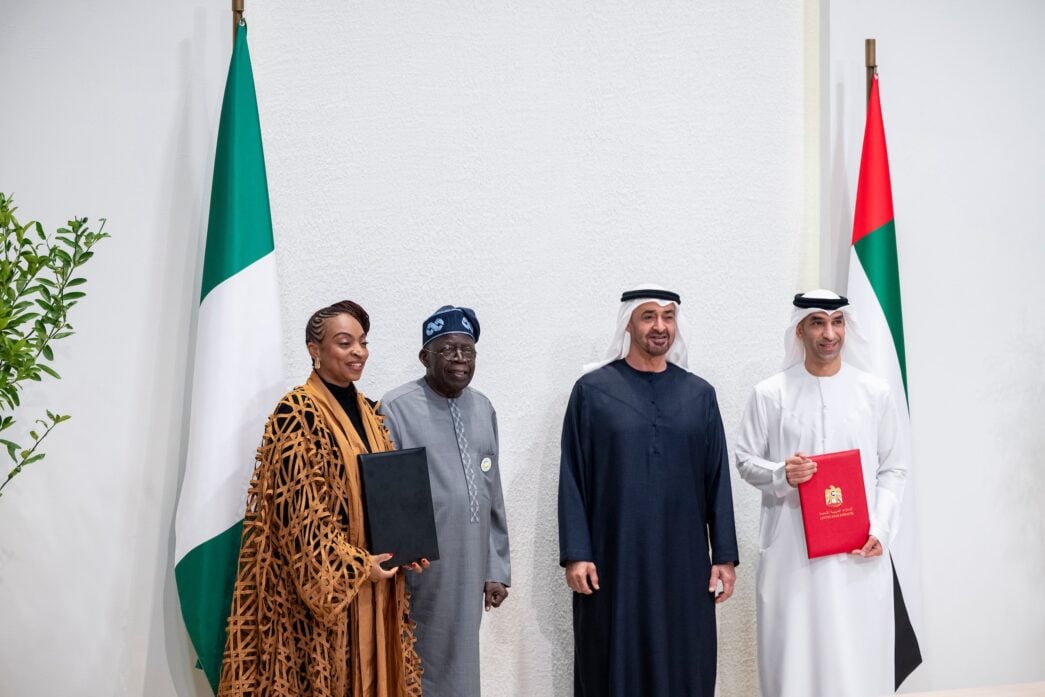
President Bola Tinubu has announced that Nigeria and the United Arab Emirates (UAE) have signed a comprehensive economic partnership agreement (CEPA), granting duty-free access for thousands of Nigerian products into the Arab country.
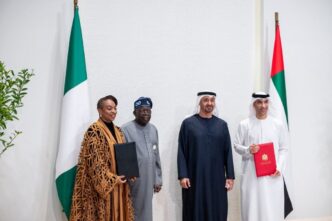
Gatekeepers News reports that the agreement was signed on the sidelines of the Abu Dhabi Sustainability Week by President Tinubu and UAE President Mohamed bin Zayed Al Nahyan.
“For Nigerians, this agreement is not abstract. It opens duty-free access for thousands of Nigerian products into the UAE, expands opportunities for our exporters, manufacturers, and service providers, and gives UAE investors clearer confidence to back Nigeria’s productive economy,” Tinubu said.
He added that the deal supports Nigeria’s industrialisation and diversification goals while positioning the country as a gateway for trade and investment into Africa. “This is the work of economic reform, purposeful engagement and measured partnerships. The outcomes will serve Nigeria’s long-term national interest,” the president said.
Tinubu commended the sustained efforts of Jumoke Oduwole, Minister of Industry, Trade and Investment, and her UAE counterpart, Thani bin Ahmed Al Zeyoudi, for bringing the negotiations to a successful conclusion.
What the Agreement Delivers for Nigeria
Minister Oduwole explained that the UAE will eliminate tariffs on over 7,000 Nigerian products, including fish and seafood, oil seeds, cereals, cotton, pharmaceuticals, and chemicals. Over the next three to five years, tariffs will also be removed on machinery, vehicles, electrical equipment, apparel, and furniture.
She highlighted new business opportunities for Nigerian firms:
- Nigerian companies can establish operations in the UAE through corporate entities, branches, and subsidiaries.
- Nigerian business visitors can stay in the UAE for up to 90 days within 12 months to explore trade and investment opportunities.
- Managers, executives, and specialists can relocate with their companies for renewable three-year periods.
“The agreement removes long-standing constraints to foreign direct investment,” Oduwole said. “UAE investors now have clarity and confidence to invest in Nigeria’s productive sectors. This will support our industrialisation agenda, enhance transport and logistics connectivity, and create quality jobs for our youthful population.”
Nigeria’s Commitments Under the Agreement
On its part, Nigeria will eliminate tariffs on around 6,000 products, with 60% of these removed immediately and the remainder phased over five years. These products include industrial inputs, capital goods, and machinery to strengthen Nigeria’s productive capacity. Nigeria’s Import Prohibition List will remain in effect.
On trade in services, Nigeria’s commitments cover 99 services across 10 sectors, including business, communications, transportation, financial services, construction, distribution, health, environmental services, recreation/sports, and tourism.
Oduwole emphasized swift implementation, with the Ministry of Industry, Trade and Investment (FMITI) working alongside agencies such as the Nigerian Customs Service (NCS), Nigerian Export Promotion Council (NEPC), Nigerian Investment Promotion Commission (NIPC), and Standards Organization of Nigeria (SON) to ensure Nigerian businesses fully benefit from the agreement.
“The agreement was negotiated for the Nigerian private sector,” she said. “I urge you to identify your opportunities with enhanced market access and move with confidence into the UAE market with the protections we have secured for you. Nigeria is open for business, and Nigerian companies now have access to the UAE, the Middle East, and the rest of the world.”