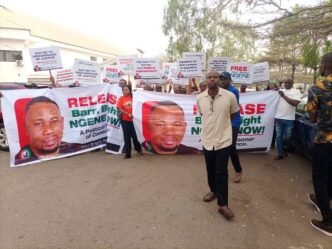




Hundreds of workers from the Federal Capital Territory Administration (FCTA), supported by the Nigeria Labour Congress (NLC), marched to the National Industrial Court in Abuja on Monday to demonstrate against the government as their indefinite strike continues.
Gatekeepers News reports that the protest came after the NLC publicly backed the strike, saying it was justified because of what labour leaders describe as ongoing violations of workers’ rights by the FCTA management and political leadership.
Many workers carried placards with messages such as “Wike Must Go!!”, “Abuja No Be Rivers”, “Pay Our Promotion Arrears”, “Enough Is Enough”, and “No Working Tools”.
The strike began last week under the Joint Union Action Committee (JUAC) after a seven-day ultimatum given to the FCTA to address unresolved welfare issues expired. Workers have complained about five months of unpaid salaries, long-outstanding promotion arrears, poor working conditions, and other grievances, which they say have not been properly resolved.
In response, Nyesom Wike, the Minister of the Federal Capital Territory, filed a lawsuit at the National Industrial Court challenging the legality of the strike. The suit, marked NICN/ABJ/17/2026, names JUAC’s President, Rifkatu Iortyer, and Secretary-General, Abdullahi Saleh, as defendants and seeks a court order to compel the striking workers to resume duties.
Justice Emmanuel Subilim heard arguments from both sides and adjourned the matter until Tuesday, January 27, for a ruling on a motion asking the court to halt the industrial action. The workers, meanwhile, continued to picket the court, insisting their protest will go on until their demands are met.
The strike has already caused disruptions in several government offices and services across Abuja, with heavy security deployed to the FCTA Secretariat as officials tried to carry out duties amid the protests. Teachers in the territory were also ordered by the Nigeria Union of Teachers to join the strike in solidarity.
Labour leaders have called for unity and ongoing mobilisation, saying their action aims to force meaningful negotiations and better working conditions for all FCTA workers.