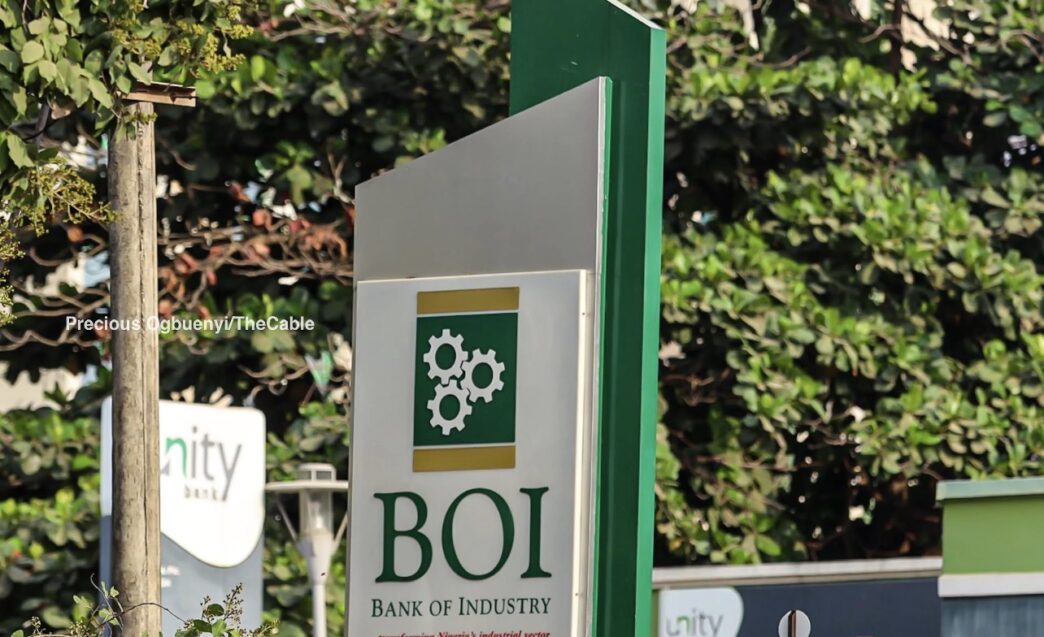
The Bank of Industry (BOI) has announced that it released a record N636 billion in funding to businesses across Nigeria in 2025, marking the highest annual loan disbursement in the institution’s history.
Gatekeepers News reports that in its 2025 impact report released on Wednesday, the development finance bank said the funds were distributed to more than 7,000 enterprises operating across key sectors of the economy, including manufacturing, agribusiness, micro, small, and medium enterprises, infrastructure, power, information and communication technology, and the creative industry.
The bank said the record performance reflects rising demand for long-term financing, driven largely by its relatively affordable interest rates and longer repayment tenures, especially at a time of tight global credit conditions and rising borrowing costs.
President Bola Tinubu commended the Bank of Industry for the milestone, saying it demonstrates the positive impact of ongoing economic reforms aimed at improving access to capital and strengthening development finance in the country.
In a statement issued by his special adviser on information and strategy, Bayo Onanuga, the President described the achievement as proof of improved institutional discipline and growing investor confidence.
“The N636 billion disbursed by the Bank of Industry in 2025 translates directly into productive capacity across Nigeria,” Tinubu said.
“At a time of global financing constraints, Nigeria expanded access to long-term capital for its businesses. That is a direct outcome of reform, credibility and institutional discipline.”
BOI explained that the achievement aligns with its 2025–2027 transformation agenda, which focuses on strengthening its balance sheet, improving operational efficiency, mobilising long-term capital, and channeling funding into sectors critical to national economic development.
Despite global economic pressures that widened financing gaps and placed strain on development finance institutions, the bank said it successfully scaled up lending while maintaining strong asset quality, with a non-performing loan ratio of less than 1.5 percent.
A sector-by-sector breakdown of the disbursements showed that N202 billion went to agro-allied enterprises, N100 billion to infrastructure, N79 billion to manufacturing, N77 billion to extractive industries, and N55 billion to service-based businesses.
The bank said the funding was supported by a €2 billion syndicated facility secured in late 2024, the federal government’s N200 billion MSME intervention scheme, and an additional €210 million mobilised in 2025 from international partners. It also deployed N73 billion in managed and matching funds on behalf of state governments and institutional partners.
Under the federal government’s MSME intervention programme, BOI said it achieved over 95 percent performance as the main disbursing agency, while the presidential conditional grant scheme reached 957,400 beneficiaries during the year.
Data from the report showed that N51 billion was released to nano enterprises, N32 billion to micro businesses, N178 billion to small and medium enterprises, and N375 billion to large-scale companies. The bank said its interventions led to the creation and preservation of about 1.6 million jobs, supported more than 7,000 new MSMEs, and funded 570 startups nationwide.
The bank said inclusive financing remained a core focus, highlighting its N10 billion Guaranteed Loans for Women programme, which provides up to N50 million in affordable loans to female entrepreneurs. Youth-led businesses received N12 billion, while the Rural Area Programme on Investment for Development supported 880 rural enterprises with more than N6.5 billion across all states and the federal capital territory.
Strategic projects funded during the year included the upgrade of a tomato processing plant from 3.1 to 10 metric tonnes per hour, the linkage of 47,508 smallholder farmers to processing facilities, and the deployment of 100 mini-grid power systems that connected 11,777 new customers to electricity.
The bank also said it released N100 billion to major infrastructure projects in broadband, power, aviation, and transportation, while its green financing initiatives contributed to an estimated annual reduction of over 20,000 tonnes of carbon emissions.
Through the Investment in Digital and Creative Enterprises programme, BOI said it prepared 500 founders for investment, funded 100 technology startups, and trained 400 youths through innovation initiatives, with a long-term target of reaching more than 300,000 Nigerians.
Commenting on the performance, the managing director and chief executive officer of BOI, Olasupo Olusi, said the achievement supports the federal government’s drive to deepen industrialisation and inclusive economic growth.
“Achieving over N600 billion in loan disbursements to our customers in 2025 is a significant milestone for the Bank of Industry, which aligns with the vision of President Bola Ahmed Tinubu to drive industrialisation, economic diversification, and inclusive growth across Nigeria,” Olusi said.
“Beyond this milestone, our performance this year demonstrates BOI’s continued commitment to supporting enterprises, creating jobs, and strengthening the nation’s industrial base.”
The bank also said it strengthened its institutional standing during the year by becoming Nigeria’s first national implementing entity to the United Nations Adaptation Fund and the first development finance institution in the country to receive privacy information management system certification.
It added that it earned several awards in 2025, including Best Bank for Sustainable Finance, Best Company in Financial Inclusion, and Best Company in Infrastructure Development.