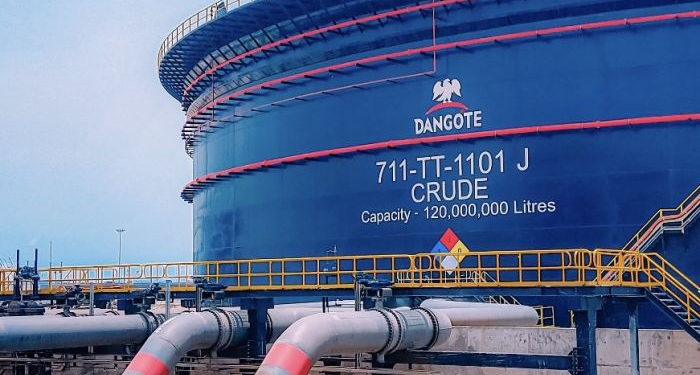
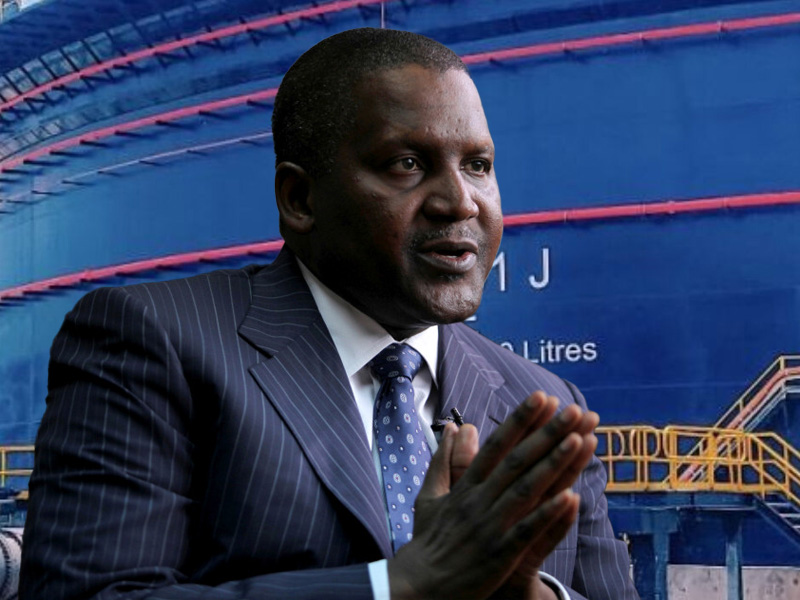
Aliko Dangote, President of the Dangote Group, has revealed that the company rejected attempts by the Nigerian National Petroleum Company Limited (NNPC) to increase its stake in the Dangote Petroleum Refinery.
Gatekeepers News reports that Dangote disclosed this on Wednesday during an interview with Nicolai Tangen, monitored by Channels Television.
According to him, the request was declined because the group intends to open up ownership of the refinery to more Nigerians through a planned initial public offering (IPO).
“The national oil company already owns 7.25 per cent, and they are trying to buy more. We are the ones that said no; we want to now spread it and have everybody be part of it,” Dangote said.
NNPC had in 2021 acquired a 7.25 per cent stake in the refinery for $1 billion, with an option to purchase an additional 12.75 per cent by June 2024.
Dangote had earlier disclosed in 2024 that the state oil company reduced its proposed stake from 20 per cent to 7.25 per cent after failing to complete payment for the remaining shares.
“The agreement was actually 20 per cent, which we had with NNPC, and they did not pay the balance of the money up until last year,” he had said.
Dangote also identified policy inconsistency and the threat of conflict as major risks facing the refinery project.
“The other biggest risk is government inconsistencies in policies,” he stated.
The billionaire businessman further disclosed that the refinery has exceeded its installed processing capacity of 650,000 barrels per day, currently operating at 661,000 barrels daily.
“The refinery has been tested. We have now processed even crude at 661,000 barrels a day. So we have demonstrated that capability,” he said.
He added that the successful delivery of the project had boosted investor confidence, making financial institutions more willing to back future ventures by the group.
Dangote said the company relied on support from institutions such as Afreximbank, Africa Finance Corporation, Zenith Bank, Access Bank, United Bank for Africa, Standard Bank, and Standard Chartered to finance the refinery, particularly after the devaluation of the naira.
Speaking on the impact of the Middle East crisis on his businesses, Dangote said the conflict had largely benefited the refinery and fertiliser operations due to rising global demand and higher prices.
According to him, fertiliser prices rose from about $400 per tonne before the crisis to around $850, while polypropylene prices climbed from $900 to nearly $3,000 in some markets.
“The effect of the war on our businesses is more beneficial than a downside because today, fertiliser is in very high demand,” he said.
He noted that Nigeria’s plastic manufacturing sector would have suffered severe disruption without the polypropylene produced by the refinery.
Dangote also disclosed that aviation fuel from the refinery had already been sold out until mid-July, with production currently standing at 20 million litres daily.
On crude sourcing, the businessman said about 56 per cent of supply comes from Nigeria, while additional cargoes are sourced from Angola, Libya, and the United States.
“We have to now buy 21 cargoes every month. That’s how big we are,” he said, adding that the refinery’s capacity would expand to 1.4 million barrels per day within the next 30 months.
Dangote further alleged that vested interests benefiting from the former fuel subsidy regime attempted to frustrate the refinery project.
“The Mafia are the people who are actually benefiting because Nigeria was giving out almost $10bn every year as a subsidy,” he said.
“There are shippers, traders, and local beneficiaries making billions who did not want us to settle down because they believed we were coming to displace them.”
The industrialist also revealed plans to attract more investors and inject about $45 billion into the group’s businesses in pursuit of a $100 billion revenue target by 2030.
He projected that the group’s earnings before interest, taxes, depreciation and amortisation (EBITDA) would rise from $3 billion recorded last year to more than $30 billion by 2030.
During the interview, Dangote also spoke about his personal commitment to Nigeria, revealing that he sold his properties in the United States and the United Kingdom to focus on industrial investments at home.
“When I decided to go into the industry, I sold all my properties in the US and the UK. I wanted to really sit in Nigeria and concentrate,” he said.
According to him, his business philosophy is centred on producing goods Nigerians consume daily through a backward integration strategy aimed at reducing imports and boosting local production.