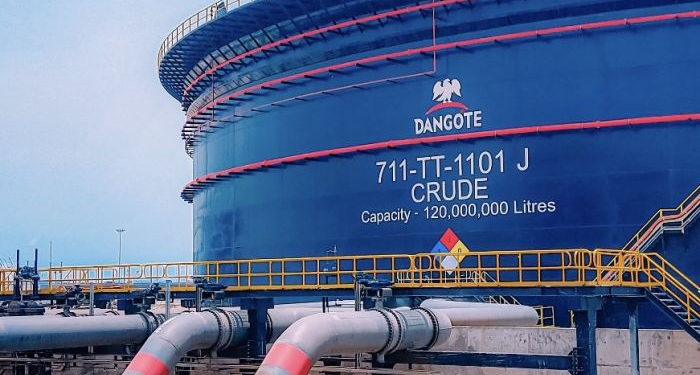
A Federal High Court in Lagos has issued an interim injunction restraining the Nigerian Midstream and Downstream Petroleum Regulatory Authority (NMDPRA) from shutting down, restricting or otherwise interfering with the operations of the Dangote Petroleum Refinery.
Gatekeepers News reports that Justice Akintayo Aluko issued the order on Monday while ruling on a motion ex parte marked FHC/L/CS/1174/26, filed by Dangote Petroleum Refinery Nigeria Limited.
The refinery’s legal team was led by Olawale Akoni and Abimbola Akeredolu, both Senior Advocates of Nigeria (SANs).
The company approached the court following a letter dated August 24, in which the NMDPRA allegedly directed the suspension of the loading and truck-out of petroleum products from the refinery.
Dangote Refinery subsequently asked the court to restrain the NMDPRA, its officers, agents, representatives, privies or anyone acting on its authority from enforcing or implementing the directive pending the hearing and determination of the motion on notice.
The company also sought an interim injunction preventing the regulator and its agents from entering, sealing, shutting down, restricting access to, obstructing, suspending, disrupting, inspecting, supervising, sanctioning or otherwise interfering with its facilities and operations within the Lekki Free Zone.
While moving the application, Akeredolu told the court that it was supported by a 42-paragraph affidavit deposed to by Wale Aroge, a written address and documentary exhibits marked A1 to A6.
He urged the court to grant the reliefs sought by the refinery.
Court’s ruling
In his ruling, Justice Aluko said the court had carefully considered the application, affidavit evidence, exhibits and submissions of counsel, including the NMDPRA’s August 24 letter.
The judge noted that the refinery’s case was that the NMDPRA lacked regulatory and oversight powers over operations within free zones, including the Dangote Industrial Free Zone.
Aluko also referred to a March 2 letter issued by the Attorney-General of the Federation (AGF), which, according to the judge, stated that the NMDPRA was not entitled to exercise regulatory powers or oversight functions over operations within free zones.
The judge said the court had also considered the NMDPRA’s August 24 letter, through which the agency purportedly sought to exercise such regulatory powers.
“The important question, therefore, is whether the defendant can or should be allowed to exercise such regulatory authority pending the determination of the substantive issues before the court,” Aluko said.
The judge held that the depositions contained in paragraphs 17 to 32 of the refinery’s affidavit disclosed serious issues requiring determination by the court.
On the urgency of the application, Aluko said paragraphs 33 to 39 of the affidavit established the need for judicial intervention.
According to him, the refinery was seeking to preserve the subject matter of the suit pending the determination of its motion on notice.
“Every court has the inherent power and duty to preserve the res and prevent a situation where the subject matter of litigation would be destroyed or altered before the substantive application is determined,” the judge said.
Aluko further held that the refinery had satisfied the conditions required for the grant of an interim injunction.
He noted that Dangote Refinery had also undertaken to indemnify the NMDPRA in damages if the court eventually determined that the injunction should not have been granted.
“Accordingly, I find merit in the application, and the same is hereby granted in terms of the reliefs sought. The plaintiff shall file a formal undertaking as to damages,” the judge ruled.
The judge directed that the order and notice of the court be served on the NMDPRA and adjourned the case until September 9 for the hearing of the motion on notice.
When contacted by TheCable for clarification on the dispute with the Dangote Refinery, George Ene-Ita, NMDPRA spokesperson, said the agency could not comment on the matter because it was before the court.
“The matter is sub judicial and in respect to the Hon. Justice’s decision, we cannot comment on the matter for now,” Ene-Ita said.