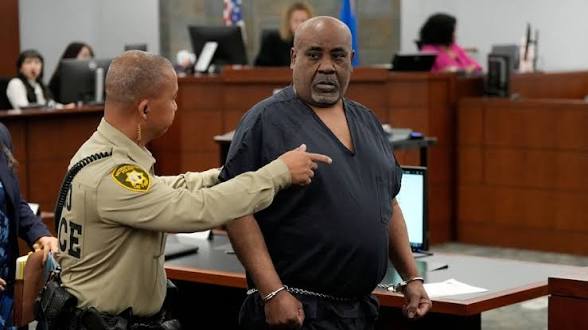
Duane “Keffe D” Davis, a former Los Angeles gang leader convicted of orchestrating the 1996 killing of rap legend Tupac Shakur, has been sentenced to a minimum of 40 years in prison.
Gatekeepers News reports that the sentence, handed down on Tuesday in a Las Vegas courtroom, is likely to keep the 63-year-old behind bars for the rest of his life, nearly three decades after the death of one of hip-hop’s most influential artists.
Davis, who formerly led a faction of the notorious Crips gang, had spoken publicly for years about his involvement in Shakur’s killing but denied the allegations when he went to trial.
He had appeared to believe he could evade justice, even writing in his memoir that he had ordered the murder.
Delivering the sentence, Judge Carli Kierny criticised Davis for repeatedly acknowledging his involvement while portraying himself as someone who had moved on with his life.
“For three years, I’ve heard you say some variation of the same thing to law enforcement… in your book, and it’s something like, ‘Yeah, I was involved in this, but I’m different. I’ve moved on. I got out of Compton. I’m a grandfather now,’” Kierny said.
“I’m here to tell you that’s not how this works.”
The judge stressed that Davis could not escape responsibility for taking another person’s life and depriving a family of a loved one.
“You don’t get to take a man from his family. You don’t get to take his very life, his whole future from him, and just walk away from it. Especially when that man is Tupac Shakur,” she said.
Shakur, popularly known as 2Pac, was a central figure in the rivalry between East Coast and West Coast hip-hop artists in the United States. He was 25 when he was shot in Las Vegas.
Evidence presented at Davis’s trial showed that he ordered the September 7, 1996, attack after his nephew was beaten by members of Shakur’s entourage during a confrontation at a Las Vegas casino.
About two hours later, a gunman in a white Cadillac pulled alongside the BMW carrying Shakur and opened fire at a red light.
Prosecutors said Davis handed a firearm to a passenger in the back seat of the Cadillac and instructed the person to shoot the rapper. Shakur died six days later from his injuries.
The identity of the gunman has never been definitively established. Davis was the only person in the Cadillac that night still alive at the time of the trial.
Marion “Suge” Knight, co-founder of Death Row Records and the driver of the BMW, was also wounded in the attack.
‘Born an Icon’
Shakur’s murder became one of the most prominent unsolved cases in American music history, fuelling decades of speculation among fans about the circumstances surrounding his death and the people responsible.
The rapper, whose catalogue includes hits such as “All Eyez on Me” and “California Love”, was the son of a Black Panther activist. He grew up in Harlem and Baltimore before becoming one of the defining figures of California hip-hop after signing with Los Angeles-based Death Row Records.
His sister, Sekyiwa Shakur, paid an emotional tribute to him in court on Tuesday, describing her brother as someone who had been destined for greatness.
“He was born an icon,” she said.
She explained that their mother had deliberately raised him to stand up for others and champion human rights.
She said Shakur “consciously raised him to be a human rights activist, someone to stand up for those weaker and smaller than he was, and that’s who he was to me and all the family. He was the person that you go to for protection.”
Sekyiwa added that her brother had dedicated his career to advancing the interests of his people and was compassionate towards women, children and those in need.
“He dedicated his career to the advancement of his people. He was gentle and kind to women and children. He fed anyone he knew that didn’t have. He was truly my shining star, my shining prince. He was who God trusted to take care of me,” she said.
Davis did not offer an apology or express remorse before the sentence was announced. He instead maintained that he would appeal his conviction.