

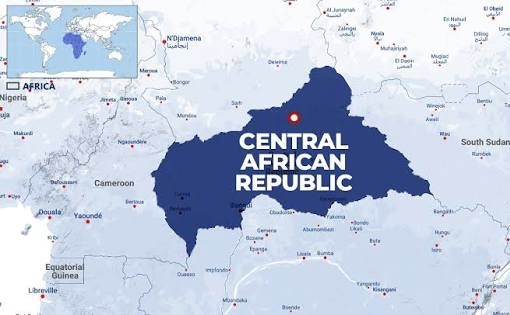
The Central African Republic (CAR) has intensified border surveillance and health screening measures amid concerns that the deadly Ebola outbreak in neighbouring Democratic Republic of Congo (DRC) could spread across their shared border.
Gatekeepers News reports that authorities in the Central African capital, Bangui, have introduced daily checks on travellers crossing the Oubangui River, which separates the two countries.
The measures come as the DRC battles an Ebola epidemic that has recorded about 10,000 cases across Africa, with the vast majority reported in the central African country.
At M’Poko Bay pier in Bimbo district, southwest of Bangui, travellers arriving by canoe from the DRC are required to wash their hands and undergo temperature checks.
Maldiana Bagalama, a health worker responsible for screening at the entry point, explained the procedure.
“Passengers arriving by canoe dock at the entry point. Then they disembark one at a time,” she said.
“One of our colleagues is there to direct them to the hand-washing station. Next, we brief them on the situation, then direct them to the tent for temperature checks and registration,” Bagalama added.
Concerns over a possible cross-border spread have increased because the virus has been detected in three Congolese regions bordering the CAR.
The two countries also share a porous frontier stretching more than 1,500 kilometres, much of which remains largely unmonitored.
Although the DRC remains the epicentre of the outbreak, Ebola has spread to other parts of Africa, with cases reported in Kenya and one detected in Nigeria.
The disease, which is transmitted through contact with infected bodily fluids and causes severe haemorrhagic fever, has claimed more than 15,000 lives across Africa in the past 50 years.
Despite the health risks, economic activities along the Oubangui River continue, with fishermen, canoe operators and fish traders depending on the waterway for their livelihoods.
Neige, a fishmonger and mother of three, expressed fears that residents working along the river could be among the first victims if the virus reaches the CAR.
“We are worried because we work right here, by the river, and if Ebola reaches here we shall be the first to fall victim to it. We’re asking the ministry of health to take far greater precautions,” she said.
Similarly, Foxy Yeti Nzapa, a 25-year-old canoe operator and father of two, said transporting passengers between the countries exposes him to potential infection.
He explained that canoe transportation was his only source of income despite the risks involved.
“It’s hard to find work in the Central African Republic and this is my only source of income. My concern is that the people we bring back from the other side might also put us at risk, given that we provide transport between the two countries without any protection. It’s dangerous,” he said.
Nzapa added that reports of Ebola-related deaths in communities across the river had heightened his fears.
“From over there, we sometimes hear this or that person has died of Ebola. I could also become infected. So we need preventive measures to protect ourselves, as we are in constant contact with the other side,” he said.
Meanwhile, CAR authorities say they have strengthened border controls through the deployment of health workers and other security personnel at designated entry points.
Dr Valentin Nebanga, a departmental head at the Ministry of Health, said personnel from the Water and Forests Department, Customs, Civil Protection and Internal Security Forces were also involved in the exercise.
“We have entry points staffed by health workers, the Water and Forests Department, Customs, Civil Protection and Internal Security Forces,” Nebanga said.
He explained that all travellers, both incoming and outgoing, undergo routine screening by community health workers.
“They take their temperatures and ask travellers a number of questions using a standardised form,” he added.
Nebanga said the government had also launched public awareness campaigns, involving neighbourhood chiefs, community leaders and religious figures to educate residents on Ebola prevention.
He stressed that public awareness and cooperation were essential to containing the threat, particularly as the country had not recorded any confirmed cases.
However, he acknowledged that sustaining the response and keeping health workers engaged remained a challenge.
“We’ve not had any cases yet, but our biggest challenge remains retaining staff and keeping them engaged,” he said.
“But we are never fully prepared,” Nebanga conceded.