

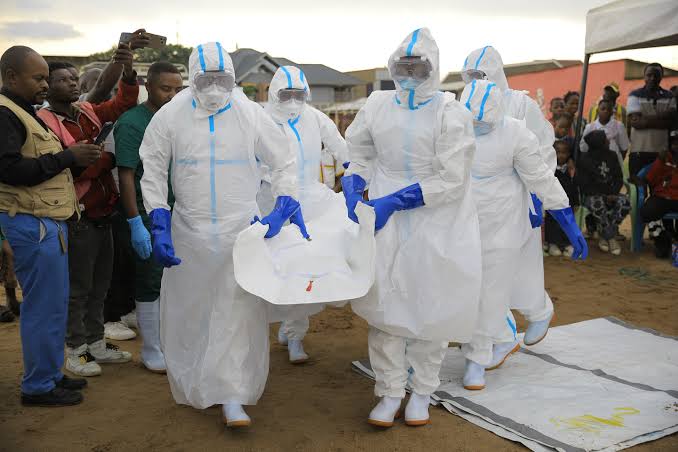
Health workers battling an Ebola outbreak in the eastern Democratic Republic of Congo (DRC) are facing growing resistance from local communities, with traditional burial practices, cultural beliefs and distrust of authorities complicating efforts to contain the virus.
Gatekeepers News reports that in Bulambo-Isale, a rural community in North Kivu province, tensions escalated this week when residents gathered along a dirt road to prevent an ambulance carrying the body of an Ebola victim from entering the community for burial, according to an AFP report.
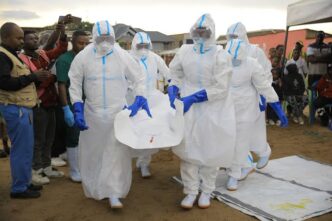
Health authorities require victims of the highly contagious haemorrhagic fever, which spreads through direct contact with bodily fluids, to be buried in sealed body bags to prevent further transmission.
Such burials are conducted by specially trained health workers wearing protective equipment. However, some residents object to the practice, insisting that traditional customs require deceased persons to be buried by their families and returned to the soil of their ancestors.
Patricien Kambale, a university graduate who later became a livestock farmer, accused authorities of imposing Ebola control measures without adequately considering local beliefs and perceptions.
“The authorities have imposed the Ebola response on locals without first making sure how they interpret it,” he said.
Kambale explained that the removal of sick residents to treatment centres without adequate communication often fuels suspicion when families later learn that their relatives have died.
“The sick victim gets carted away in a vehicle and locals don’t know where they’re being taken. Then we learn later that the person has died so locals think the doctors are using poisoned medicine to kill people,” he said.
Distrust of government institutions, which many residents associate with corruption and nepotism, has further complicated the response.
Communities in the mineral-rich eastern region have endured decades of violence involving armed groups, leaving many residents feeling neglected and suspicious of government interventions.
Wilson Kasyani, chief doctor for the Vuhovi health district, which includes Bulambo-Isale, expressed concern over the safety of medical personnel operating in the volatile region.
“Weapons are everywhere,” he said, describing the security challenges confronting health workers.
He disclosed that medical personnel had faced frequent attacks linked to resistance against Ebola control measures.
“Today, people entered a nurse’s home and wounded her son,” Kasyani said.
“And yesterday we had to stop someone who wanted to attack investigators with a machete.”
Roland Vivaya, head of the local youth council, said most residents of Bulambo-Isale remained unconvinced that Ebola was real.
He admitted that he had also doubted the existence of the disease until he became infected and nearly died.
Vivaya said the resistance was largely driven by a lack of understanding rather than outright defiance, despite residents’ memories of previous Ebola outbreaks.
Kambale recalled that during an earlier outbreak, images of medical workers operating under military protection frightened members of the community and deepened suspicion.
The current outbreak is caused by the Bundibugyo strain of Ebola, for which there is currently no approved vaccine or specific treatment.
Vivaya questioned how health workers could convince residents, many of whom have little or no formal education, to prioritise Ebola when they have endured decades of deaths and suffering caused by armed conflict.
“How can you explain to locals — many of whom have never been to school — why there’s this sudden focus on this disease, when we’ve been dying for decades from the conflicts here,” he said.
He added that he only understood the virus after receiving treatment at an Ebola centre, where information sessions were organised for patients.
However, he said such awareness programmes had failed to reach everyone in the affected communities.
Vivaya also blamed resistance on the failure of some health workers to understand local languages and cultural practices, adding that residents sometimes interpreted the response as an attempt by outsiders to profit from the outbreak.
Bulambo-Isale is regarded as a cultural and religious centre of the Nande people, one of the largest ethnic groups in eastern DRC.
Traditional chief Pimbo Kakule said the Ebola response must take local burial customs into account to gain community acceptance.
From his home, overlooking one of the community’s 12 sacred hills, Kakule explained that Nande traditions require family members to bury their dead so that the deceased can remain connected to their ancestors.
“Our people believe there is life after death and our customs must be respected when a person is buried. Otherwise we think they’ve been sacrificed,” he said.
He warned that failing to observe traditional burial practices could have serious spiritual implications for the community.
“A person who isn’t able to communicate with their dead can’t get into heaven,” Kakule said.
The traditional ruler argued that health authorities could reduce tensions by involving families in safe burial procedures rather than imposing decisions on them.
“If we were to say: ‘Your brother’s died. We’re going to teach you how to bury him,’ we might reach an agreement and there wouldn’t be all this tension,” he said.
“We are fighting the disease, not the response teams.”
Financial incentives offered to locally recruited workers involved in the Ebola response have also become a source of suspicion and resentment.
Some residents reportedly view the higher wages as evidence of profiteering, fuelling conspiracy theories and hostility towards those participating in the response.
Kambale recalled that when he received a vaccine against the Zaire strain of Ebola in 2020, some neighbours accused him of accepting money to spread the virus and threatened to burn down his house.
“Even protecting yourself has become a problem,” he said.
The situation has also been exploited by pressure groups comprising members of youth organisations linked to local politicians, who sometimes obstruct health workers attempting to reach sick residents.
Salama Mwengesyali, who coordinates Ebola public information sessions in the area, said some of the disruptions were caused by marginalised individuals who could be brought into the response through training and engagement.
“If we could bring all these individuals in, train them and get them involved in tackling Ebola, we could overcome this resistance,” she said.
“What we lack are the means to do that.”
Mwengesyali said her team lacked sufficient funding to encourage residents in rural farming communities to attend lengthy awareness sessions or support health workers in reaching households through phone calls and outreach visits.
Kasyani said the situation had deteriorated to the point where health workers sometimes had to visit homes personally to persuade families to accept protective burial procedures.
He also raised concerns about poor conditions at the local Ebola treatment centre, which he said was constructed largely from wooden planks.
According to him, patients endure difficult conditions, with two recently escaping from the facility.
“People tell themselves that if they go there, they’re going to die,” he said.
The challenges highlight the importance of community engagement, culturally sensitive communication and improved healthcare facilities in containing the outbreak in eastern DRC.