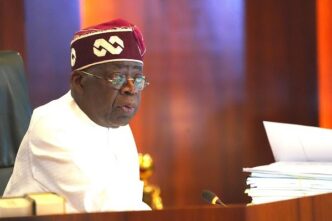


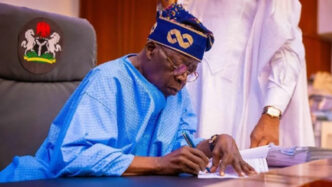

Federal Executive Council (FEC), chaired by President Bola Tinubu, has approved 2026 appropriation budget, projecting a total expenditure of N58.47 trillion, six percent higher than the 2025 estimate.
Gatekeepers News reports that the announcement was made by Tanimu Yakubu, Director-General of the Budget Office, while briefing journalists on Friday.
Yakubu said the budget allocates N4.98 trillion to government-owned enterprises (GOEs) and N1.37 trillion to grants and donor-funded projects.
Statutory transfers are set at N4.1 trillion, while debt service, which accounts for the largest portion of spending, is projected at N15.52 trillion, including N3.38 trillion for the sinking fund to retire maturing local contractors and creditors.
He added that personnel costs, including pensions, amount to N10.75 trillion — seven percent higher than the 2025 provision and including N1.02 trillion for GOEs. Overhead costs are projected at N2.22 trillion.
Capital expenditure is set at N25.68 trillion, 1.8 percent lower than the 2025 allocation, reflecting a focus on completing ongoing projects.
Key capital allocations include N11.3 trillion for MDAs, N2.052 trillion for multilateral and bilateral loans, and N1.8 trillion for the capital component of the development levy.
According to Yakubu, the 2026 budget balances macroeconomic stability with development priorities, following a medium-term fiscal framework.
Budget assumptions are conservative, particularly for oil prices, exchange rates, and dividends from government-owned enterprises.
He noted a structural shift in revenue sources, with non-oil revenues now accounting for roughly two-thirds of total receipts, supported mainly by corporate tax, VAT, customs, and independent revenues.
Expenditure growth is primarily driven by debt service, wages, and pensions, rather than discretionary spending. Capital spending has been slightly reduced to ensure the completion of ongoing projects and value for money.
Yakubu said the larger budget deficit reflects prudence rather than policy loosening and will be financed mainly through domestic borrowing and concessional multilateral loans.