

President Bola Ahmed Tinubu has formally signed the Electoral Act 2026 (Amendment) Bill into law, marking a major update to Nigeria’s electoral framework after months of deliberations, reviews, and amendments by the national assembly.
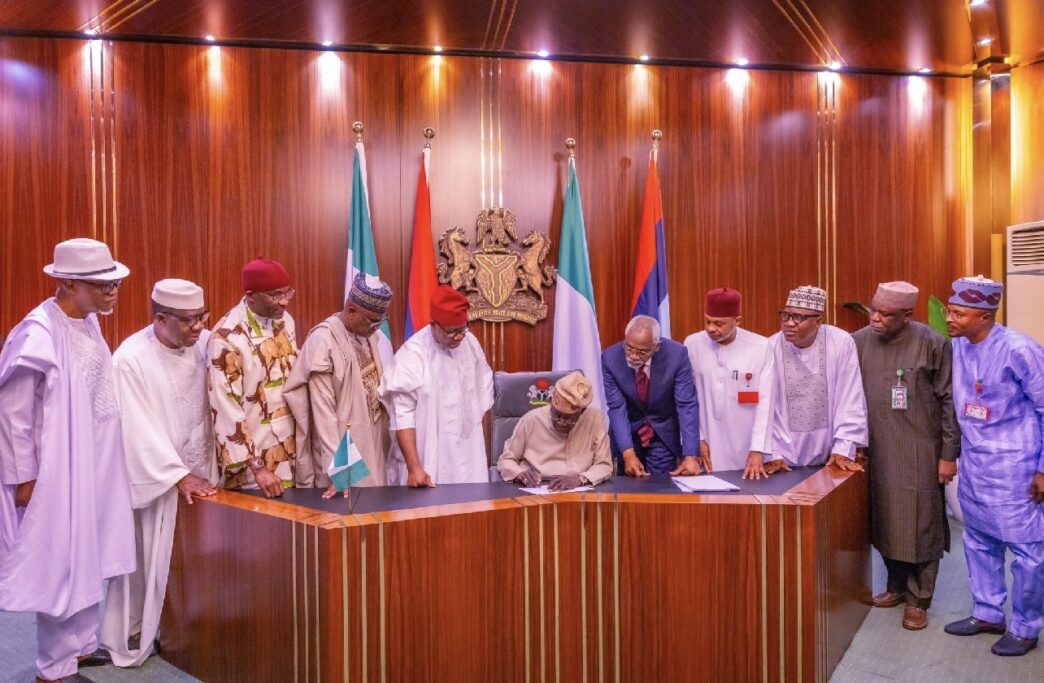
Gatekeepers News reports that the bill was passed by both chambers on Tuesday and assented to at a signing ceremony held at the State House in Abuja around 5:00 pm on Wednesday, attended by principal officers and senior lawmakers.
Speaking after endorsing the legislation, Tinubu praised members of the national assembly for what he described as thorough and constructive deliberations aimed at strengthening democracy and promoting national development. He said meaningful dialogue and careful lawmaking remain central to sustaining political stability and building a stronger nation.
“The essence of democracy is to have very solid brainstorming discussions committed to national development and nation building, the stability of the nation,” he said.
The president stressed that beyond the historic value of the amendment, the core objective is to ensure a smooth and credible electoral process that prevents confusion and protects voters from being disenfranchised. He added that Nigeria must prioritise clarity, transparency, and orderliness in election administration to deepen public trust in the democratic system.
“What is crucial is the fact that you manage the process to the extent there will be no confusion, no disenfranchisement of Nigerians; and we are all going to see democracy flourish,” he said.
Tinubu further argued that technology alone cannot guarantee credible elections, noting that human integrity remains central to the credibility of any electoral system.
“No matter how good a system is, it’s managed by the people, promoted by the people, and result is finalised by the people.
“For final results, you are not going to be talking to the computer. You are going to be talking to human beings who announce the results.”
Addressing the intense public debate surrounding the real-time electronic transmission of election results, the president urged caution, pointing to Nigeria’s broadband capacity and technological limitations. He said the country must realistically assess its digital readiness before relying fully on electronic systems.
“When you look at the crux of various agreements, maybe Nigeria should question our broadband capability. How technically are we today? How technically will we be tomorrow?” he asked.
He explained that Nigeria’s voting process remains largely manual, as voters still physically appear at polling units, collect ballot papers, thumbprint their choices, and cast their votes. The ballots are then sorted and counted manually, with only the numerical outcomes transferred onto official result forms before any form of electronic transmission.
“Essentially, the transmission of that manual result is what we’re looking at, and we need to avoid glitches,” he said, warning against excessive interference in a digital environment prone to disruptions and cyber risks.
Tinubu expressed optimism about Nigeria’s democratic journey, saying the country would continue to strengthen its institutions to achieve long-term stability, growth, and prosperity.
“Nigeria will be there. We will flourish. We will continue to nurture this democracy for the fulfilment of our dream for prosperity and stability of our country,” he added.
The amended law includes key changes to the 2027 election timetable, following an emergency session by the Senate to revise a provision that required a 360-day notice before elections. Lawmakers said the earlier version could have forced the presidential and national assembly elections to fall within the Ramadan fasting period, prompting the adjustment.
The legislation also reflects intense national debates over the electronic transmission of election results. While the Senate had initially rejected mandatory real-time uploads, public pressure led to a reconsideration.
The final amendment allows results to be electronically transmitted to INEC’s result viewing portal, while retaining manual collation as a backup option in cases of technical or network failure. However, the law stops short of enforcing compulsory real-time uploads.
Under the new framework, where electronic transmission is hindered by communication challenges, manually completed result forms will serve as the primary basis for collation and final declaration, ensuring continuity and preventing electoral disruptions.