Three commercial vessels were attacked in the Gulf on Wednesday, with one ship left ablaze, as tensions escalated after Iran threatened shipping through the strategic Strait of Hormuz, a critical route for global oil supplies.
Gatekeepers News reports that the attacks came as Iran intensified pressure on its oil-exporting neighbours amid the ongoing Middle East conflict, raising fears of a major disruption to global energy markets.
Oil prices surged by more than five per cent in early trading, extending volatility that began late last month after the United States and Israel launched strikes on Iran, killing the country’s supreme leader and triggering a broader regional war.
As the conflict entered its 12th day, the Iranian military warned it would target “economic centres and banks” linked to US and Israeli interests, increasing concerns about security along the vital shipping lane.
Leaders of the Group of Seven (G7) were scheduled to hold a virtual meeting later Wednesday to discuss releasing strategic petroleum reserves to stabilise rising oil prices.
Ahead of the talks, the bloc’s energy ministers said they “stand ready to take all necessary measures” in coordination with the International Energy Agency.
Japan signalled it could take the lead in releasing oil reserves as early as Monday without waiting for an IEA decision, Prime Minister Sanae Takaichi said.
Analysts warn that any prolonged closure of the Strait of Hormuz — which carries about 20 per cent of global oil and gas supplies and roughly one-third of fertiliser shipments used in food production — could have devastating consequences for the global economy, particularly in Asia and Europe.
On Tuesday, the United States Department of Defense said US forces had destroyed 16 mine-laying vessels that could have been used to block the strait. However, attacks using drones and missiles continued on Wednesday, with at least three commercial ships struck.
“If for any reason mines were placed, and they are not removed forthwith, the military consequences to Iran will be at a level never seen before,” US President Donald Trump wrote on social media.
Meanwhile, Recep Tayyip Erdogan, president of Turkey, urged the warring parties to negotiate a ceasefire, warning that the conflict could engulf the region.
“This war must be stopped before it becomes bigger and completely engulfs the region in flames,” Erdogan said, describing the Middle East as “once again enveloped in a smell of blood and gunpowder”.
However, Israeli authorities said they had begun a new “wide-scale wave of strikes” across Iran and against Hezbollah targets in Beirut, the capital of Lebanon.
Ships Attacked
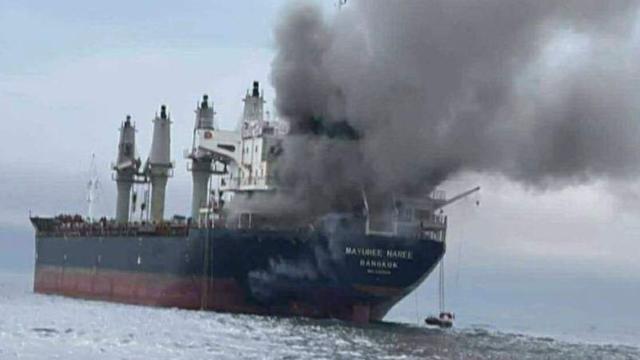
According to the United Kingdom Maritime Trade Operations security centre, the crew of a cargo ship in the Strait of Hormuz north of Oman had to abandon the vessel after an “unidentified projectile” sparked a fire onboard.
Separately, a bulk carrier and a container ship were struck in the Gulf waters off the United Arab Emirates.
Thailand’s navy said the bulk carrier Mayuree Naree was attacked while transiting the Strait of Hormuz.
“Efforts are currently underway to rescue the remaining three crew members,” the navy said, adding that 20 others had already been rescued by the Omani navy.
Authorities said investigations were ongoing to determine the cause of the attack.
Elsewhere, drones reportedly fell near Dubai International Airport, injuring four people, according to the Dubai government.
Trump has suggested the US Navy could escort oil tankers through the strait, though analysts warn that such operations could face constant threats from Iranian missiles and drones.
The Soufan Center think tank said naval escorts may not be enough to ensure safe passage.
“Any escort mission would likely face persistent threats from Iranian missiles and drones, and the security risks alone could make a single transit through the strait more costly than the profit margin on the oil shipment itself,” the group said.
The think tank added that Iran is believed to possess between 2,000 and 6,000 naval mines, which could further complicate efforts to protect shipping routes.
Rising Tensions
The conflict began after US-Israeli strikes on February 28 killed Iran’s supreme leader, Ali Khamenei.
His son, Mojtaba Khamenei, has since been named as his successor, although he has not appeared publicly amid reports he was injured.
“I heard news that Mr. Mojtaba Khamenei had been injured. I have asked some friends who had connections. They told me that, thank God, he is safe and sound,” said Yousef Pezeshkian, the son of Iran’s president.
Iran’s health ministry said more than 1,200 people have been killed and over 10,000 civilians injured in US and Israeli strikes since March 8, although the figures could not be independently verified.
The war has also spread to neighbouring countries, with Iraq and Lebanon — both home to Iran-aligned armed groups — emerging as proxy battlegrounds.
Lebanese authorities said 570 people have been killed and hundreds of thousands displaced following Israeli air strikes and ground operations targeting Hezbollah.
New Israeli strikes were reported Wednesday in Beirut’s southern suburbs, while another attack hit a building in the centre of the capital.