

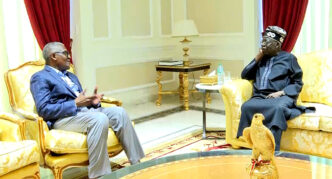

President of the Dangote Group, Aliko Dangote, has expressed concern over growing volatility in the global oil market, warning that the ongoing conflict in the Middle East could worsen economic hardship across Africa if it persists.
Gatekeepers News reports that Dangote spoke after meeting with President Bola Tinubu in Lagos on Monday, noting that although Nigeria is not directly involved in the crisis, the global nature of the oil market means its effects will still be felt.
“It means quite a lot. We don’t have much to do with it, but I know the world is a global village. And it definitely will affect us, unfortunately, but we pray this situation will be sorted out,” he said.
He warned that if the conflict continues, it could further strain African economies already grappling with debt and limited fiscal buffers.
“If it doesn’t de-escalate, we’ll end up paying big prices, like what I said earlier on to CNN. Africa is very busy paying debt, and putting this again on top of us is going to add a lot of hardship on people, on the government, on the people, on everybody, for something that we have no involvement in.”
Dangote emphasised that rising energy costs would affect nearly every sector of the economy, with businesses and households likely to face increasing pressure.
“So if this thing doesn’t de-escalate, it is going to keep going up and up and up, and governments cannot really now go and add salaries also. So people will really feel the hinge — barbers, people who are doing bread, people who have industries, who have to fire their own generator,” he said.
He also pointed to possible adjustments by governments around the world to reduce energy consumption, including remote work arrangements and shorter work weeks.
“I mean, you can see in some countries today what they’ve done; they asked everybody to work from home. I think in Indonesia, they say, ‘No, only go to work four days a week.’ And they will look at the situation.
“If it doesn’t improve, they will ask everybody not to go to work anymore. We will do it like the time of COVID, where people will now go and work from home.
“If they don’t work that day, they won’t eat. So I think really we just need all hands on deck to pray that this thing comes to an end,” he said.
Economic Boost From UK Visit
Dangote also described Tinubu’s recent state visit to the United Kingdom as a positive development for Nigeria’s economic outlook, saying it could open new opportunities for investment and cooperation.
“Well, I think it has opened ways. Today, diplomacy without the economic part of it is not complete. So I believe his own visit will open quite a lot of doors,” he said.
He highlighted a major agreement valued at about £746 million secured during the visit, describing it as significant given the challenges often associated with obtaining such commitments.
“You can see the agreement that was signed for actually improving our infrastructure, especially in the ports and other areas, which is almost £746 million; that’s quite a lot. It’s not that easy dealing with the British, getting this kind of money out of them. They, too, are struggling on their own.”
According to Dangote, the deal reflects renewed global confidence in Nigeria’s economy and leadership.
“But I think this is to show confidence. It’s not about the money. It’s about the confidence in Nigeria.
“So the moment that they do that, there will be other countries that will follow suit… Germany will come, others, so they will line up and start coming now,” he added.
He also encouraged Nigerian investors to take advantage of emerging opportunities, particularly access to international credit facilities created through such agreements.
Impact of Middle East Tensions on Oil Market
Global oil prices have remained under pressure in recent weeks amid escalating tensions in the Middle East, raising fears of supply disruptions and pushing crude prices higher.
The situation has increased the cost of petroleum products in international markets, with countries dependent on imports experiencing immediate effects.
In Nigeria, the impact has been reflected in rising pump prices as refiners and marketers adjust to higher crude costs. The Dangote Refinery and other downstream operators have also implemented price increases in recent weeks in response to global market trends.
This has added to the burden on consumers already facing inflation and rising transportation costs.
Businesses across the country continue to express concern over increasing energy expenses, particularly as many rely on petrol and diesel-powered generators due to ongoing electricity challenges. The higher costs of production are often transferred to consumers, further affecting household spending.