


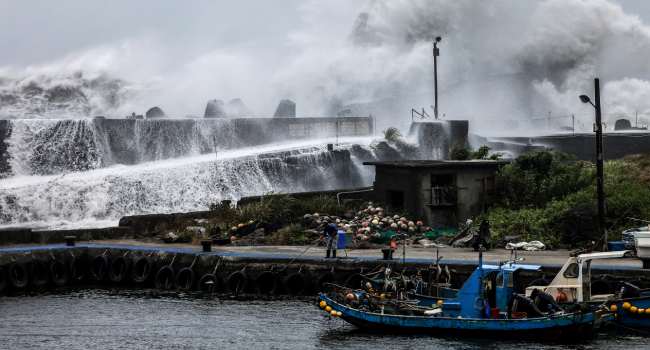
At least 15 people have been killed in landslides triggered by heavy rains in the Philippines, while thousands of residents in Taiwan have been evacuated as Typhoon Bavi approaches the island with destructive winds and torrential rainfall.
Gatekeepers News reports that the powerful storm is forecast to batter northern and eastern Taiwan, as well as Japan’s remote southwestern islands, on Friday and Saturday before making landfall in eastern China over the weekend.
Authorities in the Philippines said two rain-induced landslides on the southern island of Mindanao claimed at least 15 lives, while six others remain missing.
In Taiwan, residents of the northern port city of Keelung rushed to prepare for the storm by stocking up on food, reinforcing homes and businesses, and placing sandbags outside buildings after authorities warned of severe weather.
“They’re saying it’s going to be huge; of course that’s scary, right?” 76-year-old grocery store owner Chang Shih-huo told AFP.
“We’ve stocked up on some instant noodles and bread and stuff like that. Once the wind and rain really start picking up, we’ll have to close the shop.”
Bavi, which struck Guam and the Northern Mariana Islands as a super typhoon earlier this week, has weakened slightly but remains a dangerous system.
Taiwan’s Central Weather Administration (CWA) said the storm was packing sustained winds of 155 kilometres (96 miles) per hour, with gusts reaching about 190 kilometres (118 miles) per hour.
“From tonight through daytime tomorrow will be the period when the typhoon is closest to Taiwan, and its impact will be the most significant,” CWA forecaster Liao Chwen-huey said.
The weather agency said Bavi’s 380-kilometre wind radius makes it the largest typhoon expected to strike Taiwan in more than three decades.
Schools and businesses across northern and eastern Taiwan were closed on Friday, while hundreds of domestic and international flights were cancelled ahead of the storm.
At Keelung’s markets, residents bought fresh food and other essentials, while shop owners secured their premises.
“What you’re seeing now is the most remarkable sight we haven’t seen in 10 years,” restaurant owner Penny Pan said as her husband stacked sandbags outside their business.
“In the past we never used sandbags to prepare for typhoons. But this time they’re forecasting Force 10 gusts, so the captains and fishermen have all been saying we need to be better prepared.”
Thousands evacuated as authorities brace for impact
Forecasters warned that Bavi could dump nearly one metre of rain in parts of Taiwan, increasing the risk of flooding and landslides, with the strongest winds expected on Saturday.
Authorities also urged residents to stay away from coastal areas as waves of up to nine metres (30 feet) were forecast.
Nearly 9,000 people have been evacuated, more than half of them from the mountainous eastern county of Hualien, where officials are closely monitoring two barrier dams.
Taiwanese President Lai Ching-te urged residents in high-risk areas to remain on “high alert,” while more than 28,000 military personnel, along with emergency equipment and vehicles, were placed on standby for rescue operations.
“We’re worried,” Samuel Fu, who works at a noodle shop in New Taipei City’s coastal district of Bali, told AFP.
“This is the first time we’ve experienced such a big typhoon… since we opened the shop.”
Japan, China prepare for storm
Japan’s remote Sakashima Islands also braced for the approaching typhoon, with schools and some offices closed as forecasters warned of high waves, heavy rain and possible landslides.
Dozens of flights were cancelled, disrupting travel for thousands of passengers.
“We’ve covered objects with nets so that they won’t fly away… the storm is getting gradually stronger right now,” hotel worker Masaru Nakamura said from Miyako Island.
In Okinawa, tourism operators said the storm had already affected business.
“We were originally fully reserved this weekend, but bookings were all cancelled, so it’s painful,” water sports operator Koki Ohama said.
After passing near Taiwan, Bavi is expected to make landfall in eastern China, where severe storms earlier this week killed at least 39 people, caused rivers to overflow and triggered the collapse of a reservoir dam.
Scientists have warned that rising ocean temperatures are helping tropical storms become more intense by providing additional heat and moisture. The return of the El Niño climate pattern this year is also expected to contribute to stronger weather systems across the Pacific.