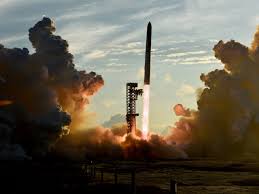
Elon Musk’s Starship megarocket reached orbit for the first time on Monday after launching from Texas, marking a major milestone for SpaceX’s ambitions to send missions to the Moon and Mars.
Gatekeepers News reports that the black-and-silver rocket, which stands more than 120 metres (131 yards) tall, lifted off amid a thick cloud of smoke during its ambitious 14th test flight.
About 26 minutes after launch, the spacecraft’s upper stage separated from the Super Heavy booster and reached orbit.
The experimental rocket was expected to undergo a test lasting approximately 10 hours, during which its upper stage would orbit Earth several times and deploy 26 next-generation Starlink satellites.
As a precaution, the spacecraft was initially launched on a suborbital trajectory. Following further deliberations, the launch team decided to carry out a second engine burn to place it into orbit.
“Starship is orbital,” a member of the launch team announced, prompting cheers from the team.
The deployment of the satellites began minutes later.
Previous Starship test flights, which followed less demanding suborbital trajectories, had ended in dramatic explosions, including incidents over the Caribbean.
Advancing SpaceX’s Ambitions
The latest test flight, conducted three months after SpaceX’s high-profile stock market debut, is aimed at accelerating the development of what is described as the largest and most powerful rocket ever designed.
After several years of development and testing in Texas, SpaceX began flying Starship in its full configuration in 2023. Since then, the company has introduced numerous modifications following a series of successful and unsuccessful test flights.
Despite the progress, significant technical challenges remain before Starship can undertake commercial missions, deploy data centres in orbit or travel to the Moon and Mars.
Musk has said he wants the spacecraft to be fully reusable, a capability that could support the company’s long-term space exploration plans.
In-Orbit Refuelling Tests Ahead
With the latest flight, SpaceX hopes to usher in what it describes as an “exciting new phase” of development, including tests of refuelling the spacecraft in orbit.
Kathleen Curlee, a senior analyst at Georgetown University’s Center for Security and Emerging Technology, explained before the launch that the second engine burn required to reach orbit was particularly challenging.
The manoeuvre is “the hardest part,” requiring “more forces and more complex calculations,” she said.
To reach the required altitude and speed, “the rocket has to do different things when it’s experiencing different levels of gravity,” Curlee told AFP.
The successful orbital milestone marks a step forward in SpaceX’s efforts to develop Starship for future space missions, although substantial engineering challenges remain.