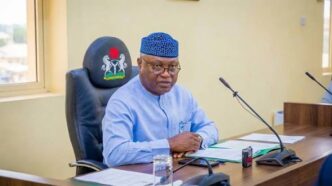
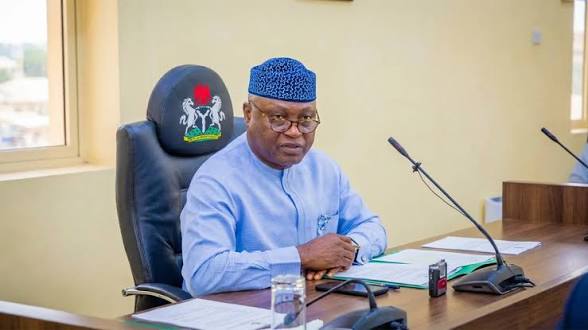
Ekiti State Governor, Biodun Oyebanji, has highlighted the progress recorded by the state in the 30 years since its creation, saying the milestone provides an opportunity to reflect on the past and chart a new course for the future.
Gatekeepers News reports that Oyebanji spoke in a statewide broadcast on Thursday to commemorate the 30th anniversary of Ekiti State, which was created on October 1, 1996, by the administration of the late military Head of State, Gen. Sani Abacha.
The governor acknowledged that the state had faced challenges over the past three decades but said its people had reasons to celebrate the progress recorded across various sectors.
He noted that despite being among the last states created in Nigeria and receiving one of the lowest allocations from the Federation Account, Ekiti had recorded notable achievements in human development.
“Ekiti leads its contemporary and many before it, including far richer states, in critical matrices of human development,” he said.
The state was created alongside Bayelsa, Ebonyi, Gombe, Nasarawa and Zamfara states, increasing the number of states in Nigeria from 30 to 36.
Oyebanji said the creation of Ekiti followed years of advocacy by traditional rulers, legal practitioners, politicians, senior bureaucrats, business leaders and community leaders under the Committee for the Creation of Ekiti State.
He said many people had doubted whether Ekiti would emerge as a state because it faced “more formidable contenders from the Southwest geopolitical zone”, but attributed its eventual creation to God.
The governor said the creation of the state, coming 120 years after the Kiriji War, represented the culmination of a long struggle by Ekiti forebears.
He congratulated Ekiti indigenes and residents, including people from other parts of the world who had made the state their home.
Oyebanji also paid tribute to members of the Committee for the Creation of Ekiti State, led by its chairman, Chief Oladeji Fasuan, as well as legal icon Aare Afe Babalola, the Ewi of Ado Ekiti, Oba Adeyemo Adejugbe, and other traditional rulers involved in the struggle.
He also honoured the memory of other heroes and heroines of the state-creation movement who had died.
The governor, who served as secretary of the Committee for the Creation of Ekiti State, described his emergence as governor 30 years later as “very humbling”.
Oyebanji equally acknowledged the contributions of former governors of the state, including Col. Inua Bawa, Navy Capt. Atanda Yusuf, Otunba Niyi Adebayo, Chief Ayo Fayose, Chief Segun Oni and Dr Kayode Fayemi.
He also paid tribute to those who served as heads of government during interregnums, including Chief Friday Aderemi, Brig.-Gen. Tunji Olurin, Hon. Tope Ademiluyi and Hon. Tunji Odeyemi, as well as former deputy governors and heads of the legislature and judiciary.
30-year transformation agenda
Oyebanji said his administration remained committed to the ideals that inspired the creation of Ekiti State.
“The vision of the founding fathers was to have a State where Ekiti people can utilize their God given natural and human resources in the most efficient, effective and inclusive manner, for the prosperity of our people,” he said.
He said the founding fathers had envisioned “an industrialized Ekiti, where private sector capital is at the centre of the economic nervous system of the state and where enterprise and productivity are the pillars of prosperity.”
The governor announced that the 30th anniversary would serve as the launchpad for a 30-year Transformation Agenda aimed at repositioning the state over the next three decades.
Under the agenda, the government plans to develop Ekiti as a leading centre for agricultural production and agro-processing, innovation and technology, education, research and skills development, tourism, culture and the creative economy, youth entrepreneurship and sustainable development.
The administration will also hold a conversation with Ekiti youths on October 7, 2026, at the Obafemi Awolowo Civic and Convention Centre in Ado Ekiti.
Oyebanji said the engagement would provide an opportunity to “remember with gratitude, to assess the present with honesty, and to approach the future with confidence and determination.”
He said the government would focus on ensuring that infrastructure developed over the past three decades translates into economic growth, quality employment, productivity and improved living standards.
“Our agenda is therefore to work aggressively to ensure that the socio-economic infrastructures we have built in these thirty years lead to real economic growth that produces quality employment, crystallize productivity, support enterprise and enhance quality of life,” he said.
The governor cited the ongoing multi-billion-naira Ekiti Knowledge Zone (EKZ) as a key project in the state’s technology and economic development plans.
“For example, the ongoing multi-billion naira Ekiti Knowledge Zone (EKZ) project is a technological park and economic ecosystem to support the innovative and creative ingenuity of our young population,” he said.
He said the long-term goal was to transform Ekiti from a state largely associated with the civil service into a technology and commercial hub.
“It is our dream that in another three decades, the tag of Ekiti as a ‘civil service’ state will have yielded to Ekiti as a Tech Hub in Nigeria’ and a major commercial centre for international trade and commerce,” Oyebanji said.
“This is our promise, and we are resolutely committed to it. The Special Agric Processing Zone (SAPZ) will also take off soon. These two projects, upon completion, will transform the economic outlook of the State and drive our government’s Shared Prosperity Agenda.”
Oyebanji concluded by urging residents to participate in the January 16, 2027 presidential election and vote for President Bola Ahmed Tinubu, citing what he described as the support and favourable treatment Ekiti had received from the president since 2023.
The governor’s call for support for Tinubu is consistent with his previously stated support for the president’s 2027 re-election bid.
The anniversary speech and the 30-year transformation agenda were also published by the Ekiti State Government.