

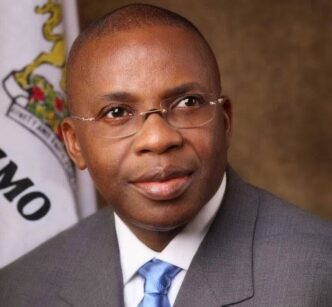
Former Governor of Imo State, Dr Ikedi Godson Ohakim, has broken his 15-year silence on the controversial circumstances surrounding the termination of his administration in 2011, recounting what he described as a coordinated political conspiracy, public humiliation, blackmail and a deliberate campaign that ultimately cost him his government.
Ohakim made the revelations on Saturday, October 31, 2026, while delivering the keynote address at the 2026 Synod of the Anglican Communion, Diocese of Isi-Mbano, held at St. Paul’s Church, Umuduru, Imo State.
In an emotionally charged and historically significant address titled “The Imo Charter of Equity: Anatomy of a Broken Covenant, the Moral Wound and a Framework for Restorative Justice,” the former governor offered an extensive account of the political events that culminated in the 2011 governorship election crisis, linking his personal experience to what he described as the unresolved injustice at the heart of the present debate over power rotation among Imo State’s three senatorial zones.
He described the events of 2011 as the first civilian-led military coup in Imo State, orchestrated by influential politicians of Owerri extraction, with the support and complicity of the Federal Government in Abuja. He argued that the political crisis went beyond an ordinary contest for power and represented a deliberate effort to undermine the established understanding of power rotation in the state.
But beyond the political contest, Ohakim’s most emotional revelations concerned the personal humiliation he and his family endured.
Revisiting the controversy surrounding an incident involving a Catholic priest, Ohakim explained how the narrative was amplified and weaponised against his administration, eventually becoming a political instrument for mobilising opposition against him. He recalled how his name was turned into a humiliating public chant, “Onye Kuru Fada Ihe,” repeated in motor parks and churches, while his children suffered public ridicule and could hardly move freely around Owerri without embarrassment.
“My name, which I had spent a lifetime building with honour, was turned into a song,” he recalled.
He described the experience as dehumanisation and character assassination, insisting that the campaign against him went far beyond legitimate political opposition.
Ohakim disclosed that, despite having access to the full security apparatus of the state and receiving intelligence reports identifying those involved in the unfolding political crisis, he resisted pressure from aggrieved youths who wanted him to authorise retaliatory action.
He said he was confronted with two choices: deploy state power to suppress his opponents and risk plunging Imo into violence, or allow the political process to take its course at the expense of his personal ambition and reputation.
He chose the latter.
“I chose peace over blood. I chose Imo over myself,” he declared.
In one of the most poignant moments of his address, the former governor recounted how he knelt alone in his room, weeping and praying to God for vindication. He subsequently narrated how, years later, at an Adoration Ground in Enugu, the same Reverend Father whose name had featured prominently in the controversy publicly apologised to him before a large congregation, acknowledging that his own investigation had established Ohakim’s innocence.
The former governor said the experience brought him profound emotional relief, adding that he had forgiven those who participated in the campaign against him. However, he made an important distinction: forgiveness does not erase history, nor does it eliminate the need for justice.
Ohakim also used the Synod to reconstruct the historical evolution of the Imo Charter of Equity, arguing that power rotation among the three senatorial zones was neither a new political invention nor a document conceived in 2023.
He traced its origins to 1989, when political leaders led by the late Chief Sam Mbakwe agreed that Okigwe Zone would not contest the governorship during the military-supervised transition because the zone had produced the last elected civilian governor.
That understanding paved the way for Owerri Zone to produce the governor in 1991 through Chief Evan Enwerem.
He further traced the arrangement to 1998, when political leaders again agreed to concede the governorship to Orlu Zone, resulting in the emergence of Chief Achike Udenwa, who subsequently secured a second term in 2003.
According to Ohakim, the understanding was that Orlu would complete eight years before power moved to Okigwe in 2007.
He argued that his emergence as governor in 2007 represented the fulfilment of that historical understanding.
However, he maintained that the arrangement was disrupted in 2011 when he sought a second term, which he considered necessary to complete Okigwe Zone’s eight-year entitlement.
He recalled that on April 26, 2011, he polled 310,106 votes against Rochas Okorocha’s 305,263 votes, before the election was declared inconclusive and a supplementary election scheduled for May 6, 2011.
Ohakim argued that what followed was not simply a conventional electoral contest but a deliberate political conspiracy that undermined the established understanding of power rotation.
He also recalled warnings that the incoming Orlu administration would serve only one term before handing over to Owerri Zone, a promise he said he cautioned against because of the difficulty of enforcing such an arrangement.
According to him, the subsequent eight years of Orlu leadership demonstrated the consequences of abandoning the original understanding.
A substantial portion of the address was devoted to the 2023 Imo Charter of Equity document produced by the Imo Council of Elders. While acknowledging that the document was well-intentioned, Ohakim questioned its historical framing, consultation process, inclusiveness and capacity to command the confidence of all three senatorial zones.
He identified two fundamental shortcomings. First, he argued that presenting the Charter as an entirely new initiative ignored its historical foundations dating back to 1989 and the political understandings that guided the allocation of the governorship between 1991 and 2007.
Second, he questioned the decision to identify Owerri Zone as the preferred beneficiary after Governor Hope Uzodimma’s tenure, arguing that such a preemptive designation complicated the process of securing genuine consensus among the three zones.
He also raised questions about the composition and activities of the committee responsible for the document, including its reported meeting history and the absence of its secretary at the meeting that produced its report.
For Ohakim, the fundamental problem is not the principle of power rotation but the absence of a sufficiently inclusive and credible process capable of securing the confidence of all stakeholders.
He warned that a Charter without justice, transparency and broad-based acceptance could become a source of division rather than an instrument of political stability. He described the present situation as the Imo Triple Dilemma: a Charter that has become a divisive political instrument, a potential threat to peace and unity, and an avenue for political manipulation.
Perhaps the most politically consequential aspect of the address was Ohakim’s call for Okigwe Zone to be given four years in 2027 to complete what he considers its truncated eight-year governorship entitlement.
He argued that Okigwe’s claim should not be viewed merely as another contest for political advantage but as a question of historical restitution and restorative justice.
According to him, the zone suffered a political injustice in 2011 when its son, who had emerged through the electoral process in 2007, was prevented from completing the expected eight-year tenure.
He maintained that other qualified Okigwe candidates could have succeeded him in 2011 if there had been legitimate reasons not to support his second-term ambition. He also argued that the political opportunities available in 2015 and 2019 to restore the original power-sharing understanding were missed.
With 2027 approaching, he believes the state has another opportunity to address the historical grievance.
“Four years to complete a truncated term, four years to wipe the tears of a people whose son carried the cross of shame for the sake of peace, should be considered reasonable,” he declared.
He insisted that allowing Okigwe Zone four years would provide an opportunity to heal the political wound of 2011 and create the foundation for a more credible and sustainable Charter of Equity.
In another significant revelation, Ohakim disclosed that he personally made efforts in 2011 to ensure that Owerri Zone succeeded him in 2015, maintaining that he visited influential political leaders, sometimes at night, to persuade them to preserve the established understanding.
He recalled that one of the greatest disappointments of his political life was discovering that a respected leader whom he had personally approached to support the arrangement subsequently led a delegation that presented Rochas Okorocha to the late Dim Chukwuemeka Odumegwu-Ojukwu for endorsement in Enugu.
Ohakim argued that had the original understanding been respected in 2011, Owerri Zone would have assumed the governorship in 2015 and completed its eight-year tenure in 2023.
He maintained that the current political disagreements over which zone should produce the next governor might have been avoided.
“We destroyed the bridge, and now we are arguing about how to cross the river,” he lamented.
In a deeply emotional conclusion, Ohakim spoke about his personal circumstances, recalling the humiliation he endured and the sacrifices he said he made to prevent violence in the state.
He disclosed that his greatest concern was never simply losing political power but the consequences of the events for his family, particularly his children, who struggled with the public humiliation surrounding their father’s name.
He recalled a particularly painful moment when his last daughter asked him: “Daddy, did you really do it?”
The former governor said the experience remained deeply painful but insisted that his appearance before the Synod was not motivated by a desire to reclaim political office or settle personal scores.
“I did not come to this Synod to reclaim a crown. I came to beg for healing, for myself, for Okigwe, and for Imo as a whole,” he declared.
He urged Imo leaders to acknowledge the historical grievances of Okigwe Zone and approach the 2027 governorship question with a genuine commitment to fairness, reconciliation and justice.
He concluded that the state could not build a sustainable Charter of Equity on unresolved grievances.
“Logically, we cannot build equity on iniquity. We cannot preach peace while we bury justice. If we must move forward, we must first look backward, not in vengeance, but in truth.”
Ohakim’s intervention introduces a significant historical and moral dimension to the ongoing debate over the 2027 Imo governorship. By connecting the origins of power rotation to the events of 1989, 1991, 1998, 2003 and 2007, and subsequently revisiting the political crisis of 2011, he has challenged political leaders and stakeholders to examine the historical foundations of the present Charter of Equity debate.
His central argument is that equity cannot be separated from justice, and that a political arrangement intended to bind the three senatorial zones must emerge from genuine consultation, mutual understanding and consensus.
He is also calling for a distinction between merely allocating political power and addressing historical grievances that continue to shape relationships among the zones.
For the former governor, the 2027 governorship presents an opportunity not simply to determine which zone produces the next governor, but to correct what he considers a historical imbalance and restore confidence in an arrangement that once provided a framework for political understanding in Imo State.
As the debate over the Imo Charter of Equity intensifies, Ohakim’s address will undoubtedly bring renewed attention to the events of 2011, the circumstances surrounding his departure from office, and the unresolved question of how the state’s three senatorial zones should share political power.
Fifteen years after the events that ended his administration, Ohakim has placed his personal account, his historical interpretation and his proposal for restorative justice before the conscience of Imo State.
Gatekeepers News is not liable for opinions expressed in this article; they’re strictly the writer’s.