

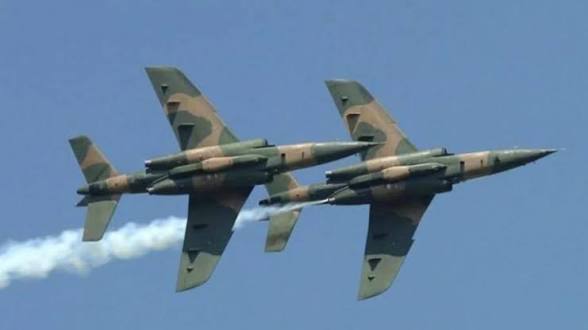
At least 40 fighters of the Islamic State West Africa Province (ISWAP) have reportedly been killed in air strikes conducted by the Nigerian military under Operation Hadin Kai around Wulgo–Momaduru in Ngala Local Government Area of Borno State.
Gatekeepers News reports that according to Zagazola Makama, a counter-insurgency publication covering the Lake Chad region, the operation was carried out in the early hours of Tuesday, November 10, following intelligence surveillance that identified a large gathering of suspected terrorists about 1.5 kilometres north-west of Wulgo–Momaduru.
The publication, quoting security sources, said an initial assessment revealed a significant concentration of fighters in the area, prompting the military to launch an air operation to disrupt the gathering and neutralise the threat.
It reported that the first precision strike targeted an identified position, with a post-strike assessment indicating that about 30 fighters were killed and a motorcycle destroyed.
Multiple secondary explosions were also reportedly observed following the strike, suggesting that additional explosive materials or other combustible items may have been destroyed.
“As the operation progressed, surviving terrorists were observed fleeing the initial impact area in an apparent attempt to escape the assault. Some of the fleeing fighters subsequently sought cover beneath trees in the surrounding area,” the publication said.
Zagazola Makama added that military surveillance teams continued tracking the fleeing fighters, leading to the identification of another concentration of ISWAP members.
According to the report, a second precision strike was launched against the location after the necessary authorisation was obtained.
A subsequent battle damage assessment reportedly confirmed that another 10 fighters had been killed, bringing the estimated death toll from the two strikes to 40.
The publication described the coordinated operation as a significant setback for ISWAP, particularly because of the number of fighters reportedly assembled in the area.
“The operation also illustrated the importance of sustained intelligence gathering, aerial surveillance and precision targeting in disrupting terrorist concentrations before they can reorganise, reinforce their positions or launch attacks against military formations and civilian communities,” it reported.
It further noted that the Wulgo–Momaduru axis remained strategically important to military operations in the Lake Chad region, where insurgent groups have continued to exploit difficult terrain and remote settlements to sustain their activities.
The reported casualty figures have been attributed to the security sources cited by Zagazola Makama.