

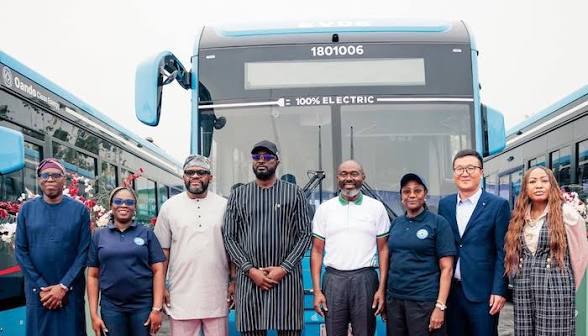
Oando Clean Energy Limited (OCEL), the renewable energy subsidiary of Oando Energy Resources, has commenced the full deployment of electric buses in Lagos following the successful completion of a pilot programme that saved approximately 216,000 litres of diesel.
Gatekeepers News reports that the expansion, carried out in partnership with the Lagos Metropolitan Area Transport Authority (LAMATA), marks the transition of the company’s electric mobility initiative from the proof-of-concept stage to full implementation in collaboration with the Lagos State Government.
During the pilot phase, the two electric buses transported about 788,000 passengers, covered 433,000 kilometres and avoided the consumption of approximately 216,000 litres of diesel, while recording almost zero downtime.
In the first nine months of 2026 alone, the service recorded more than 212,000 passenger journeys, with an average capacity utilisation of 73 per cent.
Speaking at the launch ceremony, the Lagos State Commissioner for Transportation, Oluwaseun Osiyemi, said the initiative supports the state’s ambition to achieve net-zero emissions by 2050.
“This is more than the introduction of new buses. It is a practical demonstration of our commitment to reducing transportation-related emissions, improving air quality, and building a public transport system that serves both present and future generations,” he said.
The Managing Director of LAMATA, Abimbola Akinajo, welcomed the expansion, citing more than two years of operational data gathered during the pilot programme.
She emphasised that the initiative’s success should be measured by service quality and its impact on commuters rather than the number of electric buses introduced.
“Ultimately, the success of this initiative will not be measured by the number of electric buses introduced, but by the quality of service they provide and the positive impact they make on the community experience of Lagos residents,” Akinajo said.
President and Chief Executive Officer of Oando Clean Energy Limited, Ademola Ogunbanjo, said the company had acquired the operational experience and data needed to move from the pilot stage to full-scale deployment.
“We have done the work, gathered the data, and built the practical experience required to move confidently from proof-of-concept to deployment. Our objective is not merely to encourage Nigerians to adopt electric vehicles, but to demonstrate through practical experience that electric mobility can work efficiently, reliably, and sustainably in our environment,” he said.
Ogunbanjo disclosed that OCEL was developing a comprehensive electric mobility ecosystem covering charging infrastructure, after-sales services, technical training, spare parts supply and local vehicle assembly, adding that the company had secured the necessary licence for vehicle assembly.
“This is how we move beyond importing electric vehicles to building an industry,” he said, adding, “If it can work in Lagos, it can work anywhere in Nigeria.”
Representing the Managing Director and Chief Executive Officer of the Bank of Industry, Olasupo Olusi, the bank’s Divisional Head of Infrastructure Finance, Ibitoru Olutoyin Ubosi, said the investment aligned with the institution’s mandate to stimulate economic growth.
“Transportation connects people to jobs, to businesses, to markets, and to opportunities. The quality of our transportation systems therefore has a direct bearing on our economic competitiveness and the well-being of our citizens. Investing in cleaner, reliable mass transit is an investment in both,” Ubosi said.
Country Account Manager of Yutong West Africa, Damian Li, described the deployment as an important step towards expanding environmentally friendly public transportation in Lagos and other parts of Nigeria.
“Electric buses are already running in the UK, South America, Europe and the Middle East. Now they are right here in Lagos. This is much more than handing over buses. It is the start of a green public transport future for Lagos and Nigeria,” Li said.
He added that Yutong would provide support in charging infrastructure, after-sales services, mechanic training and spare parts supply.
The electric buses are equipped with air conditioning, onboard Wi-Fi, 360-degree cameras, wheelchair accessibility and priority seating for elderly passengers.
Each Yutong-built bus has a carrying capacity of 79 passengers, comprising 39 seated and 40 standing passengers.
Beyond providing transportation services, the initiative is expected to promote awareness of clean mobility among Lagos residents by demonstrating the potential of modern, reliable and environmentally friendly public transportation.
The newly deployed buses are expected to commence commercial operations in the fourth quarter of 2026, with LAMATA managing their operations on behalf of the Lagos State Government.