

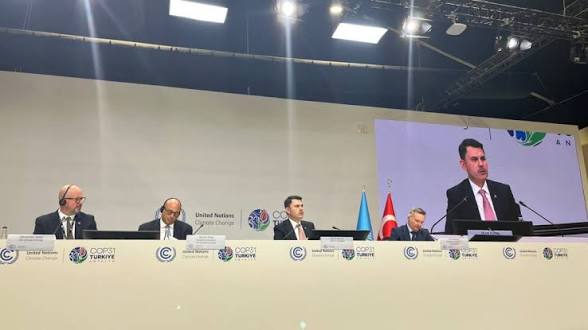
A revised draft decision at the UN climate conference (COP31) in Antalya, Turkey, has dropped a proposed $120 billion annual adaptation finance target for developing countries and removed explicit references to transitioning away from fossil fuels.
Gatekeepers News reports that the latest draft, released on Thursday, retains a broader commitment to at least triple adaptation finance by 2035 but no longer specifies that funding should reach $120 billion annually.
It also proposes further work to establish a baseline for measuring the increase and develop an implementation pathway.
The changes come amid continued calls by developing countries for increased, predictable and accessible climate finance to help vulnerable communities prepare for and respond to the effects of climate change.
An earlier version of the COP31 presidency-led cover decision, released on Monday, had proposed raising annual adaptation finance for developing countries to at least $120 billion by 2035.
The figure was based on tripling the $40 billion annual adaptation finance level associated with the Glasgow Climate Pact, adopted at COP26 in 2021.
Under the pact, developed countries agreed to double their collective provision of adaptation finance from 2019 levels to $40 billion annually by 2025.
However, the latest draft removes both the $120 billion target and the $40 billion figure as the explicit baseline for the proposed increase.
Instead, it retains the commitment to at least triple adaptation finance by 2035 while proposing further work to determine an appropriate baseline and establish an implementation pathway, including milestones and mechanisms to track progress.
The draft also proposes an “Antalya-to-Addis Ababa Roadmap on Adaptation and Resilience Finance” to identify predictable and scaled-up public funding sources for adaptation and loss and damage.
The proposed roadmap would also explore innovative financing sources and mechanisms to improve access to climate funding, with its findings expected to be considered at COP32 in 2027.
Adaptation finance refers to funding that helps countries and communities prepare for and manage climate change impacts, including floods, droughts, extreme heat, rising sea levels and coastal erosion.
Such funding supports initiatives such as early-warning systems, climate-resilient infrastructure, water management and climate-smart agriculture.
The draft acknowledges that developing countries could require approximately $305 billion annually for adaptation by 2035.
However, international public adaptation finance was estimated at between $28.2 billion and $31.7 billion in 2024, meaning even a tripling of current funding would cover only a fraction of projected needs.
Developing countries have consistently demanded that adaptation finance be increased and made more predictable and accessible, with preference for public, grant-based and highly concessional funding rather than loans that could worsen debt burdens.
Antwi-Boasiako Amoah, chair of the African Group of Negotiators (AGN) on climate change, said successful implementation would depend on adequate financial and technical support.
“Implementation needs means of implementation. Parties must speak to the language of delivery,” he said.
Amoah said Africa also needed a transition that reflected the continent’s circumstances, stressing that adaptation remained critical as global temperatures continued to rise beyond the 1.5°C threshold.
“We don’t know where we are now. A lot of things can change. We are hopeful that we would be able to get a good outcome,” he said.
On the proposed $120 billion annual target, he described the figure as a useful starting point but maintained that establishing the right baseline was important.
“$120 billion will be a good start. We want to get the baseline and foundation right,” he said.
He also warned against attempts to renegotiate the Paris Agreement, saying Africa would reject any such move.
Draft removes explicit reference to transition away from fossil fuels
The revised text also removes language contained in the earlier draft that called for an accelerated transition away from fossil fuels.
The initial proposal had advocated a “just, orderly and equitable” transition away from fossil fuels, alongside measures to accelerate electrification and increase electricity’s share of final energy consumption to 35 percent by 2035.
However, the latest version retains broader commitments to deep, rapid and sustained emissions reductions and international cooperation to increase electricity’s share of energy consumption.
It no longer makes explicit reference to fossil fuels.
Murat Kurum, COP31 president, defended the approach, saying the negotiations were not intended to reopen agreements reached at previous climate conferences.
“We are not here to rediscuss issues from COP28,” he said.
He added that electrification was part of the energy transition, stressing that the focus remained on keeping the 1.5°C temperature goal within reach.
Chris Bowen, Australia’s climate change and energy minister and president of the COP31 negotiations, said parties would continue discussions in areas where common ground could be established.
“We are happy to receive feedback,” Bowen said, adding that the presidency remained focused on implementation.
However, Mohamed Adow, director of Power Shift Africa, criticised the revised draft, arguing that it weakened the conference’s potential outcome.
“If this version of the text remains, it will be a ghost COP. COP31 has been muzzled on the most important threat causing the climate crisis,” Adow said.
“This new text has gone backwards from the one released earlier in the week.”
Rukiya Khamis, East Africa programme manager at 350.org, also criticised the removal of a specific baseline and funding target, warning that the revised proposal could delay agreement on how adaptation finance would be increased.
The revised document remains under negotiation and has not yet been adopted as an official outcome of COP31.
With only 24 hours remaining before the conference is scheduled to close on Friday, parties are expected to continue negotiations, with the talks potentially extending beyond the deadline, as has happened at previous climate conferences.