


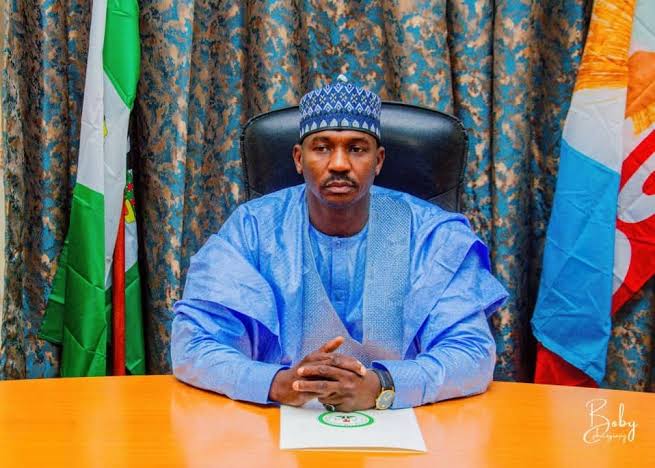
Governor Ahmed Aliyu of Sokoto State has fundamentally proven that true leadership is not measured by rhetoric, but by bold, clear, and purposeful decisions that profoundly transform the lives of the people, whose welfare and security remain the ultimate purpose of government. The governor has amply demonstrated this through the impactful policies he champions and the various projects that he pursues with diligence. From his first day in office, he has governed with this keen understanding. Sworn in on 29 May 2023, he rejected the usual political theatrics and instead laid out a clear developmental path anchored on his 9-Point SMART Agenda. In a state that had endured eight years of stalled public services and weak governance, this signaled a decisive shift toward disciplined, people-centred leadership.
From the first week of his administration, Governor Aliyu set a tone of seriousness and focus. His early actions were directed at restoring public confidence in the government’s capacity to deliver essential services. He restored power supply to public waterworks and ordered the rehabilitation of abandoned schools, hospitals, and road projects, including those inherited from the Senator Aliyu Wamakko administration that his predecessor had refused to complete. This approach, analysts note, underscored his commitment to continuity and responsible use of public funds, which must never be sacrificed on the altar of politics.
In building the new Sokoto State, Governor Aliyu has in the last two years consistently used the instrumentality of the annual budget as a strategic tool for the economic transformation of the state, directing resources with precision to priority sectors and discipline. His sectoral allocations reflect clear priorities- security, education, healthcare, infrastructure, and social welfare. For instance by dedicating a historic lion share to education and expanding funding for health facilities, the construction of roads, housing, and settling of pension backlogs, he has ensured that every naira earned by the state government works for the people. What stands out is his ability to deliver these amazing results without borrowing from the commercial banks, demonstrating fiscal prudence, transparency, and unparalleled commitment to the sustainable development of Sokoto State the Seat of the Caliphate. Governor Aliyu’s budgets have certainly become more than routine financial documents, but the blueprint for the new Sokoto State that he is building.
Education has emerged as one of the boldest areas of his reforms. Allocating 25% of the 2025 budget to the sector signaled his belief that Sokoto State’s progress rests on a strong human capital base. Schools;primary,secondary and tertiary have been renovated, new classrooms constructed, learning materials provided, and teacher welfare drastically improved. When dozens of Sokoto students were stranded during the Sudan crisis, he immediately arranged their relocation to Nigerian universities to continue medical studies, an act that shows responsive governance and empathy. These efforts have earned him national recognition, and positioned Sokoto as a state on an upward educational trajectory.
The healthcare system has also witnessed significant improvement. General hospitals and Primary Health Care centres have been rehabilitated and equipped, while hundreds of nurses, midwives, and health workers have been recruited and deployed across the state. Maternal and child health services have also been expanded, data systems digitized, and community sensitization strengthened through traditional and religious leaders. He has also addressed the issue of manpower by training medical professionals who at the completion of their courses must serve in rural communities for two years.Clearly Governor Aliyu is building a health system that is designed to endure and the icing on the cake is that he is not resting on his oars.
Security, a critical challenge across the North-West, has continued to receive a coordinated response from the state government. The establishment of the Sokoto Community Guard Corps, according to security briefings was designed to support conventional agencies with intelligence gathering and community-level surveillance. Investments in rugged patrol vehicles, motorcycles, and operational bases have improved response times, particularly in rural areas. The governor’s approach of combining state intervention, federal collaboration, and community participation reflects a growing consensus that security is a shared responsibility. Hopefully the intervention of the United States working with the Nigerian government will help defeat the insurgents.
Agriculture, long the heartbeat of Sokoto’s economy as an agrarian state, has gained fresh momentum under Governor Aliyu’s leadership. Mechanised farming is expanding through the distribution of tractors, implements, and new service centres. Irrigation schemes covering thousands of hectares, supporting year-round farming, are being implemented. Key agricultural institutions have been revived, input distribution strengthened, and climate-smart practices introduced. In addition, modern onion storage facilities are being developed to reduce post-harvest losses, stabilise prices, and strengthen Sokoto’s position as a major onion-producing hub. To Governor Aliyu, agriculture is more than a basic livelihood; it is a strategic engine for jobs, food security, industrial growth, and future export opportunities.
Under Governor Aliyu’s leadership, Sokoto State has continued to witness an aggressive expansion in public infrastructure. For example the Bera Community Road, long abandoned, has been fully reconstructed, restoring mobility and improving economic activity. Other township roads, such as the Mabera–Sarkin Adar Road and the Runjin Sambo–Gawon Nama dual carriageway, have been completed and have eased urban movement. Housing delivery is progressing steadily: more than 1,500 units have so far been completed, with about 500 more nearing completion. The government also acquired the federal government housing estate, adding additional affordable homes for civil servants and low-income families. Solar-powered streetlights now brighten major roads across the state.
In the water sector, several inherited and new water supply projects have been completed across the state at a cost running into several billions of naira. Water schemes have equally been revived in all 23 local government areas, with ongoing investments aimed at rehabilitating treatment plants, transmission lines, and distribution networks. The administration is focused on completing all inherited water projects to deliver an estimated 40 million litres of potable water daily to residents upon completion of all inherited projects. Several other critical road projects are also currently under construction.
The revival of the state’s 30MW Independent Power Plant(IPP) stands as a major breakthrough in the governor’s determination to industrialize the state. Its output when evacuated will definitely stabilize electricity supply for critical institutions, support small businesses, and reduce reliance on generators by businesses and individuals. This is a clear demonstration of a leader with both the appetite and the discipline to modernise Sokoto State’s infrastructure by powering it.
One of the governor’s most significant acts was clearing the massive backlogs of gratuity owed to retired civil servants and his humane treatment of vulnerable people. He has cleared the long-standing backlog of gratuity payments by releasing N5 billion and established a monthly payment system to ensure that future retirees are paid without delay.This singular act has restored dignity to elderly citizens who served the state faithfully. His government in a similar light has also implemented the new minimum wage and increased the monthly allowances for persons with disabilities, while strengthening social and religious institutions that support the poor. His administration has also distributed staples to cushion the harsh economic pressures to millions of households.
Governor Aliyu’s understanding of Sokoto’s religious and cultural identity has also influenced his inclusive approach to governance. His administration has invested strategically in religious institutions,and supports mosque-based welfare efforts. Religious institutions receive support to advance community welfare, while youth empowerment programmes especially in digital literacy, ICT, and media are equipping thousands of young people with the tools they need for the knowledge based economy. By blending tradition with innovation, he is building a generation ready for the future without losing touch with its roots.
Recognizing that a leader is only as strong as his team, Governor Ahmed Aliyu assembled a cabinet of competent, experienced, and focused appointees. There is no doubt that a key factor in the administration’s success is the strength of his cabinet. The Governor has appointed competent technocrats and reform-minded administrators who understand his vision and his unwavering commitment to deliver measurable results across sectors. Their work is evident in the successes being recorded in every sector. The performance of his cabinet reflects a leadership style that prioritizes merit, integrity, and professionalism across all the sectors.
Governor Aliyu has demonstrated that leadership is not defined by titles but by performance. Governor Ahmed Aliyu’s governance style is striking, that in less than three years, he has achieved what the Aminu Tambuwal administration struggled to achieve in its two terms. His SMART Agenda is no longer a manifesto; it is the blueprint that has reshaped how Sokoto State is governed. His achievements across education, healthcare, security, agriculture, infrastructure, housing, and social welfare have no doubt changed Sokoto State’s development trajectory.
Governor Aliyu, is calm, disciplined, fiscally prudent, and deeply connected to the good people of Sokoto State that he serves. He is not a governor who craves media headlines; he simply delivers results. If he continues on this trajectory, and there is no reason to believe otherwise he will certainly leave a lasting legacy and emerge as one of Nigeria’s most respected reform-driven leaders and a national reference for good governance. This blend of compassion and responsibility has endeared him to many across Sokoto State. Governor Aliyu is, without doubt, a leader to watch.
Gatekeepers News is not liable for opinions expressed in this article; they’re strictly the writer’s