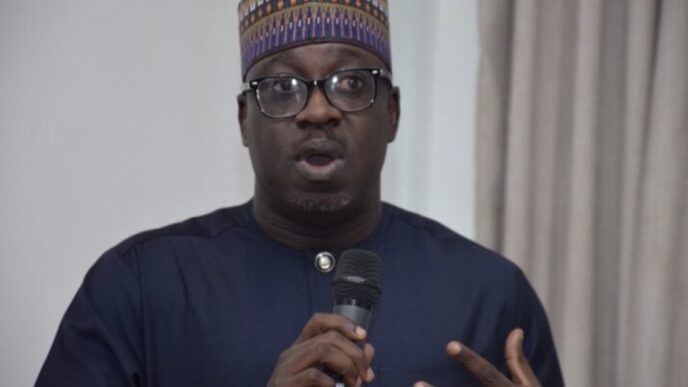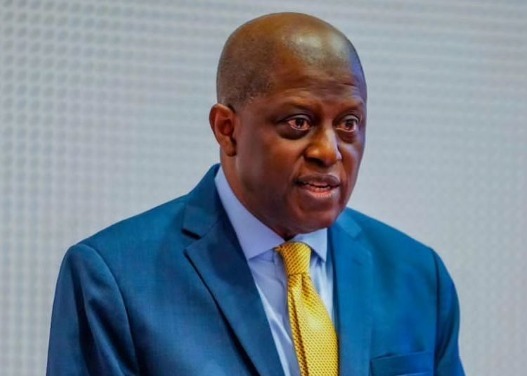
The Governor of the Central Bank of Nigeria (CBN), Olayemi Cardoso, says recent monetary and financial sector reforms have strengthened Nigeria’s capacity to withstand external shocks and restored investor confidence.
Gatekeepers News reports that according to a statement issued by the apex bank on Wednesday, Cardoso spoke at the Africa Capital Forum in London on Tuesday. The event was held on the sidelines of President Bola Ahmed Tinubu’s state visit to the United Kingdom.
The forum, themed “From Stabilisation to Capital Mobilisation,” was jointly hosted by the CBN and the UK Foreign, Commonwealth and Development Office (FCDO).
Cardoso said the apex bank has “created stronger capacity to withstand shocks” through policy tightening and institutional reforms.
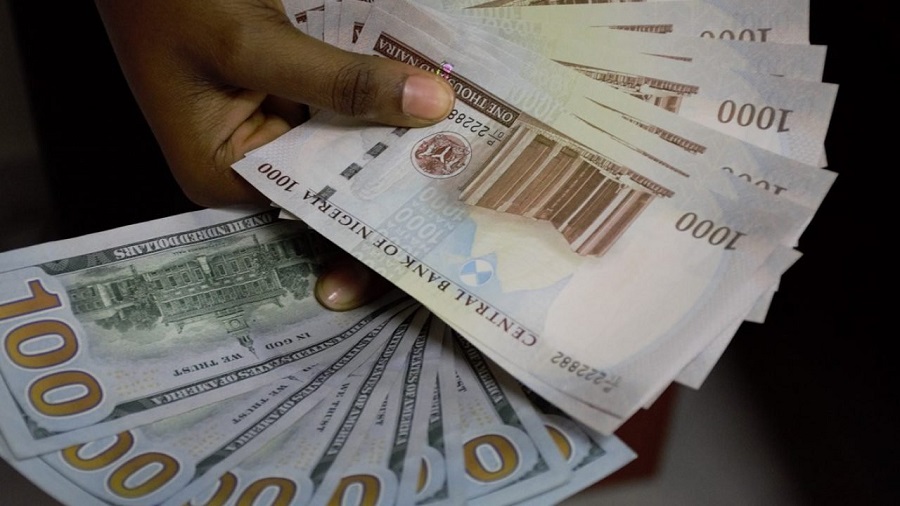
He noted that the foreign exchange market now operates with improved transparency and liquidity following recent changes introduced by the CBN.
According to him, a new FX manual has removed several capital control measures and simplified trade and investment processes.
Cardoso also disclosed that the bank has finalised a new payments system vision designed to strengthen Nigeria’s position in digital and cross-border payments.
On the banking sector, the CBN governor said more than 30 banks have already met the new capital requirements, while verification is ongoing for others.
“About 28 percent of investment in the recapitalisation came from foreign sources,” he said, adding that the development reflects renewed confidence in Nigeria’s financial system.
Cardoso further noted that diaspora remittances have increased, helping to diversify the country’s sources of foreign exchange inflows.
He said inflation has moderated and exchange rate stability has improved following recent policy measures.
“We will continue to maintain stability, not only on inflation, but in the FX market, with more transparency and consistent reporting,” he said.
The governor added that the CBN would remain vigilant in managing inflation.
“Our focus going forward is to protect the hard-earned stability we have accomplished so investors and stakeholders can plan with confidence,” he said.
Cardoso also stressed the importance of coordination between monetary and fiscal authorities to sustain economic growth.
He said the inclusion of fiscal authorities in the bank’s board and monetary policy committee strengthens policy alignment.
In addition, the CBN is working with financial technology firms to address regulatory bottlenecks and support innovation in digital finance.
According to Cardoso, the reforms have shifted Nigeria from a phase of stabilisation to one of capital mobilisation, positioning the economy for growth driven by domestic investment and improved global confidence.
Also speaking at the event, CBN Deputy Governor for Economic Policy, Muhammad Sani Abdullahi, said the apex bank has achieved a significant level of macroeconomic stability.
“We have seen stability. Net and gross reserves are high, foreign reserves are over $50 billion, the foreign exchange market has stabilised, and inflation is falling, but we are cautious,” Abdullahi said.
Similarly, CBN Deputy Governor for Financial System Stability, Philip Ikeazor, said the reforms are designed to endure beyond the current administration.
“All the reforms that have been put in place cut across stakeholders, ensuring that even at the end of this administration, people will see the need not to reverse them,” Ikeazor said.
At the forum, the British Deputy High Commissioner to Nigeria, Jonny Baxter, said the next phase of reforms should focus on converting renewed investor interest into real capital inflows.
“The next phase of the reforms should be converting renewed investor interest into long-term sustainable investments,” Baxter said, adding that the United Kingdom remains a key partner in Nigeria’s banking and capital markets.
Also speaking, the President of the European Bank for Reconstruction and Development (EBRD), Odile Renaud-Basso, highlighted Nigeria’s economic potential.
“We see all the potential in the economic stabilisation in Nigeria, the growth of the population, the appetite, the investment in new technologies, and the ability of the people to embrace new technologies,” she said.
Meanwhile, Steve Gray, Head of West and Central Africa at UK Export Finance (UKEF), emphasised the importance of transparency in sustaining investor confidence.
“Confidence is built through full fiscal transparency. But the reforms in Nigeria are providing transparency and building confidence,” Gray said.
Also, Melis Ekmen Tabojer, Managing Director for Policy Strategy and Delivery at the EBRD, said the reforms are already influencing investor behaviour.
“The recent reforms that Nigeria has had have had a huge impact in attracting investors and how policies are made,” she noted.
Speaking on behalf of the federal government, the Special Adviser to the President on Finance and the Economy, Sanyade Okoli, said Nigeria is now focused on attracting long-term capital to drive growth.
“We need to work with partners who will bring the sticky, equity capital,” she said, noting that the government alone cannot fund the country’s growth ambitions.
Banking sector leaders, including chief executives of major Nigerian lenders, also backed the reforms, saying they have improved confidence and strengthened banks’ ability to finance large-scale projects.