

An American doctor who tested positive for Ebola while working in the Democratic Republic of Congo (DRC) has been transferred to Germany for specialised treatment, according to the World Health Organization (WHO).
Gatekeepers News reports that the WHO Director-General, Tedros Adhanom Ghebreyesus, disclosed this on Tuesday while addressing delegates at the 79th World Health Assembly in Geneva, Switzerland.
The global health meeting has brought together ministers and diplomats to deliberate on global health emergencies, pandemic preparedness and healthcare funding.
Ghebreyesus said the infected doctor had been working with a medical missionary group in eastern Congo before contracting the virus.
He noted that the WHO is currently collaborating with authorities in the Democratic Republic of Congo, Uganda and the United States to contain the outbreak, warning that the situation remains concerning due to the possibility of wider transmission.
“We’re working with the DRC, Uganda and the United States,” he said.
“There are several factors that make us concerned about the potential for further spread and further deaths.
“First, beyond the confirmed cases, there are more than 500 suspected cases and 130 suspected deaths.”
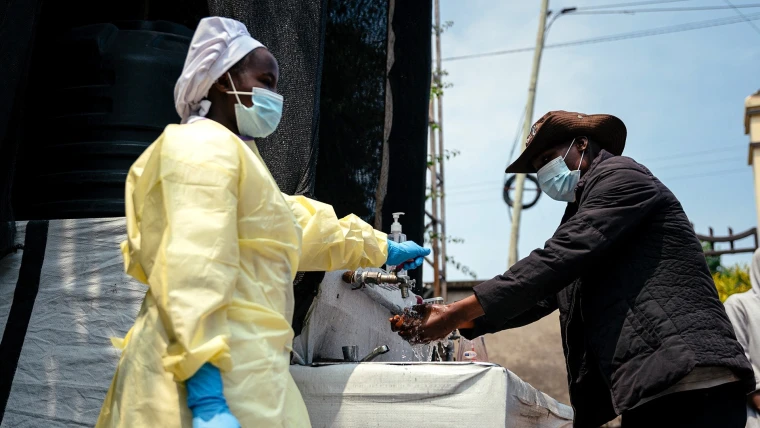
According to the WHO chief, health authorities have intensified surveillance, contact tracing and laboratory testing as suspected infections continue to increase.
He added that some infections had been identified in major urban centres, including Kampala in Uganda and Goma in eastern Congo, heightening fears of cross-border transmission.
Ghebreyesus also disclosed that several healthcare workers had died, indicating possible transmission within medical facilities.
“There is significant population movement in the area,” he said.
“The province of Ituri is highly insecure, as you may know. Conflict has intensified since late 2025, and fighting has escalated significantly over the past two months, resulting in civilian deaths.
“Over 100,000 people have been newly displaced, and in Ebola outbreaks, you know what displacement means.”
The WHO director-general explained that the outbreak involves the Bundibugyo strain of the Ebola virus, for which there are currently no approved vaccines or treatments.
Despite the absence of vaccines, he said authorities could still contain the outbreak through risk communication, community engagement, surveillance and rapid response efforts.
Ghebreyesus also praised the Ugandan government for postponing the annual Martyrs’ Day celebrations, which usually attract nearly two million people, over concerns about the possible spread of the disease.
“WHO has a team on the ground supporting national authorities to respond. We have deployed people, supplies, equipment and funds,” he said.
“I have approved an additional 3.4 million dollars from the Contingency Fund for Emergencies, bringing the total to 3.9 million dollars.”