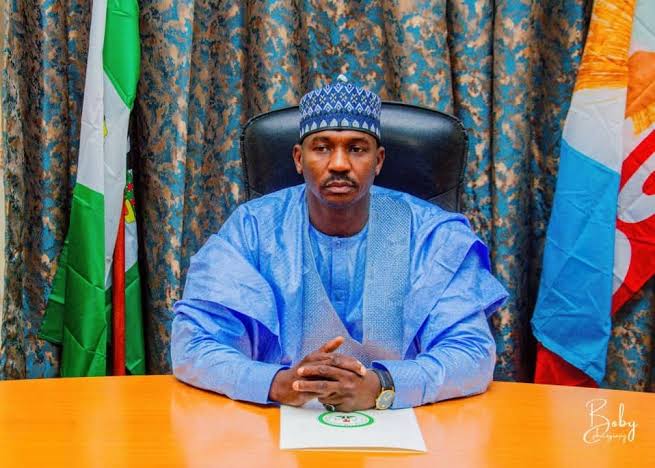
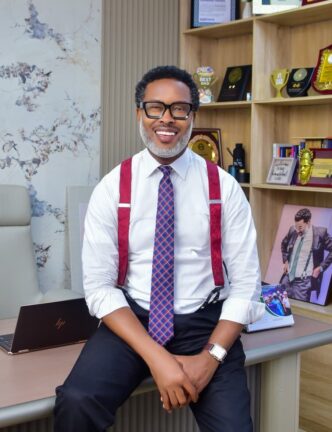
Speaking recently during the Prime Time programme on ARISE Television, government *pikin* Bayo Onanuga said he could not see the level of poverty that many Nigerians complain about, implying that public accounts of widespread hardship are overstated.
That remark is provoking public debate, not because citizens expect government officials to be pessimistic, but because leadership requires acknowledging the lived realities of the people. It is obvious that our son has become so cocooned in the comfort of government and government-provided free food that he has lost touch with the lived realities and economic hardship confronting ordinary Nigerians.
How can our son feign ignorance of the high level of hunger ravaging Nigeria? Is it that Bayo doesn’t have children, family members, relatives, neighbours, townsfolk, or old classmates who have been fatally felled by melancholy, illness, anxiety, or frustration in today’s Nigeria because of hunger and the lack of access to basic primary healthcare? *O ò lè máa jẹ oúnjẹ ìjọba ọfẹ́, kí o sì gbàgbé ìṣòro àti ìnira tí àwọn aráàlú ń kojú*.
Look, Bayo, across the country, hunger has assumed alarming proportions. Many households have quietly abandoned the idea of eating three nutritious meals a day. Parents routinely skip meals so their children can eat. Pensioners who devoted decades to public service now struggle to afford basic medications. Young graduates roam the streets for years without meaningful employment. Informal workers wake up each morning uncertain whether the day’s earnings will even cover transportation, let alone food.
Nigeria remains among the countries with the largest populations facing acute food insecurity. Bayo, when last did you go to the market? The soaring prices of rice, beans, garri, bread, and other staples have transformed ordinary meals into luxuries for millions. Behind the economic statistics are human stories of deprivation, despair, and avoidable suffering.
Bayo, you may be aware that in 2025, the World Happiness Report ranked Finland as the happiest country in the world for the eighth consecutive year. Surprisingly, Nigeria, which was ranked the happiest country in the world in 2003, was ranked 105th out of 147 countries in the 2025 report. Libya emerged as the highest-ranked country in Africa, occupying the 79th position and surpassing its neighbours in life satisfaction and societal well-being despite its ongoing challenges. The Nordic countries, including Denmark, Iceland, and Sweden, also remained among the world’s happiest nations. The United States, which fell out of the top 20 for the first time, was ranked 24th, having reached its highest position of 11th in 2012.
When Nigeria was ranked the happiest country in the world in 2003, Nigerians were considered optimistic and content despite economic and political challenges. However, since then, Nigeria’s ranking in global happiness reports has steadily declined. For example, in 2019, Nigeria ranked 85th; in 2020, it dropped to 115th; in 2021, it ranked 116th; in 2022, it fell to 118th; in 2024, it improved slightly to 102nd; and in 2025, it slipped again to 105th out of 147 countries.
Nigeria’s low ranking in the World Happiness Report reflects the deterioration of living conditions in recent years. Basic human needs such as food, potable water, electricity, shelter, sanitation, and primary healthcare are no longer guaranteed for millions of citizens. More than 40 per cent of Nigerians live in poverty, while wealth inequality continues to widen. Rising inflation, particularly in food and fuel prices, has significantly worsened the cost of living. High unemployment, especially among young people, has fuelled frustration and diminished optimism. The depreciation of the naira has made it increasingly difficult for Nigerians to afford essential goods and services. The healthcare system remains underfunded, leading to frequent doctors’ strikes and increasing dependence on medical tourism.
For the first time in Nigeria’s political history, suicide has become an alarming national concern. Nigeria has been ranked among the countries with high suicide rates, and today it is ranked fifth globally among countries with the highest suicide rates. Why should the suicide rate continue to soar? The answer is simple: human life has become increasingly devalued in Nigeria. Hunger and suffering have turned many Nigerians into walking corpses. Many come from troubled homes and struggle with depression, paranoia, anger, and melancholy. Cultural, family, and religious values are steadily eroding. For instance, a pastor, who should ordinarily counsel people contemplating suicide, takes his own life because of accommodation problems. Similarly, a student dies by suicide after receiving a disappointing JAMB result.
According to the 2026 Global Report on Food Crises, Nigeria ranks second in the world by the number of people facing acute food insecurity. The top five countries are: the Democratic Republic of the Congo (30.6 million people), Nigeria (29.4 million people), Sudan (24.6 million people), Yemen (18.1 million people), and Afghanistan (17.4 million people).
Nigeria ranked 115th out of 123 countries in the 2025 Global Hunger Index, with hunger classified as “serious.” In addition, UN agencies have identified Nigeria as one of the world’s highest-concern hunger hotspots in 2026. In June 2026, the Food and Agriculture Organization (FAO) and the World Food Programme (WFP) warned that about 34.8 million Nigerians could face acute food insecurity between June and August 2026.
Nigeria also has one of the world’s largest populations of malnourished children. According to the latest joint estimates by the World Health Organization (WHO), UNICEF, and other UN agencies, Nigeria has the highest number of maternal deaths in the world. Nigeria also currently ranks first among countries with the largest number of people without access to electricity. Together, Nigeria, the Democratic Republic of the Congo, and Ethiopia account for roughly one-third of the world’s population without access to electricity.
On electricity supply, Bayo says that electricity generation in Nigeria has increased since President Tinubu assumed office. Bayo, are you living in the same Nigeria as the rest of us, or are you living on the moon? How can you claim that power generation in Nigeria has increased? Tell that to the Marines.
In an age defined by digital technology and industrial automation, Africa’s so-called largest economy, Nigeria, still cannot guarantee a stable supply of electricity.
For most Nigerians, electricity is not a utility but a gamble. Homes and businesses brace daily for power outages. Generators rumble to life, filling the air with noise and fumes. The low hum of inverters has become the soundtrack of urban life. What ought to be a basic public good has been reduced to a private struggle for survival.
Why has this problem proved so intractable? It is not for lack of resources, nor even for lack of ideas. Nigeria’s electricity crisis is, at its core, a failure of execution.
Now Nigerians are told, once again, to adjust. Electricity Distribution Companies (DisCos) are rationing supply because they receive only about 2,830 megawatts (MW) of power, a consequence of persistent gas shortages. In response, the Nigerian Independent System Operator (NISO) has scaled down grid generation to about 3,940.53 MW, with output at times plunging as low as 1,490 MW.
The Tinubu administration’s reaction is telling. Rather than resolve the structural constraints, it has announced plans to add just over 200 MW of solar power through rural electrification initiatives. According to the Rural Electrification Agency (REA), this forms part of a $750 million public programme. While commendable in isolation, such measures barely scratch the surface of a crisis measured in thousands of megawatts.
The immediate consequences are evident in the allocation of limited power across the country. Abuja Electricity Distribution Company receives the largest share, followed by Ikeja Electric and Eko Electricity Distribution Company. Others make do with far less. Ibadan, Benin, and Enugu receive modest allocations, while Port Harcourt, Kano, Kaduna, Jos, and Yola operate on even tighter margins. In effect, scarcity is merely being redistributed.
At the heart of Nigeria’s electricity problem lies a familiar paradox. Nigeria, a country endowed with vast natural gas reserves, cannot supply sufficient gas to fuel its own power plants. Instead, global market dynamics, exacerbated by tensions in the Middle East, make gas exports more lucrative, while domestic prices remain artificially constrained. The result is predictable: power plants are starved of fuel, and electricity generation falters.
For ordinary Nigerians, this is not news but routine. For decades, households and businesses have been forced to improvise, relying on generators, candles, rechargeable lamps, and increasingly, inverters. Electricity in Nigeria is not a public utility in any meaningful sense; it is a private burden borne individually and inefficiently.
What is new, however, is the symbolism of the state’s response. Reports that the Aso Rock Presidential Villa has turned to solar power to mitigate unreliable electricity supply are striking. When the seat of government adopts the same coping mechanisms as its citizens, it suggests not resilience but resignation. Yet Bayo continues to tell Nigerians that power generation has increased.
This raises an uncomfortable question: if the Presidency must generate its own electricity, what hope is there for the rest of the country? Solar panels and inverters are not solutions to a national electricity crisis. They are escape routes for those who can afford them, leaving millions behind in darkness.
The human and economic costs are immense. Small businesses spend heavily on diesel to keep generators running. Students struggle to study at night. Hospitals maintain costly backup systems to power life-saving equipment. Across the informal economy, artisans—from barbers to bakers—find their livelihoods repeatedly disrupted by unreliable electricity. Productivity suffers, incomes shrink, and opportunities are lost.
Nigeria’s electricity crisis persists not because of a lack of resources or ideas, but because of a lack of execution and political will. Incremental measures and stopgap solutions will not suffice. What is required is a coherent, sustained strategy that addresses the entire electricity value chain, from gas supply and pricing to transmission infrastructure and revenue collection.
Bayo, both on the campaign trail and after assuming office, President Bola Ahmed Tinubu repeatedly identified electricity as one of Nigeria’s greatest obstacles to economic growth and national development. He assured Nigerians that stable electricity was achievable and reportedly declared that if he failed to solve the problem, Nigerians should not vote for him again.
That statement was bold. It reflected an understanding that electricity is the engine of modern civilisation. No nation can industrialise in darkness. No economy can become globally competitive when factories depend on diesel generators, hospitals perform surgeries under the constant threat of power outages, students cannot study reliably, and small businesses spend a significant portion of their income simply to keep the lights on.
As I have stated above, after nearly four years of the Tinubu administration, Nigeria’s electricity crisis persists. Nigerians are still living in darkness. Therefore, Tinubu should not be returned to office in 2027.
Two years ago, when arguments condemning the Tinubu administration’s signing the Samoa Agreement were gathering momentum, Bayo commented that the respected senior legal practitioner who raised the alarm was merely playing to the gallery because, according to him, the Samoa Agreement did not contain provisions relating to LGBT rights, abortion, or transgender issues.
After reading Bayo’s comments on Samoa Agreement, I initially chuckled. On second thought, however, I excused Bayo for advancing that line of argument. Why? Because he is not a lawyer, let alone someone who understands how international treaties and agreements are interpreted against the backdrop of Nigeria’s social, economic, cultural, and philosophical values. Bayo is not even conversant with the euphemisms and diplomatic language often deployed by the European Union and the United Nations in advancing policies that undermine African traditional family values and cultural heritage, as protected under Article 18 of the African Charter on Human and Peoples’ Rights. So how could he possibly understand the diplomatic euphemisms contained in the Samoa Agreement?
In any event, it is heartening that reason later prevailed over misplaced patriotic emotions regarding the Samoa Agreement. Members of the National Assembly were so enraged that a single government official in Geneva could unilaterally sign the agreement without recourse to the National Assembly, despite the provisions of Section 12 of the 1999 Constitution governing the domestication of treaties.
Indeed, one fiery member of the House of Representatives moved a motion on the floor urging Nigeria to withdraw from the Samoa Agreement, which he argued had been imposed on African countries by the European Union. Furthermore, some Muslim legislators and senior government officials (May the peace and blessings of Almighty Allah be upon them) have vowed to work tirelessly to ensure that Nigeria does not implement any provisions of the Samoa Agreement that they consider inconsistent with the country’s constitutional, religious, and cultural values.
On insecurity, our son, Bayo, argues that sections of the Nigerian media exaggerate the country’s security challenges by creating the impression that the entire country is unsafe, whereas insecurity is concentrated in particular locations rather than nationwide.
While no responsible journalist should sensationalise violence or portray isolated incidents as nationwide realities, it is equally dangerous for Bayo to minimise the gravity of an insecurity crisis that has claimed thousands of lives, displaced entire communities, and left millions living in fear.
The painful truth is that insecurity is no longer a distant tragedy affecting only remote communities in the North-East or North-West. It has steadily spread to other regions, including parts of the South-West that were once widely regarded as relatively secure.
The recent killing of a school principal and the abduction of 46 schoolchildren in the South-West are painful reminders that criminal violence respects no regional boundaries. For the families of those victims, debates over media exaggeration are irrelevant. Their reality is measured not by newspaper headlines but by empty classrooms, shattered homes, and lives permanently scarred by terror.
Bayo, instead of lamenting the fact that terrorists and abductors have now infiltrated the South-West—as exemplified by the killing of a school principal and the abduction of 46 schoolchildren, most of whom are under the age of five—you argue that the country’s security challenges are being exaggerated.
Bayo, you have not commented on *Sheikh Gumi’s* statement that the Tinubu government is complicit in the terrorism ravaging Nigeria and that it knows the identities of the sponsors of terrorist groups. Gumi also alleged that he and members of the Federal Government have attended meetings with terrorists.
Bayo, the Federal Government has not publicly denied these allegations. Gumi has not been questioned by the DSS. Is Gumi above the law? Or could it be that the government has not responded because there are issues requiring clarification? Nigerians deserve a clear and unequivocal response from the authorities to these serious allegations.
The saddest aspect is that the terrorists themselves are not in hiding. In several parts of Katsina State, for instance, they occupy the homes of the very people they displaced. They levy taxes, enforce illegal tolls, and openly taunt the government, boasting that the state is too weak to challenge them.
Yet, instead of arresting them, the Tinubu government has rolled out the red carpet—holding “peace meetings,” offering amnesty, enrolling some into the Nigerian Army, and even promising full scholarships abroad for others. In a country where millions of law-abiding youths struggle to access education, the idea of terrorists receiving government-sponsored scholarships is a stark symbol of a failed state.
Nothing illustrates a failed state more dramatically than the reappearance of *Ado Aleru*, one of the most notorious terror kingpins in Katsina State. Long linked to mass killings, mass abductions, and scorched-earth raids, Aleru resurfaced casually at a government “peace meeting,” seated comfortably among state officials.
The images shocked the nation: a wanted criminal presented not as a fugitive but as a stakeholder in regional security. For traumatised communities in Katsina, Zamfara, Kaduna, and Sokoto, this spectacle was a profound betrayal. Many wondered aloud: How does a terrorist on multiple security watchlists walk into a government forum unchallenged? Who facilitated his movement? Why are victims burying their dead while perpetrators of terrorism are granted VIP treatment?
If *Aleru’s* presence was shocking, the appearance of another notorious terrorist commander, *Kachalla Ummaru*, was even more disturbing. Fully armed—with rifles and bandoliers strapped across his chest and torso—Ummaru addressed government officials in Matazu Local Government Area, speaking with the confidence of someone who knows the state has no power over him. “Truth be told, the government doesn’t care about anyone,” he said. “All it’s after is how to generate money.”
That a heavily armed criminal could issue such an indictment at a government-sanctioned meeting speaks volumes. It highlights public disillusionment and exposes the extent to which the government’s authority has eroded.
Then came a statement that stunned even the most seasoned observers. During a separate peace meeting in Charanchi and Batagarawa Local Government Areas of Katsina State, *another terrorist* stepped forward and declared on camera:
“It was the government that turned us into terrorists. It was the government that wanted us to engage in banditry, but now it has called us and told us to stop.”
He went further:
“If the government wants all this insecurity to end, they have the power to end it—but they don’t want it to end.”
Such an admission, delivered openly to government negotiators, strikes at the heart of Nigeria’s security tragedy. Whether fact, exaggeration, or manipulation, the statement reflects a dangerous perception shared by many citizens: that the line between the state and terrorist groups has grown disturbingly thin.
Citizens expect empathy from government, not defensiveness. When Nigerians express fear over worsening insecurity, the appropriate response is not to question whether the media have amplified the crisis. It is to reassure the public through decisive action, improved intelligence, effective policing, and measurable reductions in violent crime.
Governments earn credibility not by disputing public perception but by producing tangible security outcomes.
The controversy surrounding the remarks by Sheikh Ahmad Gumi illustrates why transparent official communication is equally important. Gumi reportedly made serious allegations regarding contacts with terrorist groups and the government’s knowledge of their sponsors. Such claims, if accurately reported, are of enormous public importance. They cannot simply be ignored.
If the allegations are false, Nigerians deserve a prompt and unequivocal official rebuttal. If they contain elements requiring investigation, the appropriate security agencies should examine them thoroughly. If individuals have made statements suggesting knowledge of terrorism financing or operational networks, the public naturally expects law enforcement agencies to determine whether such information can assist ongoing counter-terrorism efforts.
Silence, however, creates uncertainty. In the absence of clear official explanations, speculation inevitably flourishes. In fact, In fact, such ominous silence inevitably fuels public suspicion and undermines confidence in the government’s position. That serves neither the government nor the national interest.
In the light of the foregoing, the consensus among Nigerians across the geopolitical zones of the country is that, having failed woefully on all fronts over the last four years, President Tinubu does not deserve a second term. Just take a cursory look around you. There is hardly any sector of the economy that has not been adversely affected in the last four years. One can scarcely point to any significant achievement of President Tinubu during his stewardship.
The Lagos-Calabar Coastal Road, which Bayo frequently cites as a major achievement, is reportedly already experiencing flooding, raising concerns about the quality of its construction. Trust Chagoury. One may reasonably question the quality of a project if due process and accountability are lacking.
It is sad that while millions of Nigerians are grappling with hunger, crushing inflation, stagnant incomes, and an unprecedented cost-of-living crisis, the First Lady encourages them to consider starting akara businesses.
Small businesses can indeed lift families out of poverty, but they cannot flourish in an economy crippled by inflation, unreliable electricity, multiple taxation, insecurity, and weak consumer purchasing power. Even the humble akara seller depends on affordable beans, cooking oil, transportation, stable electricity, access to credit, and customers with disposable income. Without addressing these structural obstacles, encouraging more Nigerians to enter micro-enterprises merely redistributes hardship instead of creating prosperity.
Nigeria does not need more survival tips. It needs an economy that enables hardworking citizens to live with dignity, earn a decent livelihood, and feed their families without depending on extraordinary resilience. Akara may sustain a household, but it cannot substitute for sound economic leadership.
Therefore, Nigeria needs a brand-new President in 2027. We have tried President Tinubu and the First Lady, and, in the view of many Nigerians, they have failed to meet the expectations of many Nigerians.
Interestingly, President Tinubu has previously said that Nigerians should vote him out in 2027 if he fails to fix the country’s electricity sector. Now that his administration has failed to improve electricity supply, as well as other key sectors, Tinubu should leave office in 2027.
President Tinubu has also described himself as a stubborn politician and said that even if only three Nigerians voted for him in 2027, he would still bounce back. Some have interpreted this remark as suggesting undue confidence in the electoral process because of his relationship with the Chairman of the Independent National Electoral Commission (INEC), who was formerly his lawyer.
President Tinubu must not attempt to impose himself on Nigerians. Any attempt to undermine the democratic process in 2027 will be strongly resisted. The INEC Chairman is urged to ensure that the 2027 presidential election is conducted in a free, fair, credible, and transparent manner. Many Nigerians have expressed strong feelings about the integrity of future elections and insist that the outcome of the 2027 presidential election must reflect the genuine will of the electorate.
Sonnie Ekwowusi is a lawyer and Member of the Editorial Board of The Guardian Newspaper
Gatekeepers News is not liable for opinions expressed in this article; they’re strictly the writer’s