


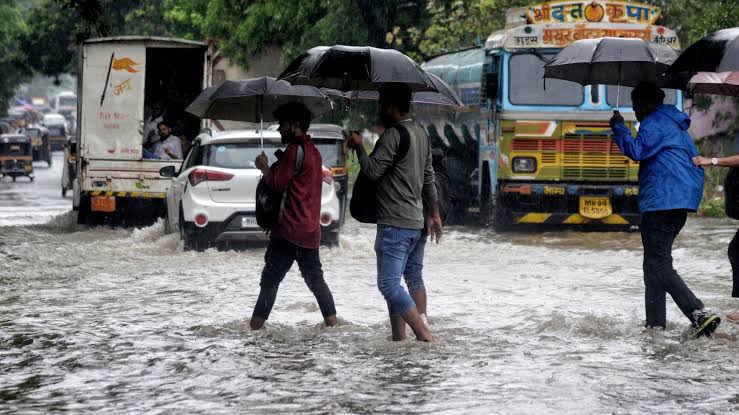
Torrential rainfall has triggered widespread flooding across parts of India, submerging homes and vehicles while disrupting road, rail and air transportation.
Gatekeepers News reports that the India Meteorological Department (IMD) on Thursday issued a red alert for Mumbai, Raigad, Palghar and Thane, warning of intense rainfall at isolated locations over the next few hours.
Heavy downpours inundated several parts of Mumbai, including Dadar, Parel, Hindmata, Charkop, Worli, Goregaon and Andheri, slowing traffic and causing severe congestion across major roads.
The IMD forecast heavy to very heavy rainfall across Mumbai and its suburbs, with the possibility of extremely heavy showers from Thursday night into early Friday. It also warned that wind speeds could reach up to 60 kilometres per hour.
In neighbouring Navi Mumbai, overnight rainfall flooded the Sanpada underpass, bringing traffic to a halt.
Several vehicles were left stranded, forcing motorists to seek alternative routes and worsening traffic along Palm Beach Road and other key roads.
According to the Brihanmumbai Municipal Corporation (BMC), some parts of the city recorded more than 200 millimetres of rainfall within 24 hours.
The civic body’s monsoon report showed that between 8 a.m. and 6 p.m. on Wednesday, the island city received an average of 49 millimetres of rainfall, while the eastern and western suburbs recorded 99 millimetres and 90 millimetres, respectively.
Data from the IMD’s Colaba and Santacruz observatories showed rainfall of 30 millimetres and 108 millimetres, respectively, during the same period.
The heavy rainfall also disrupted suburban train operations and air travel, with three flights diverted because of adverse weather before later returning to Mumbai, officials said.
The IMD warned that heavy to very heavy rainfall accompanied by gusty winds is expected to continue over the next 24 hours.
The latest flooding comes after an unusually dry start to the monsoon season. According to the IMD, India experienced its fifth-driest June since records began in 1901 and is expected to receive below-average monsoon rainfall in July.
A monsoon is a seasonal weather pattern in which shifting winds bring months of heavy rainfall followed by a drier period. It accounts for about 70 per cent of India’s annual rainfall, replenishing water resources and sustaining agriculture, which remains the primary source of livelihood for nearly half of the country’s population.