

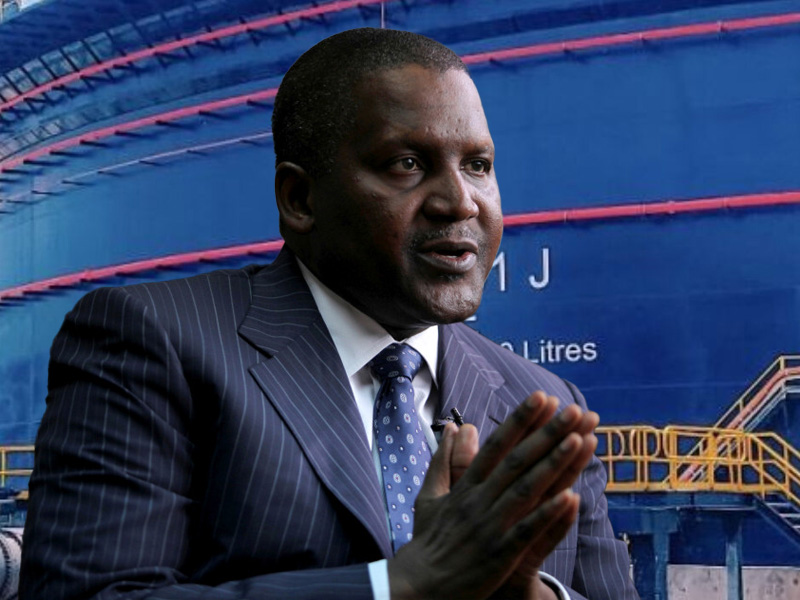
Africa’s richest man, Aliko Dangote, has emerged as one of the biggest beneficiaries of the global energy market disruption triggered by the US-Iran conflict, according to a report by The Wall Street Journal (WSJ).
Gatekeepers News reports that in its report published on Friday, the newspaper said Dangote is finally reaping the rewards of his $20 billion refinery investment after enduring years of delays, cost overruns and construction challenges.
According to the publication, the refinery reached full production capacity in February, positioning it to meet growing global demand for refined petroleum products without relying on shipments through the Strait of Hormuz.
“The huge refinery reached full capacity in February—just in time to supply the world with diesel, jet fuel and gasoline that doesn’t need to pass through the Strait of Hormuz,” the report stated.
WSJ said increased demand for refined petroleum products has significantly boosted Dangote’s wealth.
“Surging demand for refined petroleum products has boosted Dangote’s wealth by some $4.86 billion since the start of the year, according to the Bloomberg Billionaires Index, bringing his net worth to about $34.8 billion.
“Dangote’s repeated bets on the rise of Africa’s middle class, from cement to sugar to salt, have helped the 69-year-old become the world’s 65th-wealthiest person.”
The report noted that output of petrol, diesel and aviation fuel from the refinery has risen by more than 70 per cent this year.
Devakumar Edwin, Group Vice-President of Dangote Industries, told the publication that the company plans to list the refinery on the Nigerian Exchange (NGX) later this year, targeting a valuation of at least $50 billion.
He added that the company also intends to pursue a secondary listing, most likely in New York.
Energy market disruption boosts refinery business
According to WSJ, the energy shock caused by the conflict has favoured producers outside the Middle East that are unaffected by supply disruptions.
“Rising demand for Nigeria’s crude and refined products has boosted the country’s wider economy, supporting its currency and limiting rising gasoline prices,” the newspaper said.
“The conflict has been a particular boon for Dangote, whose refinery is by far the largest in Africa.”
The publication added that although the refinery commenced production in 2024, the business has received a significant boost from the geopolitical crisis.
Demand surges across Africa, Europe
Edwin said demand for products from the Dangote refinery has increased sharply across sub-Saharan Africa, while exports of jet fuel to Europe have also risen.
He disclosed that expanding the refinery’s processing capacity to 1.4 million barrels per day by 2028 is expected to cost about $13 billion.
The executive also revealed that Dangote Industries is planning another refinery project in Lamu, a coastal town in Kenya.
According to Edwin, the project—which includes the construction of a port—is estimated to cost about $15 billion and could be completed within three years.
He said a suitable site has already been selected and the company is prepared to begin the design phase.
Local crude supply, distribution remain key hurdles
Despite the refinery’s growing success, WSJ identified access to sufficient domestic crude oil as one of its biggest challenges.
“So far, Nigeria’s state oil company, NNPC, hasn’t been able to deliver even close to what Dangote requires,” the report said.
“That is because the government needs to sell crude to overseas buyers to service oil-backed loans and fulfill long-term export contracts.”
The report also noted that expanding distribution across Africa remains another major hurdle.
To address the challenge, Dangote Industries plans to acquire its own fleet of ships to reduce transportation costs, establish a distribution hub in Namibia to serve Southern Africa, and construct a pipeline stretching more than 1,500 miles to supply landlocked countries including Zimbabwe, Botswana and Zambia.
Edwin acknowledged that with increasing production volumes, efficient distribution will be the company’s next major priority.