

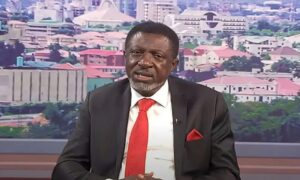
Paul Ibe, spokesperson for Atiku Abubakar, says the former vice-president would restore petrol subsidy if elected president in 2027, but only as a temporary measure before phasing it out.
Gatekeepers News reports that speaking on AIT, Ibe said the proposed intervention would give Nigerians and businesses time to recover, stimulate economic activity and improve productivity.
He stressed that Atiku’s proposal would not revive the old subsidy regime, which he described as opaque, but would instead link government support to crude oil production and domestic refining.
“We are not returning to Egypt. We are not going back to the old regime that was opaque,” Ibe said.
“What he’s simply saying is that the subsidy that he is advocating will be tied to the barrel, the crude oil barrel. This is perhaps the only thing that we have in so much abundance that Nigerians have not yet benefited from.”
According to Ibe, crude oil would be supplied to local refiners at a discounted price, allowing them to produce petrol and diesel at lower costs and ultimately sell the products at cheaper pump prices.
“The crude oil will be sold at a discounted price, subsidised to refiners, and that will enable refiners to be able to produce fuel and diesel at a cheap cost. And when they produce cheaply, they will sell at the real pump price,” he said.
Ibe said an independent committee would determine the appropriate refinery price based on prevailing market conditions.
He added that despite the deregulation of the downstream petroleum sector, the government could still monitor prices to ensure refiners and marketers complied with the policy.
“There’ll be a window because, of course, we deregulated. You may not fix the price but you can have price monitoring to ensure that everybody aligns with what government hopes to achieve,” he said.
‘It Will Be for a Period’
Ibe said the proposed subsidy would be implemented for a limited period to stimulate economic activity and improve productivity.
“It is not something that is… It is for a time, and it is essentially to ensure that we jumpstart this economy,” he said.
When asked whether the intervention would be temporary, Ibe replied in the affirmative, adding that Atiku had advocated a phased removal of subsidy even during the 2023 election campaign.
“If you recall, his argument, even in 2023, was that they’re going to have recourse to having a phased removal,” he said.
Ibe criticised the administration of President Bola Tinubu for removing petrol subsidy alongside other major economic reforms without allowing the economy sufficient time to adjust.
“No surgeon, no doctor would carry out two or more serious major surgeries, one after the other. They would do one, allow the patient to recuperate, and then undertake the second, or the third,” Ibe said.
“But what has this administration done? The issue of subsidy, flippant. No cabinet. No advisers. Just in the heat of the moment, it has been removed. No shock absorbers. Nothing. No palliatives. Absolutely nothing.”
He said the simultaneous removal of petrol subsidy, deregulation of the foreign exchange market and removal of electricity subsidy had worsened the economic hardship facing Nigerians.
According to Ibe, Atiku’s proposed intervention would give households and businesses room to recover and increase productivity.
“You need to give Nigerians and give manufacturers an opportunity to ensure that there is productivity,” he said.
“There is little or no productivity in this economy because, I mean, you talk about paying salary, that’s what they are doing there. There is no creativity. They’re simply having plenty of naira as a result of the devaluation.”
Ibe also said Atiku’s economic agenda would seek to diversify the Nigerian economy beyond its dependence on crude oil.
“We also need to start thinking about an economy that is beyond the oil economy. We need to diversify our economy,” he said.
The comments come amid an ongoing disagreement between Atiku and Tinubu over the former vice-president’s proposal to restore petrol subsidy.
Tinubu had criticised the proposal as evidence of “serious ignorance on governance and economy”.
Atiku subsequently rejected the criticism, maintaining that his proposal was not a return to the former subsidy regime but a targeted, capped, budgeted and independently audited intervention aimed at supporting domestic production.