

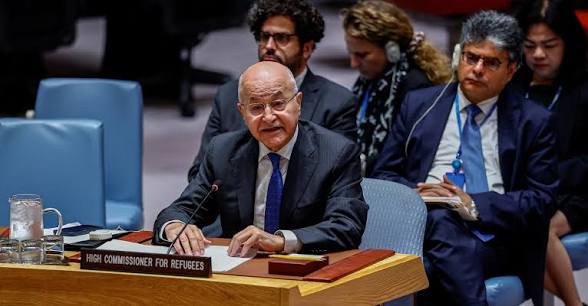
Nearly 8.3 million refugees and other forcibly displaced people worldwide are at risk of losing access to essential assistance due to severe funding cuts, the United Nations High Commissioner for Refugees (UNHCR) has warned.
Gatekeepers News reports that the UN refugee agency, in a report released on Tuesday, said its ability to protect and assist refugees, internally displaced persons (IDPs) and stateless people was being undermined by a sustained and worsening funding shortfall.
“UNHCR’s ability to protect and assist refugees, internally displaced people (IDPs) and stateless people is being eroded by a sustained and worsening funding shortfall,” the agency said.
According to the report, UNHCR’s available funding fell from $5.2 billion in 2024 to $3.9 billion in 2025, while the number of people under its protection remained close to historically high levels.
The agency said it required $8.5 billion in 2026 to protect refugees but had received only 32 per cent of the amount, or $2.7 billion, by the end of July.
As a result, nearly 8.3 million forcibly displaced people are “at risk of losing access to UNHCR assistance”.
“Continued severe funding cuts are pushing refugee support and protection structures towards breaking point in the world’s main displacement situations,” the agency added.
UNHCR said it had introduced reforms and prioritisation measures to safeguard its most critical operations but warned that the scale and persistence of the funding shortfall were now affecting even its highest-priority activities.
Dominique Hyde, UNHCR’s Director of External Relations, warned that the continued cuts could undermine essential protection systems.
“Protection cannot be reduced indefinitely without systems collapsing,” Hyde said.
“Below a certain threshold, services do not simply reach fewer people; they can stop functioning altogether, leaving those most at risk without the protection they need.”
Funding Cuts Threaten Protection Services in Several Countries
The agency said the funding crisis was already affecting vulnerable populations in several countries.
In Chad, about 319,000 refugees were facing registration delays, leaving them without the documentation needed to access essential services, while approximately 233,000 children could lose access to child protection services.
In Ethiopia, child protection coverage in some areas had declined by as much as 85 per cent.
UNHCR also warned that tens of thousands of survivors of sexual violence and children at serious risk in Sudan could lose access to critical protection services.
Hyde said the loss of essential services could expose displaced people to the same dangers they had fled in their home countries.
“When registration stops or child protection services disappear, ‘the very risks that people fled — violence, exploitation and abuse — reappear in displacement’,” she warned.
UNHCR Cuts More Than a Quarter of Its Workforce
According to UNHCR, 117.8 million people worldwide were forcibly displaced from their homes at the end of 2025, down from a record 123.2 million in 2024.
Of the total, 35.6 million were refugees under the agency’s mandate, with two-thirds originating from Venezuela, Ukraine, Syria, Afghanistan and Sudan.
The agency said it had eliminated nearly 5,000 jobs in 2025, representing more than a quarter of its workforce, amid declining financial support from major donors.
The United States, traditionally the world’s largest donor, has significantly reduced foreign aid, while other major contributors have also tightened their spending.
UNHCR said the funding cuts were undermining its efforts to help displaced people achieve self-reliance and reduce their dependence on humanitarian assistance.
In Iraq, up to 350,000 refugees and asylum seekers risk losing access to economic inclusion opportunities, the agency said.
Returnees Also Face Reduced Assistance
The agency warned that funding shortages were also affecting people returning to their home countries, whether voluntarily or under pressure.
In Syria, 162,500 vulnerable internally displaced people and returning refugees would not receive initial financial assistance unless additional funding was secured quickly.
UNHCR said the lack of support would reduce their ability to rebuild their lives and reintegrate into their communities.