

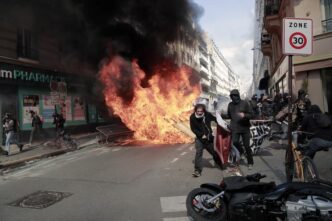
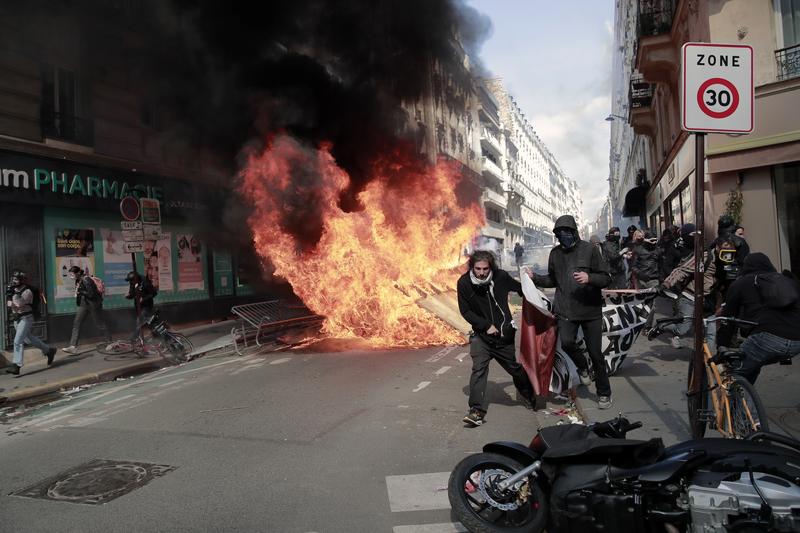
On the weekend of 17 October 2026, hundreds of thousands of people marched across France against rising prices, poor public services and school challenges. Most of them were peaceful. But as night fell, things changed. Masked groups set cars and barricades on fire, smashed windows and looted shops in Paris, Marseille, Bordeaux and other cities. In Limoges, protesters burned the historic town hall and destroyed much of it. The trouble did not stop at the French border. Clashes were also reported in Italy, Portugal, Belgium and Albania, and in Milan, fire burned in front of the famous cathedral for two nights.
The full cost of the destruction is still being counted, and the numbers differ from one report to another. One account says nearly 2,400 people were arrested and about 1,500 businesses were damaged. Another says at least 3,000 businesses were affected. What no one disputes is that the police were overwhelmed. France’s interior minister admitted that police had “lost control” in major cities and offered to resign, but President Emmanuel Macron refused. By Monday, the prime minister had ordered “very limited” and “localised” curfews.
The main reason for the riots in most accounts, is the cost of living. Reports from several European countries point to rising prices, weaker public services, expensive housing and falling education standards. Europeans have lived through years of high energy bills and inflation. Rents have grown faster than wages in many cities, and young people feel cheated. They were told to study hard and follow the rules, yet they cannot afford a home, and they watch their schools and hospitals get worse. That kind of anger does not need much to explode.
Politics added it’s own fuel. France will hold a presidential election in about six months, and opposition leader Marine Le Pen has called the government “exhausted and incapable.” Officials, for their part, have blamed “ultra-left” agitators. In an election season, every burning car becomes a talking point, and each side tells the story that suits it best.
The role of organised groups is the most disputed part of the story. Some commentators, mostly on the political right, say radical left-wing networks, and in some cases Islamist fundamentalists, took over genuine anger for their own purposes as some evidences have suggested. A counter-extremism think tank reports that one far-left collective in France celebrated the police’s apparent loss of control, and another refused to condemn the violence. Others argue that real grievances and poor handling by the authorities created the tinderbox in the first place. Both views can be partly true. Organised groups can show up at a protest, but they can only recruit where people are already angry. No one burns down a town hall over an idea alone.
There is one more ingredient: weak deterrence. Once looters see that no one is stopping them, a march becomes an opportunity. That is how a protest about school conditions ends with expensive shops emptied. Wherever there is real anger, there will also be people who simply want to steal.
Nigerians reading these reports will recognise much of this, because we have seen it before. Nigeria is not Europe. Our incomes are lower, our institutions are younger, and the average Nigerian family has far less to fall back on. But the way unrest works is the same everywhere, and our own recent history is the best teacher. The first lesson is that economic pain is a political risk, not just a number in a report. Since the fuel subsidy was removed and the naira was floated, millions of Nigerians have watched the cost of transport, food and cooking fuel go up. The EndBadGovernance protests of August 2024 showed how quickly that frustration can find its voice. If a rich European democracy can see its cities burn over prices and public services, no Nigerian official should assume that people’s patience has no limit. Reforms may be necessary, but the pain they cause must be softened in ways people can actually see, through relief that reaches households quickly and honestly, not just on paper.
Young people are the second lesson. The unrest in Europe was driven largely by students and young workers who feel shut out of decent homes and decent futures. Nigeria has one of the youngest populations in the world, and too many of our graduates have no work or work far below their training. A government that wants peace must treat jobs, skills and affordable education as a matter of national security. A young person who has a stake in the economy has little reason to light a match.
The way the state responds matters just as much. The French police were criticised for losing control, but Nigeria’s problem has often been the opposite. The memory of #EndSARS in October 2020 is still fresh, and it shows what happens when peaceful protesters are met with force. Grief and rage replace the original complaint, and the crisis can no longer be talked away. The right path lies between weakness and brutality: well-trained, well-equipped and accountable police who protect peaceful marchers, deal firmly with those who turn violent, and use no more force than the situation needs. When officers are accused of abuse, honest and independent investigations are the only way to win back public trust.
We must also learn to separate protest from crime. Governments are too quick to label every protester a paid troublemaker, and protesters sometimes excuse every act of violence as understandable rage. Both are wrong. Europe shows how easily a peaceful march can be hijacked, and how quickly the public turns against a cause once shops are looted and historic buildings burn. Organisers in Nigeria should be clear about their leadership, their discipline and their demands. Authorities should be just as clear that peaceful assembly is a right guaranteed by the constitution, not a favour that can be taken away whenever it becomes inconvenient.
Social media is another factor. Online calls to action and dramatic images, some of them misleading, helped the unrest spread across Europe. Nigeria knows this problem well, as a false video or rumour can move a crowd in minutes. Governments that speak only after a crisis has started have already lost the first round. They need to communicate clearly and often, long before trouble begins. Citizens, too, must learn to check before they share.
Finally, desperate times attract opportunists. Nigerians have seen warehouses broken into during unrest, including stores where relief materials were said to be hidden away. These scenes teach two things. Crime always feeds on chaos. But people also loot most readily where they believe the system has been looting them. The best protection against both is fairness and openness in how public resources are shared.
It would be wrong, however, to draw hasty conclusions. The European riots do not prove that democracy is failing, as some commentators claim. Nor do they prove that protest itself is dangerous, as some governments will be tempted to say. The events are still unfolding, the facts are still disputed, and early accounts from partisan sources should be read with care. Nigerians should resist the urge to borrow a conclusion that simply matches their existing politics.
What the burning streets of Paris, Milan and Limoges really teach is an old lesson. When prices rise, services decay, young people see no future and the state seems either absent or too heavy-handed, one spark can start a great fire. Europe has deep institutions, strong welfare systems and capable emergency services, and it is still struggling to put out the flames. Nigeria has much thinner margins. The wise response is not to wait and see whether it happens here, but to act now by easing the burden on families, creating real opportunities for the young, reforming the police so they protect rather than provoke, and listening to citizens before they are forced to shout. A government that listens early rarely has to answer for burning buildings later.
Dr Frederick Imuebe Braimah is a senior lecturer in the Department of Political Science, Elizade University Ilara-Mokin, Ondo State. Nigeria
Gatekeepers News is not liable for opinions expressed in this article; they’re strictly the writer’s.