

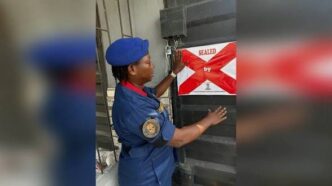
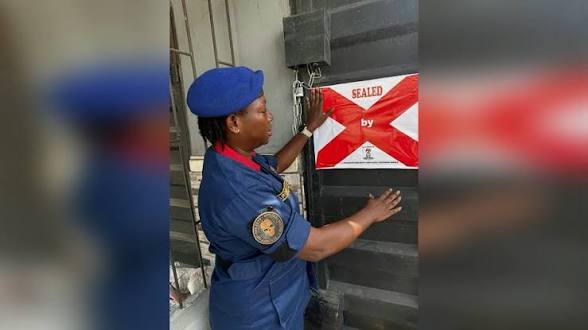
The Nigeria Security and Civil Defence Corps (NSCDC), Delta State Command, has sealed seven private security companies operating illegally in the state and arrested 13 security guards over various regulatory violations.
Gatekeepers News reports that the enforcement operation, aimed at sanitising the private security industry, was conducted in two separate exercises across Asaba and Warri by the monitoring team of the Corps’ Private Guard Companies Department.
The team was led by the Head of the Department, Deputy Commandant of Corps (DCC), Emmanuel Peters, following intelligence gathering and covert surveillance targeting security companies allegedly operating outside the regulatory framework.
According to the NSCDC, the seven affected Private Guard Companies (PGCs) were sealed for operating without valid licences, while investigations revealed that some had continued operations with licences that expired several years ago.
The agency also arrested 13 security guards working with licensed private security companies for various regulatory infractions.
The violations included failure to renew operational licences, non-payment of prescribed branch fees, unauthorised relocation between states and within the state, as well as other breaches of established regulations.
Reacting to the operation, the Delta State Commandant of the NSCDC, Chinedu Fabian Igbo, commended the personnel involved for their intelligence-driven and covert enforcement activities, which led to the discovery and closure of the illegal outfits.
Igbo described the operations of unlicensed private security companies as a serious violation of the law, warning that allowing such organisations to operate without proper regulation and supervision could undermine public safety and expose individuals and corporate institutions to additional security risks.
He stressed that private security operations must comply with the provisions of the law, noting that regulatory compliance was essential to promoting professionalism, accountability and effective supervision in the industry.
The commandant assured that the state command would conduct thorough investigations into the activities of the affected companies and ensure that individuals and organisations found culpable were prosecuted in accordance with the law.
He also cautioned members of the public, corporate organisations and other institutions against engaging unlicensed private security operators, urging them to patronise only companies duly registered and licensed by the appropriate authorities.
In his remarks, Peters advised individuals, businesses and organisations seeking private security services to verify the operational and licensing status of companies before entering into contractual agreements.
He urged members of the public who were uncertain about the regulatory status of any private security outfit to contact the Private Guard Companies Department of the NSCDC Delta State Command for verification.
Peters reiterated that the NSCDC, under the provisions of the NSCDC Act 2003, as amended in 2007, has the statutory responsibility to license, regulate, monitor, supervise and train private guard companies operating across the country.
He maintained that the Corps would sustain its monitoring and enforcement operations to ensure compliance with established regulations and bring operators found working outside the law to justice.