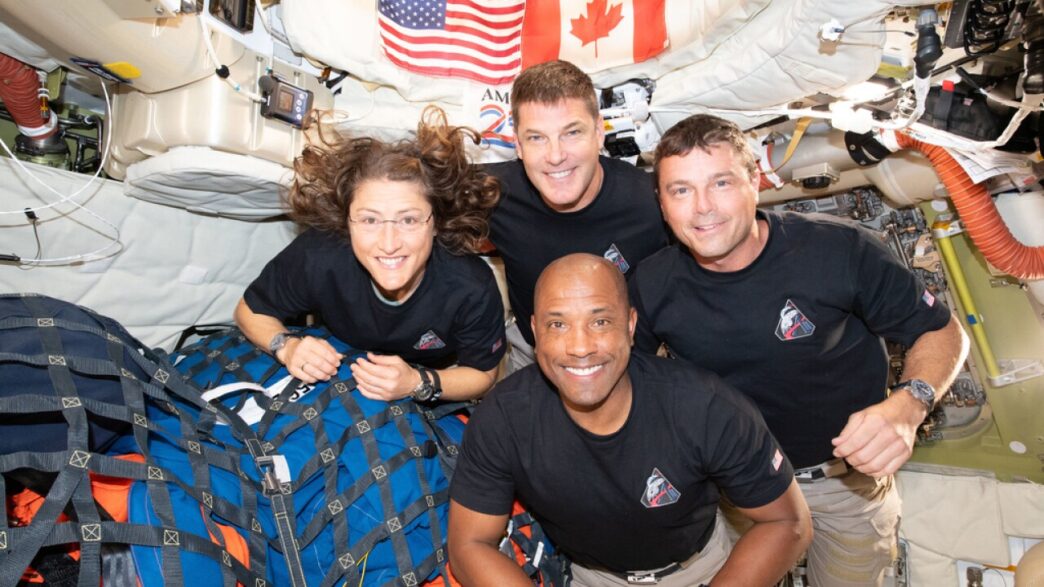
The crew of Artemis II prepared for a high-stakes return to Earth on Friday, targeting a Pacific Ocean splashdown to conclude humanity’s first crewed journey to the moon in more than 50 years.
Gatekeepers News reports that tension gripped mission control as the four astronauts — Reid Wiseman, Victor Glover, Christina Koch and Jeremy Hansen — began reentry aboard their Orion capsule, Integrity.
Travelling at speeds of up to Mach 32, the spacecraft faced extreme heat during atmospheric reentry, placing critical focus on its heat shield — a component that showed visible wear during an uncrewed test flight in 2022.
The capsule, designed to operate autonomously, was not expected to require manual intervention except in emergencies. A tense six-minute communication blackout — a standard phase of reentry — was anticipated before parachutes deployed for splashdown.
Awaiting recovery was the USS John P. Murtha, supported by aircraft and helicopters, in a coordinated effort reminiscent of the Apollo-era missions. The return marked the first such joint operation between NASA and the US Department of Defense since Apollo 17.
Record-Breaking Journey
Launched on April 1, Artemis II did not land on the moon but achieved several milestones, including surpassing the distance record set by Apollo 13. The crew traveled as far as 252,756 miles (406,771 kilometres) from Earth — farther than any humans in history.
During the flyby, the astronauts captured unprecedented views of the moon’s far side and witnessed a rare total solar eclipse.
The mission also delivered emotional moments, including a request by the crew to name lunar craters in honour of their spacecraft and Wiseman’s late wife.
Challenges in Space
Despite its successes, the nearly 10-day mission encountered technical issues, including valve problems affecting drinking water and propellant systems. A malfunctioning toilet system forced the crew to rely on improvised solutions throughout much of the journey.
Still, the astronauts downplayed the difficulties.
“We can’t explore deeper unless we are doing a few things that are inconvenient,” Koch said, “unless we’re making a few sacrifices, unless we’re taking a few risks, and those things are all worth it.”
Hansen added:
“You do a lot of testing on the ground, but your final test is when you get this hardware to space, and it’s a doozy.”
Paving the Way for Future Missions
Artemis II serves as a critical test flight under NASA’s broader Artemis programme, which aims to return humans to the moon and establish a sustained presence.
Upcoming missions include Artemis III, which will focus on docking operations, and Artemis IV, targeting a crewed landing near the moon’s south pole by 2028.
Reflecting on the mission’s broader impact, Wiseman expressed hope that it would inspire global unity and appreciation for Earth.
“But what we really hoped in our soul is that we could for just for a moment have the world pause and remember that this is a beautiful planet and a very special place in our universe, and we should all cherish what we have been gifted,” he said.