



The debate over the proposed construction of another airport in Ndikelionwu, Anambra State, barely fifty kilometres from the Chinua Achebe International Airport at Umueri, is far more than a local political controversy.
It is an opportunity to interrogate one of the most neglected questions in Nigeria’s development strategy:
Have we invested too much in aviation and too little in a transport systems that actually drive broad-based economic development?
Those who oppose the proposal have advanced a simple argument.
Rather than constructing another airport within an hour’s drive of an existing one, the state should deploy its scarce financial resources to upgrading the facilities at Umueri, modernising its passenger terminals, improving its runway infrastructure and expanding its cargo-handling capabilities.
Others argue that the billions required for a new airport would yield far greater social returns if invested in roads, hospitals, schools, industrial estates, irrigation schemes, a modern sports complex, or other productive infrastructure.
These are legitimate concerns.
But they point to an even larger national problem.
Nigeria has, over the past three decades, quietly cultivated a development model that equates airports with progress.
Successive governments have multiplied airports across the federation, while roads deteriorated, railways stagnated and inland waterways remained neglected.
The result is a transport system that is not only economically inefficient but also increasingly dependent on scarce foreign exchange.
The time has come to ask whether this model serves Nigeria’s long-term interests.
AVIATION SERVES ONLY THE FEW, BUT THE WHOLE NATION PAYS
According to the Nigerian Civil Aviation Authority (NCAA), Nigeria recorded approximately 15.7 million passenger movements in 2024, of which about 12.05 million were domestic passengers and roughly 3.2 million international passengers.
Preliminary figures for 2025 indicate that domestic passenger traffic has risen further to over 13 million passengers.
At first glance, these figures appear impressive.
However, statistics require context.
Nigeria is now home to well over 230 million people.
The overwhelming majority of these passenger movements represent repeated travel by the same relatively small segment of affluent Nigerians: politicians, public officials, corporate executives and business travellers.
They do not represent twelve million different Nigerians boarding aircraft.
In reality, well over ninety-five per cent of Nigerians do not routinely use air transport. Their daily mobility depends almost entirely on roads, motorcycles, buses and, where available, rail.
This raises an obvious question.
Should public transport policy be designed around the travel preferences of a small elite or around the mobility needs of the overwhelming majority of Nigerians?
Development economics leaves little doubt about the answer.
AVIATION IS NIGERIA’S MOST IMPORT-DEPENDENT INDUSTRY
Unlike roads and railways, aviation contributes relatively little to domestic industrial production because nearly every strategic input is imported.
Aircraft are imported.
Aircraft engines are imported.
Avionics are imported.
Ground-handling equipment is imported.
Navigation systems are imported.
Replacement parts are imported.
Insurance premiums are substantially paid abroad.
Aircraft leases are denominated in United States dollars.
Pilot type-rating programmes are frequently conducted overseas.
Major maintenance inspections often require foreign technical facilities.
Even aviation turbine fuel, despite Nigeria’s status as a major crude oil producer, has historically depended upon imported refined products or domestically refined products priced according to international markets.
Every aircraft flying within Nigeria therefore represents a continuing demand for foreign exchange.
The aviation industry is, by its very nature, one of the most foreign exchange-intensive sectors in any developing economy.
This dependence has repeatedly exposed Nigeria’s economic vulnerabilities.
The International Air Transport Association (IATA) has on several occasions expressed concern over billions of naira equivalent trapped in Nigeria because foreign airlines were unable to repatriate their earnings owing to shortages of foreign exchange. Some international carriers reduced services, while others delayed expansion plans until the situation improved.
The lesson is unmistakable.
A country that imports virtually every component required to sustain aviation cannot endlessly expand the industry without imposing significant pressure on its external reserves.
AIRPORTS ARE NOT DEVELOPMENT
Perhaps the greatest misconception among political leaders is the belief that airports automatically stimulate economic growth.
They do not.
Airports facilitate development where there is already substantial economic activity.
They rarely create development by themselves.
Infrastructure economists distinguish between productive infrastructure and prestige infrastructure.
Productive infrastructure increases productivity throughout the economy.
Prestige infrastructure primarily enhances political visibility.
The distinction matters.
Nigeria currently has more than thirty airports, in addition to numerous airstrips and heliports.
Yet aviation activity remains highly concentrated.
NCAA industry data indicate that Lagos alone accounts for well over half of all passenger and aircraft movements in the country.
Many state airports therefore operate far below commercial capacity while continuing to consume public resources through maintenance, security, electricity, personnel and regulatory oversight.
The Anambra proposal must therefore be examined not through political sentiment but through the lens of economic efficiency.
If an international airport already exists at Umueri, should scarce state resources be devoted to building another airport fifty kilometres away?
Or would upgrading the existing facility generate higher economic returns?
The answer appears self-evident.
OPPORTUNITY COST MATTERS
Every investment choice excludes another.
Economists describe this as opportunity cost.
The billions of naira required to construct another airport could finance hundreds of kilometres of rural roads.
It could modernise public hospitals.
It could improve schools.
It could establish industrial parks.
It could expand irrigation schemes that enhance food security.
It could construct a world-class football stadium and associated recreational facilities capable of generating tourism, employment and community development.
Infrastructure should not be evaluated according to political symbolism but according to the number of people whose lives it improves.
Measured by this standard, roads and railways consistently outperform airports.
RAILWAYS ARE THE MISSING LINK
The greatest casualty of Nigeria’s fascination with aviation has arguably been railway development.
Across Europe, Japan and China, rail, not aviation, forms the backbone of inter-city passenger transport.
France’s TGV.
Germany’s ICE.
Japan’s Shinkansen.
China’s vast high-speed rail network, now exceeding 45,000 kilometres.
These countries possess sophisticated aviation industries, yet millions of business travellers still choose rail because it is efficient, affordable, environmentally sustainable and capable of moving vastly larger numbers of passengers.
Railways also produce what economists call high multiplier effects.
Every railway corridor stimulates housing, manufacturing, logistics, agriculture, tourism and commercial development.
Stations become centres of economic activity.
Industrial estates emerge along transport corridors.
Property values appreciate.
Employment expands.
Road congestion declines.
Freight costs fall.
Regional integration improves.
Unlike airports, which primarily serve passengers already travelling, railways reshape entire regional economies.
Nigeria’s principal commercial corridors—from Lagos to Ibadan, Abuja to Kaduna, Port Harcourt to Aba, Onitsha to Enugu and Kano to Kaduna—are ideally suited for modern standard-gauge rail services capable of replacing substantial volumes of domestic air travel.
Such investments would generate far greater social and economic returns than constructing additional airports.
THE RISE OF THE PRIVATE JET CULTURE
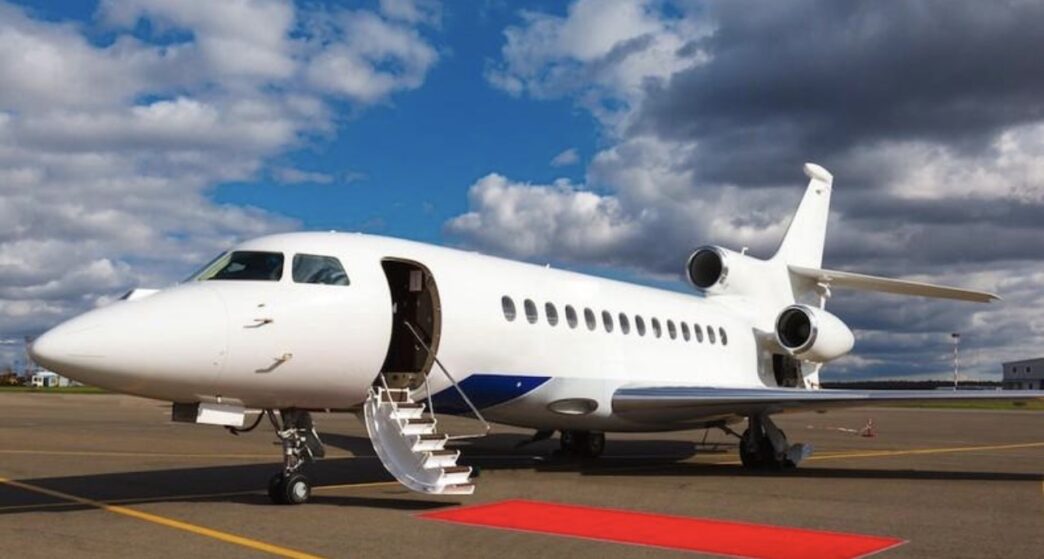
Perhaps no development better illustrates Nigeria’s distorted priorities than the remarkable proliferation of private jets.
Business aviation undoubtedly has legitimate functions.
Industrial executives, emergency services and specialised operators often require aircraft.
But Nigeria’s private jet phenomenon has increasingly become a symbol of conspicuous consumption.
More than a century ago, the American economist Thorstein Veblen described this behaviour as conspicuous consumption:
the acquisition of luxury goods primarily to display wealth and social status rather than to improve productive capacity.
Nigeria offers a striking modern example.
Aircraft increasingly serve as symbols of prestige.
Political officeholders, religious leaders and wealthy businessmen often regard ownership of a private jet as the ultimate marker of success.
This culture carries profound consequences.
When decision-makers themselves rarely travel by road or rail, they experience little urgency to improve them.
The deterioration of highways becomes someone else’s problem.
Railway development becomes politically less attractive.
Public transport loses influential advocates.
A nation cannot build inclusive infrastructure when its leadership increasingly isolates itself from the transport realities experienced by ordinary citizens.
SECURITY AND NATIONAL RESILIENCE
Overdependence on aviation also carries strategic risks.
The COVID-19 pandemic demonstrated how vulnerable global aviation can become.
Disruptions to international supply chains, shortages of aircraft parts, foreign exchange crises and geopolitical tensions all affect aviation more severely than domestic transport systems.
A resilient transport network requires balance.
Roads.
Railways.
Inland waterways.
Ports.
Airports.
Each performs a complementary role.
No serious developing economy should rely disproportionately on one mode of transport, particularly one that depends overwhelmingly upon imported technology and foreign exchange.
A DIFFERENT DEVELOPMENT PHILOSOPHY
This argument is not against aviation.
Nigeria requires efficient airports.
It requires safe airlines.
It requires international connectivity.
It requires air transport for emergency services, tourism, diplomacy and high-value commerce.
The issue is one of priority and sequencing.
A country facing persistent foreign exchange shortages, infrastructure deficits and widespread poverty should allocate public investment according to economic multipliers, employment generation and social inclusion.
By those measures, railways, highways, inland waterways and logistics infrastructure deserve far greater priority than the continued proliferation of airports.
Existing airports should first be modernised, fully utilised and commercially optimised before new ones are contemplated.
Every proposed airport should undergo an independent cost-benefit analysis.
Its projected passenger demand, revenue potential, employment effects and economic returns should be rigorously scrutinised before public funds are committed.
BEYOND ANAMBRA
The debate over another airport in Anambra is therefore about much more than Anambra.
It is about Nigeria’s development philosophy.
It is about whether we shall continue to equate prestige projects with economic progress.
It is about whether public investment will continue to serve political symbolism or national productivity.
No nation has ever built enduring prosperity merely by multiplying airports.
The world’s most successful economies invested first in the infrastructure that moved the greatest number of people, reduced production costs, integrated markets and strengthened domestic industries.
For Nigeria, that infrastructure is not another airport.
It is modern railways.
It is efficient highways.
It is inland waterways.
It is logistics corridors.
It is the productive backbone of a competitive economy.
Airports have their place.
But they should not occupy the place that belongs to roads, railways and the infrastructure that carries not only passengers, but the entire economy toward sustainable development.
▪️Mr Boniokoye Imegwu, A Transport and Maritime Consultant, writes from Reading, England