

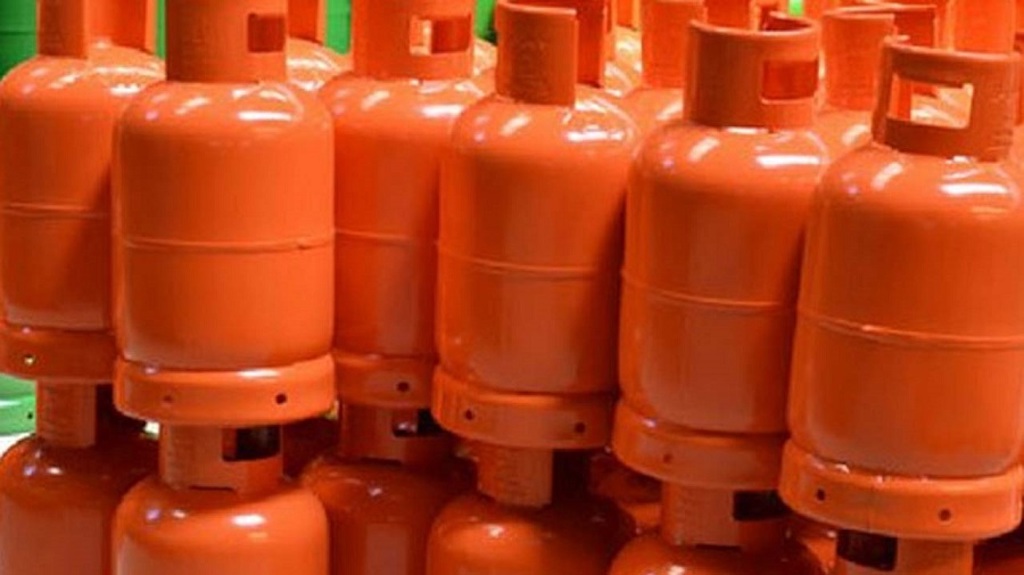
The retail price of Liquefied Petroleum Gas (LPG), commonly known as cooking gas, has fallen by about 39 per cent from the record levels recorded in June, offering much-needed relief to households as improved depot supply and lower wholesale prices filter through to consumers across Nigeria.
Gatekeepers News reports that in June, cooking gas sold for more than N2,000 per kilogramme, reaching as high as N2,300 in some parts of the country. However, recent market checks by BusinessDay show that retail prices have declined to around N1,400 per kilogramme in Lagos, Enugu and several other states.
The sharp decline has translated into significant savings for consumers.
For Lagos resident Juliet Onyinyechi, a routine refill of her 6kg gas cylinder cost far less than expected.
She had budgeted N14,000 for the refill and transportation after paying N13,800 for the same quantity last month, when cooking gas sold for N2,300 per kilogramme. Instead, she was charged N8,400.
“At first, I was confused. When I came to the same filling station last month, it cost N13,800 for the usual 6kg I often buy because a kilogramme was N2,300,” she told BusinessDay.
“So I didn’t expect to pay less. But he told me a kilogramme now costs N1,400, hence why my bill dropped to N8,400. I was happy.”
Industry operators attributed the decline to stronger product availability at depots and lower loading costs in July.
Current depot prices range between N1,005 and N1,030 per kilogramme across major suppliers. While 11 Plc and NIPCO are selling at N1,025 per kilogramme, Ardova is offering LPG at N1,020, Navgas and PPMC at N1,005, and Rain Oil at N1,030 per kilogramme.
The lower wholesale prices have enabled retailers to reduce pump prices by more than 30 per cent in many locations.
Many households say the development has eased the financial strain caused by rising living costs.
A Lagos resident identified as Mama D said the reduction had made daily life more manageable for her family.
“When the guy I buy gas from told me about the price drop, I was happy. In fact, happiness does not capture how I felt. At the peak of the surge last month, my family suffered so much,” she said.
“At one point, we had to turn to coal pot. It wasn’t convenient, but at least it enabled us to eat cooked food.”
The decline comes as Nigerians continue to grapple with elevated food prices. Although food inflation eased to 17.52 per cent in June alongside a headline inflation rate of 15.91 per cent, high transportation costs and insecurity continue to put pressure on household spending.
In Enugu, cooking gas prices have also fallen to about N1,400 per kilogramme from roughly N1,900 in June, although prices still vary by location and retailer.
Gas dealer Obiora Ani, who operates in the Uwani area of Enugu, said the reduction reflects improved supply across the country.
“When you go to other parts of the country, the price of cooking gas has dropped as well, not only in Enugu. The drop is encouraging more people to fill their cylinders,” he said.
Despite possessing one of Africa’s largest natural gas reserves—estimated at about 215 trillion cubic feet—Nigeria continues to face domestic supply challenges because a significant portion of its gas production is exported.
Data from the Nigerian Upstream Petroleum Regulatory Commission (NUPRC) showed that more than 2.1 billion cubic metres of gas were exported in December alone.
Industry stakeholders have argued that while exports remain important, a greater share of domestic gas production should be reserved for the local market to improve affordability and energy security.
Speaking at the BusinessDay CEO Forum, Managing Director of Aradel Holdings, Adegbite Falade, said Nigeria must leverage its comparative advantage in natural gas.
While the country also has abundant fertiliser, urea and methanol resources, he said gas remains Nigeria’s greatest economic asset.
“So, in terms of the knock-on domino effect, gas is the game changer for us,” he said.
According to the Nigeria LPG Production & Supply Matrix (2023–2026) report, national consumption of cooking gas is projected to rise by 20 per cent to 1.8 million metric tonnes in 2026, up from 1.5 million metric tonnes in 2023.
However, average national supply over the same period is estimated at just 1.6 million metric tonnes, leaving a supply gap of at least 150,000 metric tonnes that is largely bridged through imports.
The dependence on imports leaves domestic LPG prices vulnerable to exchange rate fluctuations and movements in the international energy market.
Analysts say maintaining the current decline in cooking gas prices will depend on sustained domestic supply, stable foreign exchange conditions and increased investment in Nigeria’s gas infrastructure. They warned that any disruption to supply could quickly reverse the recent gains enjoyed by consumers.