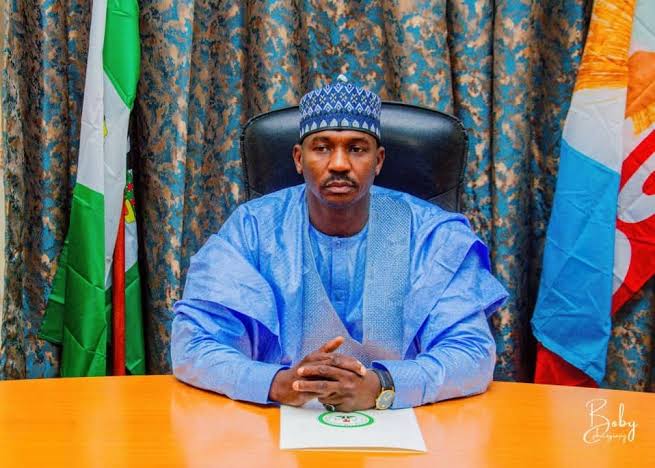
“Agricultural development in Sokoto State must not be a seasonal occupation dictated by rainfall. Through ‘farming without seasons’—supported by irrigation, availability of inputs , and market access—we are transforming the challenges into opportunities to build an unbeatable rural economy.”
Governor Ahmed Aliyu
Under Governor Ahmed Aliyu, the Sokoto State Government sees agriculture differently—beyond a traditional way of life and subsistence farming, but as an engine for food security, job creation and economic transformation. As a deliberate policy, the administration has demonstrated its determination to move the sector towards modern, technology-driven and commercially viable agriculture capable of feeding families, creating wealth, generating employment, providing raw materials for industries and improving farmers’ incomes. This strategic shift is firmly anchored in the Governor’s 9-Point Smart Agenda, where agriculture occupies a central place in his development vision,with the clear objective of building a productive, resilient and sustainable agricultural economy that can drive the state’s economic prosperity.
The importance of agriculture to the economy of Sokoto State cannot be overstated. More than 70 percent of the state’s population is actively engaged in farming, while official state sources estimate that more than 80 percent of its inhabitants practise one form of agriculture or another, whether crop cultivation, livestock production. Agriculture is therefore far more than an economic sector in Sokoto; thus,any serious effort to achieve sustainable economic transformation in Sokoto State must, consequently, place agriculture at the centre of its development strategy. Agriculture is, without doubt the economic lifeblood of the state.
According to the National Bureau of Statistics, agriculture remains one of Nigeria’s largest employers, accounting for roughly a third of the national GDP. In Sokoto, farming forms the bedrock of rural livelihoods, with staples and cash crops—millet, sorghum, rice, wheat, onions, tomatoes, cowpeas, and garlic—cultivated across its extensive agricultural belt. The state’s comparative advantage is reinforced by its location within the Sokoto-Rima Basin, one of the region’s most vital natural irrigation corridors.
The huge investment in agriculture by the Governor Aliyu’s administration is therefore understandable. Long before crude oil emerged as Nigeria’s dominant foreign exchange earner, agriculture was the backbone of the nation’s economy and a major source of foreign exchange. It is this heritage that the governor is determined to revive. For him, revitalising the sector is not just desirable; but an economic imperative. Thankfully he has taken into consideration the fact that the challenges confronting agriculture today are, however, significantly different. Climate change, insecurity, inflation and the rising cost of farm inputs continue to threaten agricultural productivity. And this is where leadership comes in;finding solutions to problems. This explains the investment in modern agriculture— mechanisation, irrigation and value-chain development—a deliberate strategy to unlock the sector’s full economic potential, improve farmers’ productivity and incomes, and guarantee food security.
Recognising the strategic importance of food security, Governor Aliyu’s administration has prioritised direct input support. The state government recently launched a massive ₦7.7 billion wet-season input initiative, supplying over 157,000 bags of free and heavily subsidized NPK and Urea fertilizers, alongside thousands of bags of high-yield, drought-resistant seeds, herbicides, and insecticides across all 23 Local Government Areas. Rather than relying solely on open market forces—which have priced many smallholders out of production—the administration stepped in directly.
Crucially, to prevent these vital inputs from falling into the hands of black-market speculators, the government overhauled its distribution monitoring, instituting strict anti-diversion protocols and direct community-allocation channels.
Across many parts of North West, rural insecurity and banditry have disrupted farm operations. But Sokoto State has tackled this head-on by integrating security response networks into rural agricultural hubs, allowing communities in vulnerable local government areas to return to land that had laid fallow for seasons. For Governor Aliyu, high-yield seeds and fertilizer can only be effective if a farmer is safely able to access his field.
Equally transformative has been the shift toward off-season, climate-smart irrigation systems. To counter increasing rainfall variability and desertification, Governor Aliyu’s “farming without seasons” initiative has modernized critical water infrastructure. Alongside the completed ₦270 million, 450-hectare Kware Irrigation Scheme, major efforts are underway to rehabilitate the Lugu Dam and Wurno irrigation systems.
To build a climate-resilient farming system, the state has partnered with the Sustainable Power and Irrigation for Nigeria (SPIN) project to integrate solar-powered irrigation pumps, reducing farmers’ reliance on expensive diesel generators. Furthermore, the establishment of a 7,000-hectare Moringa agroforestry project is helping to combat desert encroachment while generating significant economic benefits for rural families. Beyond its environmental value, moringa offers multiple income streams through the production and sale of its leaves, seeds and oil, and opportunities for processing, value addition and local employment. Its resilience to harsh climatic conditions also makes it a valuable crop for strengthening household incomes and diversifying livelihoods in vulnerable rural communities.
Bumper harvests, while a sign of increased agricultural productivity, has also created a serious challenge: post-harvest losses. For perishable crops such as tomatoes and onions—an area in which Sokoto is a major national producer—significant quantities are usually lost before reaching consumers because of inadequate storage, processing and market access. Recognising this challenge, the government has taken steps to ensure that increased production translates into higher incomes for farmers. It has distributed hundreds of rural grinding machines and processing mills directly to agrarian communities, enabling farmers to process and add value to their produce closer to the point of production. In the onion sector in particular, the commercial development of 5,000 acres dedicated to onion, millet and garlic cultivation is being complemented by efforts to establish structured processing and export pathways, opening access to regional markets in Ghana and the Benin Republic. The objective is clear: to move farmers from simply producing more to preserving, processing and profitably marketing what they produce.
The government is also tackling post-harvest losses through investment in storage infrastructure, particularly for onions. The recently launched onion storage facility will enable farmers to preserve their harvest for longer periods, reduce spoilage and limit distress sales during periods of glut. By extending the shelf life of onions and allowing farmers to take advantage of better market conditions, the facility is expected to improve incomes while strengthening Sokoto’s position in the national onion value chain.
Connecting these farms to markets requires addressing the state’s rural road deficit. Through the Rural Access and Agricultural Marketing Project (RAAMP)—supported by joint funding from the state, World Bank, and French Development Agency—Sokoto has targeted over 1,000 kilometers of rural feeder roads. Key projects like the ₦10.47 billion, 27-kilometer Wamakko-Bunkari road will ensure that harvested crops reach urban market hubs quickly and economically, slashing transport costs that previously ate into their profits.
The investment in livestock development completes this ecosystem. As a central pillar of Nigeria’s pastoral economy, Sokoto’s cattle, dairy and leather trades support thousands of households. The administration has strengthened veterinary services, disease surveillance and vaccination drives to protect animal health, while recognising that livestock manure enriches soil health and livestock sales provide an important buffer for crop farmers against unexpected shocks. Beyond livestock production, the government is promoting value addition in the leather sector, including skills-acquisition programmes that equip young people with practical skills in leatherwork and create pathways into sustainable livelihoods. Government patronage further provides an assured market for locally made leather products, as gifts and souvenirs for visitors to the state. Sokoto State is also exploring the opportunities of exporting beef to Saudi Arabia.
Perhaps the greatest strength of Sokoto State’s current trajectory in the sector lies in this interconnectedness. Subsidised inputs, solar-powered irrigation, processing machinery, rural feeder roads, livestock development and climate adaptation do not exist as isolated policy promises; they operate as components of a unified system.
Challenges such as fluctuating weather patterns, security concerns and macroeconomic inflation remain constant pressures. However, by aligning strategic budgetary investments with effective execution on the ground, Governor Ahmed Aliyu’s policy framework demonstrates a clear understanding of a fundamental truth: long-term economic growth begins with a productive, well-connected and climate-resilient farming system—one capable not only of producing more, but of creating jobs, strengthening rural incomes and turning agriculture into a driver of broad-based prosperity.