

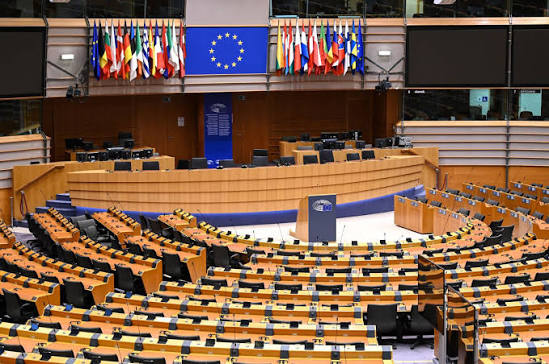
The European Parliament has called for closer scrutiny of aid programmes in Africa to ensure that they deliver measurable and sustainable benefits to people in partner countries.
Gatekeepers News reports that Udo Bullmann, a member of the European Parliament, said stronger monitoring was necessary to guide future decisions on development assistance, particularly as the global landscape changes and African countries seek greater autonomy in their partnerships.
Bullmann spoke during a meeting with African journalists at the European Parliament in Brussels, Belgium.
The meeting was facilitated by the Taz Panter Foundation as part of a workshop on the impact of global powers on local realities, held between September 20 and 29 in Berlin and Brussels.
Speaking on the future of Europe-Africa relations, the German lawmaker said stronger partnerships with countries of the Global South would be central to the EU’s external action.
“In times of geopolitical insecurity, where actors like China or the US, follow a strong strategy of pure extractivism in Africa, the EU wants to offer an alternative,” Bullmann said.
“It wants to create partnerships on equal footing, where the benefits for the people and the environment in African partner countries are at the centre of our collaboration.”
He said Europe’s need for critical minerals for its technological and economic transition had increased its interest in strengthening partnerships with resource-rich countries in Africa, Latin America and Asia.
“Europe has understood that it needs critical minerals for its technological transition and its economic and political position in the world. European stakeholders know that a whole lot of minerals are in the soil of Africa, Latin America, and Asia, and therefore have an interest to win new partners and strengthen existing ones,” he said.
Bullmann advocated greater local processing and refining of African raw materials, saying this could increase employment and economic benefits on the continent.
“Instead of simply exporting raw materials, I advocate for a larger part of value creation to stay for instance in Africa. If more processing and refining is done locally, we can ensure that more jobs and prosperity are created locally,” he said.
EU’s Global Gateway strategy
Launched in 2021, the Global Gateway is the EU’s €300 billion strategy for strengthening links between Europe and countries around the world.
The initiative focuses on five broad areas: digital infrastructure, climate and energy, transport, health, and education and research.
Last year, Gautier Mignot, EU envoy to Nigeria and ECOWAS, said the bloc was seeking to strengthen its partnership with Nigeria through the strategy.
In March, the EU announced a €290 million investment package for Nigeria covering areas including digital infrastructure, healthcare manufacturing, agriculture and migration management.
Asked how the EU assesses the impact of its interventions, Bullmann raised concerns over the absence of a sufficiently clear framework for measuring outcomes.
“Monitoring the outcomes of our programmes is important to ensure that they have a positive impact on the people of our partner countries,” he said.
“The more clearly we scrutinize projects and collaborate with actors – such as NGOs, civil society organisations, or parliaments, in our partner countries – the easier it is to improve programmes.
“We can measure development through the amount of jobs we create, whether fair wages are paid, what the impact on the environment is and whether the development is sustainable on the run. This is what we need.”
Bullmann said discussions were at an advanced stage in the European Parliament on establishing a framework to measure the outcomes of EU-funded projects.
He said such a framework would help improve accountability and provide a clearer basis for determining whether development programmes were achieving their intended objectives.