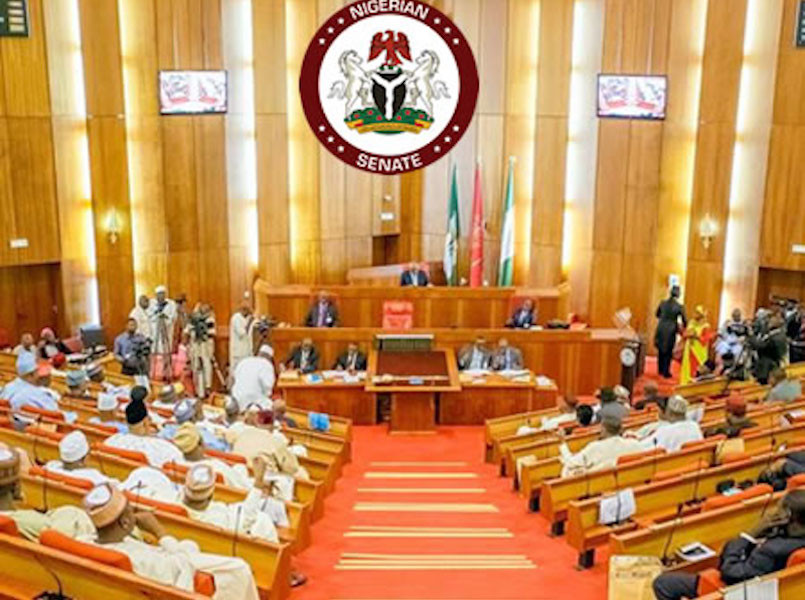


Senate Majority Leader, Opeyemi Bamidele, has said the National Assembly does not automatically approve borrowing requests from the executive arm of government, insisting that lawmakers scrutinise such proposals against previously approved fiscal plans.
Gatekeepers News reports that Bamidele, who represents Ekiti Central Senatorial District, made the clarification on Thursday while responding to questions from Senate correspondents in Abuja over concerns about Nigeria’s rising external debt and the speed at which lawmakers approve loan requests.
He acknowledged that the 10th National Assembly had approved every borrowing request submitted by President Bola Tinubu’s administration but maintained that such approvals were not automatic.
“We are familiar with the concern of Nigerians about loans. Do we always accede to the requests of the executive arm of government to borrow? My answer would be no,” he said.
“Have we acceded to every request by this administration to borrow? My answer would be yes.”
The Senate leader explained that borrowing proposals were assessed based on the Medium-Term Expenditure Framework (MTEF), Fiscal Strategy Paper (FSP) and borrowing plan presented to the legislature by the executive.
According to him, the documents outline the government’s projected revenue and expenditure, including the proportion of spending expected to be financed through internally generated revenue, domestic borrowing and external loans over a three-year period.
Bamidele noted that the Constitution and the Fiscal Responsibility Act require the President to present the MTEF and FSP to the National Assembly at least 30 days before submitting the annual budget.
He said lawmakers also considered unforeseen economic developments that could affect the assumptions upon which the fiscal projections were based, citing the war in Iran as an example.
Explaining the legislature’s responsibility, he said lawmakers examined whether individual borrowing requests fell within the limits of the fiscal framework already approved by the National Assembly.
“Our primary assignment as a parliament is to go back to what we had approved as a medium-term expenditure framework and a fiscal strategy paper to say this borrowing that they want to do, does it fall within the perimeter of what we had approved?” he said.
“If it does, we will approve; if it does not, that’s the only time you hear noise.”
His comments came amid renewed public concerns over Nigeria’s borrowing commitments following the Senate’s approval of fresh external loan requests.
On November 25, the Senate approved a $20.52 billion and €1.045 billion supplementary external borrowing plan for 2026 and 2027, alongside a N10.79 trillion external borrowing request to finance the 2026 budget deficit.
The approvals followed the presentation of reports by the Senate Committee on Local and Foreign Debts.